












































































































































































How to Organize a Yarn Stash and Keep Moths Out
Sort a yarn stash by weight, give every dye lot its own record, and store wool where clothes moths cannot reach it, with freezer times from conservators.
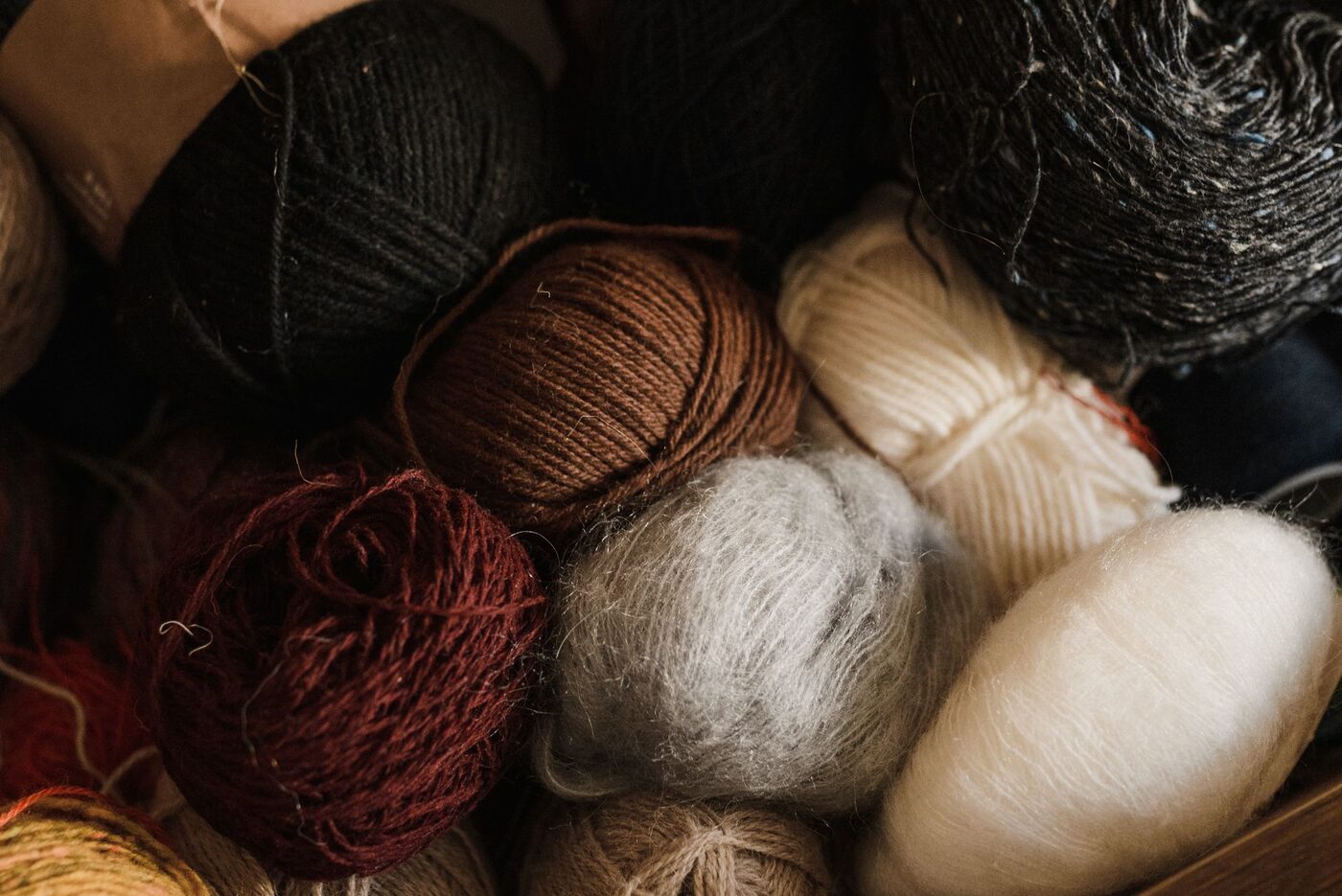
Take every skein out, check each one for moth damage, freeze anything you are unsure of at -20°C (-4°F) or colder for a week (a freezer thermometer tells you whether yours gets there), sort what survives by the weight number on its band, record each dye lot as its own entry, and put clean wool back in airtight containers. The Canadian Conservation Institute’s freezer figure is the one number to memorize, because it turns “I think I saw a moth” from a crisis into a chore.
The order counts for more than the bins you buy. Sorting yarn you have not checked spreads eggs into tidier piles.
1. Take everything out, all of it
Not one drawer at a time. Everything, onto a bed or a clean floor, in daylight.
The reason is in the moth’s habits. Penn State Extension notes that both common clothes moth species shun light and are frequently overlooked by homeowners, and UC IPM describes them as weak flyers that stay close to whatever they are eating. The skein at the bottom of the bag, the one nobody has handled since it was bought, is where they settle.
2. Look for what moths leave behind
You will rarely see an adult. The webbing clothes moth is about 7 to 8 mm long with its wings folded, per Penn State Extension’s clothes moth fact sheet, and it hides. What you will see is damage and debris.
Penn State describes larvae feeding beneath a blanket of silk, feces and pieces of the food source, and says damaged woolens show furrows on the surface. On a ball of yarn, look for a matted patch with grit in it and strands that come apart short when you tease them. The casemaking species carries a tube of silk and wool that, Penn State notes, is hard to see because it is the same color as what it is eating.
Larvae favor hidden parts: Penn State finds them under cuffs and collars. In a stash, check the inside of a center-pull ball and the twist of a hank. Give extra attention to any skein that sat beside a worn sweater, since UC IPM says fabrics with food, perspiration or urine stains are more subject to damage.
3. Freeze anything you are not sure about
The CCI’s note on controlling insect pests with low temperature gives a practical treatment of -20°C for one week, and explains why a mild freezer falls short: insects commonly protect themselves against temperatures as low as -15°C (5°F). Household chest freezers, by the CCI’s figures, run between -18°C and -28°C. UC IPM’s home advice is gentler, several days below 18°F (about -8°C), but if you have the space, use the museum number.
How you bag it counts as much as the temperature:
- Seal each batch in clear polyethylene so you can see inside. If the seal is good, the CCI says, all condensation forms on the outside of the bag.
- Press out the air by hand. The note strongly discourages sucking it out with a straw.
- Leave it a full week at -20°C or colder. Put a freezer thermometer in with it, and if it reads warmer than -20°C, turn the dial colder.
- Take it out and keep the bag sealed for a day while it comes to room temperature.
- Open it, shake each skein over a sink and look again. If anything is still alive, the CCI says to cool it a second time.
Heat kills moths too. UC IPM lists at least 30 minutes in an oven above 120°F, or a wash of 20 to 30 minutes in water of at least 120°F, but the same page warns that many woolen items should not go in hot water. For a stash of wool, cold is the safer method.
4. Split animal fibers from everything else
Clothes moths eat animal fiber. Penn State says the webbing clothes moth feeds on hair, wool, fur, feathers and similar animal products, while synthetics, cottons and other plant materials are not attacked unless stained with food or body oils.
So the first sort is wool, alpaca, mohair, cashmere and anything else with animal hair in it, against acrylic, cotton, linen and the rest. The second pile wants dust protection, not the same guard.
The ball band tells you which pile, and it is a legal statement. The FTC’s guide to the Textile and Wool Acts labeling rules lists “all fibers, yarns and fabrics” among covered products and requires fibers to be listed by weight in descending order of predominance. Fibers under 5% can be lumped together as “other fiber”, with one exception that settles the sort: wool or recycled wool must be named with its percentage even when it is under 5%. For labeling, “wool” also covers the hair of the Angora goat, Cashmere goat, camel, alpaca, llama and vicuna. So any of those words on the band, at any percentage, puts the yarn on the wool side.
5. Sort by the weight number on the band
Inside each fiber pile, sort by weight. Where the band prints the Craft Yarn Council’s category number, a digit from 0 to 7, sort on that rather than the word, because words like “sport” and “DK” each cover a range. Here is the Craft Yarn Council’s standard yarn weight system, trimmed for sorting:
| Number | Category | Also sold as | Knit gauge per 4 in | Needles |
|---|---|---|---|---|
| 0 | Lace | Fingering, 10-count thread | 33 to 40 sts | 1.5 to 2.25 mm |
| 1 | Super Fine | Sock, Fingering, Baby | 27 to 32 sts | 2.25 to 3.25 mm |
| 2 | Fine | Sport, Baby | 23 to 26 sts | 3.25 to 3.75 mm |
| 3 | Light | DK, Light Worsted | 21 to 24 sts | 3.75 to 4.5 mm |
| 4 | Medium | Worsted, Afghan, Aran | 16 to 20 sts | 4.5 to 5.5 mm |
| 5 | Bulky | Chunky, Craft, Rug | 12 to 15 sts | 5.5 to 8 mm |
| 6 | Super Bulky | Super Bulky, Roving | 7 to 11 sts | 8 to 12.75 mm |
| 7 | Jumbo | Jumbo, Roving | 6 sts and fewer | 12.75 mm and up |
The council labels its table guidelines only. On swapping yarns, its yarn questions and answers page says a same-weight swap is fine if you test the gauge, and a different weight is a flat no, because each project is designed for a specific weight.
Sorted this way, choosing yarn for a pattern means opening one box, not six.
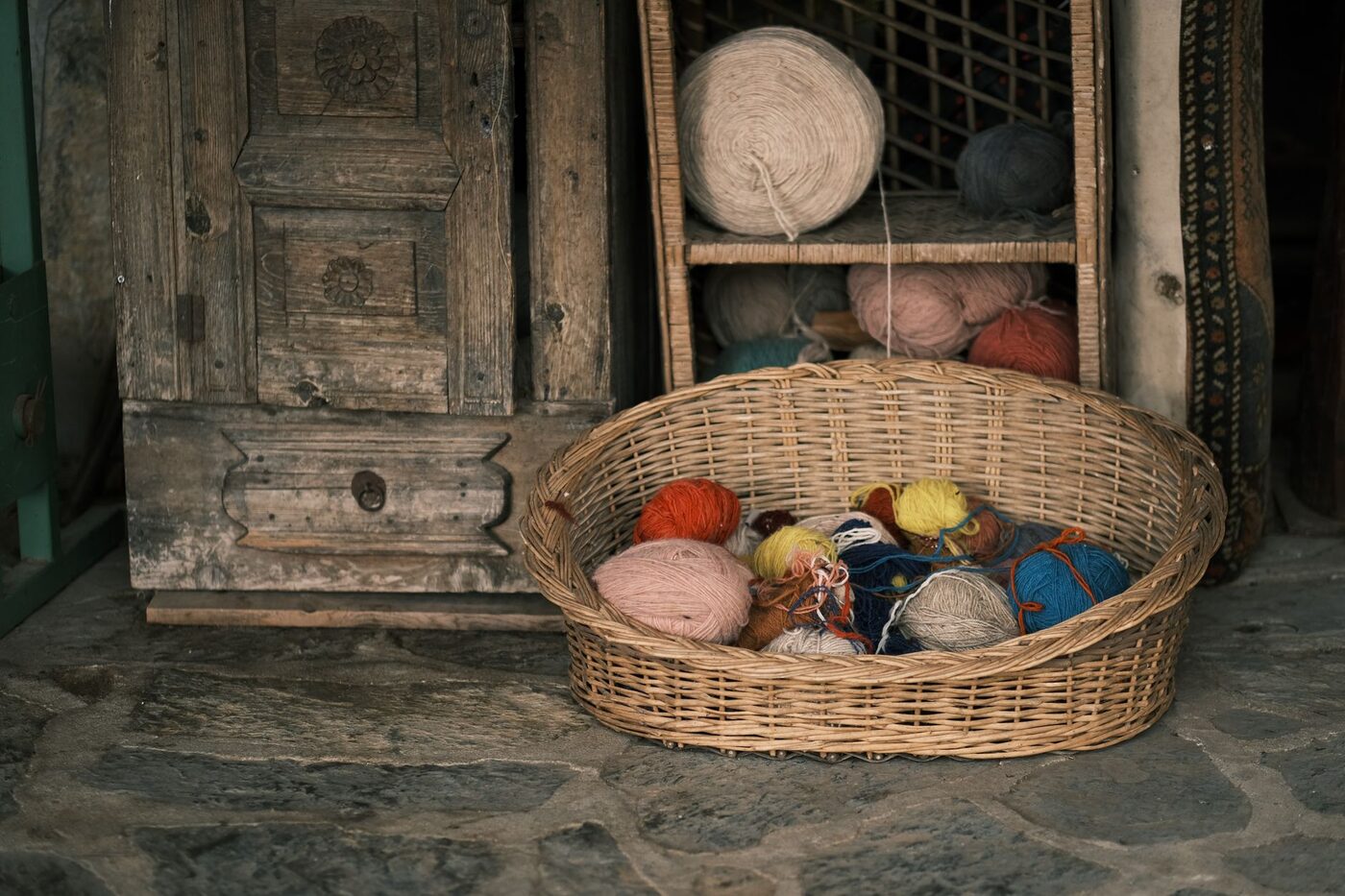
A basket like that one is lovely and, for wool, an open invitation. Keep baskets for the acrylic you are knitting this month.
6. Give every dye lot its own record
Lion Brand’s support page on what dye lots are puts it plainly: a dye lot is the batch the yarn was dyed in, and all the yarn in one batch carries the same dye lot number on the label. Another batch can differ. The company says it cannot match lots for you, and prints a line on every label telling you to buy what you need of a lot at one time. The Craft Yarn Council adds the exception: yarn spun from fiber that was colored first is sold as “no dye lot”.
So two bags of the same yarn in the same color are two stash entries unless the lot numbers match. Say you have six skeins of a fine merino, four from lot 18 and two from lot 21 (an illustrative case). That covers a sweater body and matching sleeves only if you knew before you cast on. Found out at the second sleeve, it is a stripe.
Paper bands get lost, so keep the record where you can search it. StitchNest is a yarn stash tracker that keeps the dye lot on every entry: brand, name, colorway, dye lot, fiber content, one of eight weight categories from lace to jumbo, grams total and remaining, length per skein, skein count and a photo, which is where the band goes. Type a dye lot that matches an entry you already have, same brand and colorway, and the field warns you before you save. The Duplicate option copies an entry for another purchase of the same yarn but leaves the dye lot blank, so the number comes from the band in your hand. Search covers the dye lot field too.
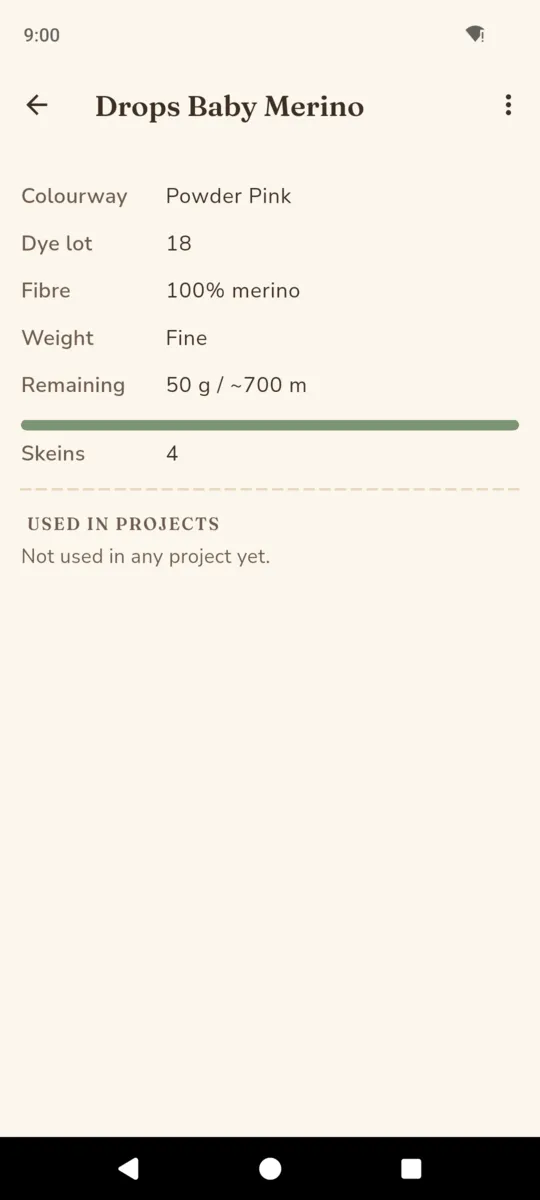
A stash split by lot grows fast. Ten colors bought in two lots each is twenty records before the odd single skeins (an illustrative count). The standard tier holds 25 yarn entries; the paid tier removes that cap, and nothing already entered is ever locked.
7. Seal it, but only when it is clean and dry
UC IPM’s storage rule is short: make sure items are clean and clear of pests, and place them in an airtight container. Both halves matter. A sealed bin keeps moths out, and it also shelters any eggs you missed, which is why the freezer comes first.
Then there is damp. The CCI’s page on incorrect relative humidity treats air over 75% RH as damp. Its mould table splits on dirt. Materials whose surface is rich in soluble protein, starch or sugar, starched, sized or dirty textiles among them, go from about 100 days to mould at 70% RH, to 10 days at 80%, to 2 days at 90 to 100%. Clean plant-based materials, clean textiles included, typically need 80 to 85% RH before mould growth is likely at all. Dirt feeds mould as well as moths, which is one more reason the yarn goes in clean. It also warns that plastic wrapped around something damp traps the damp. Yarn from a wet basement gets a few days on a rack before it goes in a bin.
Skip the unheated garage. The CCI says uneven temperature across a package leads to damp, even condensation, and so do sudden, extreme drops. The same reasoning sits behind storing 3D printer filament dry.
8. Hang a trap and set a reminder to look
UC IPM says the sex pheromone in a clothes moth trap draws male moths onto a sticky surface. Males only, so a trap will not stop a female laying eggs. Treat it as an early warning. Put one near the stash.
Penn State’s timings set the checking interval. Eggs hatch in 4 to 10 days in summer and can take three weeks or more in winter, and egg to adult takes one to three months. A monthly look through the wool bins in warm months, and every two or three months in winter, catches a problem within a single generation.
Vacuum under the bins while you are there. Penn State says that in many instances clothes moths can be prevented or controlled solely by vacuuming, and UC IPM adds the step people forget: empty the bag promptly.
What cedar, lavender and mothballs can and cannot do
Cedar is the one people trust, and the evidence is thin. UC IPM calls cedar chests and cedar closet floors debatable, and says the oil can kill small larvae but not large ones. Lavender smells nice. Neither replaces a sealed lid.
Mothballs are another matter, and the National Pesticide Information Center’s answer on mothballs is a short read before you buy any. They are almost 100% active ingredient, paradichlorobenzene or naphthalene, and they work by turning into a gas that builds up inside an airtight container and kills moths and eggs. Used that way, NPIC says, exposure for people and pets is low. If you can smell them, you are breathing the pesticide.
For a hobby stash, I would rather rely on the freezer and a good lid than keep a pesticide in the room I knit in.
Keep the records moving as the yarn gets used
A stash list goes stale the first evening you knit from it. The Craft Yarn Council says the band is there to help you choose the number of skeins a project needs, which only works if the grams on your record match the grams in the bin.
In StitchNest, logging the grams a project used takes them off that yarn’s remaining figure, and the yarn’s page lists the projects it went into. Log more than the entry has left and it asks before saving. A kitchen scale does the rest: weigh the half-used ball and correct the number.
If moths got there first
Bag and freeze everything in the affected bin, damaged or not, as in step 3. Throw out badly furrowed yarn, because a grazed strand is a weak strand. Vacuum the shelf and floor, get rid of what the vacuum picked up the same day, and wash the bin. Then go through the other wool bins once more.
Once the bins are clean and the counts are right, start with the wool box you checked first and enter it into StitchNest’s stash, one dye lot at a time, so the next shop visit starts with a search instead of a guess.
Common questions
How long do I need to freeze yarn to kill clothes moths?
The Canadian Conservation Institute gives -20°C (-4°F) for one week as a practical treatment, and UC IPM describes several days below 18°F. Seal the yarn in clear polyethylene first so condensation forms on the outside of the bag, then let it come to room temperature for a day before opening it. If you still find live larvae, freeze it again.
Do clothes moths eat acrylic or cotton yarn?
Penn State Extension says synthetics, cottons and other plant materials are not attacked by webbing clothes moth larvae unless they are stained with food or body oils. A blend with wool in it is still food, though. Under FTC rules wool must be named with its percentage even below 5%, and alpaca, cashmere, camel, llama and vicuna hair all count as wool, so the band tells you.
Does cedar keep moths out of a yarn stash?
Not reliably. UC IPM calls the effectiveness of cedar chests and cedar closet floors debatable, and says the oil can kill small larvae but does not affect large ones. Clean yarn in an airtight container is the protection, and cedar adds a pleasant smell.
Can I mix two dye lots in one project?
You can, with care. Lion Brand suggests working alternating rows from the two lots to soften the change, and comparing the yarns in both natural and artificial light first. Two lots side by side in the same piece, with no alternating, is where the line shows.
Photos: Arina Krasnikova / Pexels , Sami Aksu / Pexels