















































































































































































A Sourdough Baking Schedule, Worked Out Backwards
One weekend loaf planned from the time it leaves the oven, step by step, with the clock times, the clash with a work day and the two changes that fix it.
Say you want bread out of the oven at nine on Saturday morning. Most sourdough recipes give you durations: thirty minutes for this, four hours for that, overnight in the fridge. None of them tell you what time to start, and the answer is less obvious than it looks once a job gets in the way. So here is one loaf, worked through with real clock times, including the bit where the first plan falls apart.
The steps and how long each one takes
The schedule below uses a standard overnight sourdough. These durations are the defaults in the bake timeline of BreadMath, and they are typical of an overnight recipe:
- Autolyse, flour and water resting together: 30 minutes
- Mix and knead, with the starter and salt: 15 minutes
- Bulk ferment: 4 hours
- Pre-shape: 20 minutes
- Final shape: 10 minutes
- Cold proof in the fridge: 12 hours
- Bake: 45 minutes
That adds up to 18 hours. The fridge alone is 12 of them. That matters, because it is the one step you can stretch or shrink without much harm.
Counting back from Saturday at nine
To plan backwards you start with the finish time and subtract each step in reverse. The bake starts at 8:15 on Saturday. The cold proof has to begin twelve hours before that, at 8:15 on Friday evening. Final shape goes in at 8:05 pm, pre-shape at 7:45 pm, bulk ferment at 3:45 pm, mixing at 3:30 pm and the autolyse at 3:00 pm.
Three o’clock on a Friday afternoon. If you work regular hours, the plan has just failed at its first step. This is where a lot of people give up on weekday sourdough, and it is a scheduling problem rather than a baking one.
Moving the slack into the fridge
The fix is to stop treating the 12-hour cold proof as fixed. If you get home at six, start the autolyse then and let everything that follows slide later, and take the difference out of the fridge time. Here are both versions side by side:
| Step | Recipe as written | Fitted around work |
|---|---|---|
| Autolyse | Fri 3:00 pm | Fri 6:00 pm |
| Mix and knead | Fri 3:30 pm | Fri 6:30 pm |
| Bulk ferment | Fri 3:45 pm | Fri 6:45 pm |
| Pre-shape | Fri 7:45 pm | Fri 10:45 pm |
| Final shape | Fri 8:05 pm | Fri 11:05 pm |
| Cold proof | Fri 8:15 pm, 12 h | Fri 11:15 pm, 9 h |
| Bake | Sat 8:15 am | Sat 8:15 am |
| Out of the oven | Sat 9:00 am | Sat 9:00 am |
Nine hours in the fridge is still a full overnight proof. Shipton Mill’s own workday method, which mixes at half six in the evening, puts its loaves in the fridge at quarter past ten and bakes them at quarter past seven the next morning, so about nine hours there too.
The cost is the late finish. Shaping at quarter to eleven on a Friday is not everyone’s idea of a good night. If that is the deal-breaker, the other lever is bulk fermentation, which brings us to temperature.
Why four hours is a guess
The four-hour bulk ferment is an assumption about your kitchen. King Arthur’s bakers say a healthy dough sits between 75°F and 80°F, and that in winter they mix with water up to 100°F because dough loses heat fast in a cool room. Their example is a kitchen at 62°F, where a warm dough cools significantly within a short time and fermentation slows down with it.
In practice that means the same recipe can finish bulk in, say, three and a half hours in July and need well over five in January. On a work-night schedule this is the step that decides whether you shape at ten or at midnight. Warmer water and a warm spot for the bowl, such as an oven with only the light on, pull the finish earlier. Treat the clock time in the table as the moment to start checking, then shape when the dough has grown and feels airy and domed.
The starter has its own schedule
Everything above assumes the starter is ripe at 6:30 pm, when it goes into the dough. King Arthur’s starter guidance describes a healthy starter as one that at least doubles in about 6 to 8 hours, kept somewhere in the 70°F to 78°F range. Count back from 6:30 and the feed lands somewhere between 10:30 am and 12:30 pm, which for most people is the middle of the working day.
If you feed it at seven before leaving, it will have peaked and started to fall by the evening. The common workaround is to feed with a bigger proportion of fresh flour and water so it takes longer to ripen, or to keep it somewhere cooler during the day. Either way, it pays to watch your own starter a couple of times and note how long it takes to peak, because that number is personal to your jar and your kitchen. The guide on feeding and keeping a starter goes into ratios.
Two things the recipe card leaves out
The first is the oven. A recipe’s bake time starts when the loaf goes in, but the oven has to be hot by then. Shipton Mill preheats to 250°C and turns the oven down to 230°C once the loaf is in. If you use a covered pot, they give 20 minutes with the lid on and 10 to 20 with it off. Their schedule allows 15 minutes of preheating before the loaf goes in. If you are heating a heavy cast iron pot inside the oven, allow longer. The dough waits in the fridge while that happens, so the preheat comes out of the cold proof rather than adding to the total.
The second is the fridge itself. The cold proof works because cold slows fermentation right down, and that only holds if the fridge is cold enough. The FDA’s guidance is to keep a refrigerator at or below 40°F (4°C) and to check it with an appliance thermometer. A fridge running warm keeps fermenting your dough overnight, and a nine-hour proof starts behaving like a much longer one.
Letting the phone do the arithmetic
Doing this on paper is fine the first time. It gets tedious when you change one step and have to recount the rest, or when the finish moves from Saturday breakfast to Saturday lunch.
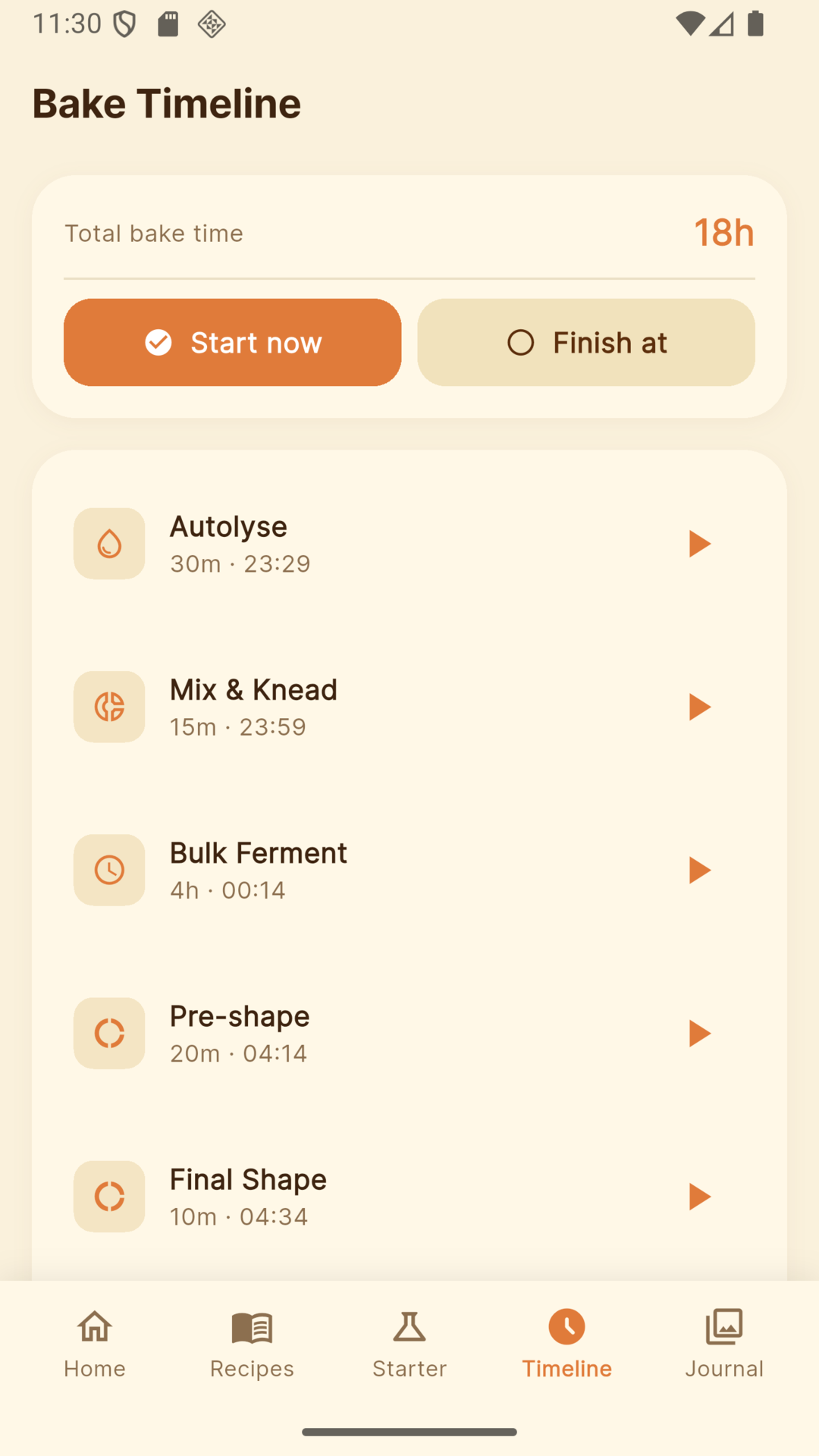
The timeline in BreadMath’s sourdough tools does this counting. It has two modes: Start now times every step forward from this moment, and Finish at takes a date and time and works the plan backwards, showing the weekday next to any step that falls on another day. You can rename a step, change its length, drag steps into a different order or add your own, such as a preheat step, and the clock times update to match. When a step’s time runs out it sends an alert naming the step that just finished and the one that comes next, which is the part that helps at 10:45 on a Friday when you have stopped watching the bowl. The timeline sits behind the app’s one-time unlock; the calculators do not.
The first time you run a plan like this, write down when bulk actually finished. That one number will fix next Friday’s schedule more than anything else here.
Common questions
How long does a sourdough loaf take from start to finish?
A common overnight method runs about 18 hours from autolyse to the end of the bake, and two thirds of that is the cold proof in the fridge. Hands-on time is well under an hour. Add the starter feed on top, which needs roughly 6 to 8 hours at a warm room temperature to peak.
Can I leave sourdough in the fridge longer than 12 hours?
Yes. The cold proof is the most forgiving part of the schedule and is the place to absorb a change of plan. Push it much further and the loaf tends to come out sourer and flatter, so if you need a lot of extra time, start later rather than leaving the shaped dough in for days.
What if my bulk ferment finishes early or late?
Go by the dough, not the clock. A warm kitchen speeds bulk fermentation up and a cold one slows it down, sometimes by hours. Shape when the dough has risen and feels airy, then move the cold proof to match. Planning backwards only tells you when each step should start, not whether the dough agrees.
Photos: Nic Wood / Pexels , Cats Coming / Pexels