














































































































































































What to Check Before Buying a Used Motorcycle
A used motorcycle checklist built on records you can verify: the VIN, title and MOT history, tyre date codes, brake fluid grades and the seller's receipts.

The checks that save the most money on a used motorcycle are the ones you can do against a record before you ever hear the engine: 17 characters of VIN, a title or MOT history, four digits on each tyre, and a line of text on the brake fluid reservoir. Each one matches what the seller told you or it does not, and none depends on how well you listen to a cold start.
A test ride tells you how the bike feels this afternoon. The records tell you how it got here. This checklist starts at home with the advert open and ends on the seller’s driveway with a torch.
Copy the VIN from the frame, not from the advert
Federal VIN rules make a bad transcription easy to spot. On a bike built for the US market since 2009, 49 CFR 565.13 requires 17 characters with no I, O or Q, so a number with a letter O in it was typed by a person. Older bikes follow an earlier version of the rule. Position 9 is a check digit that exists to catch copying mistakes, and position 10 is the model year.
Read the number off the frame yourself, compare it with the title or log book, then put it into NHTSA’s VIN decoder, which reads back what the manufacturer reported for that number. For a motorcycle the VIN encodes the make, the type, the line, the engine type and a power figure, so a decoder result showing a different engine or model year from the one in the advert ends the conversation politely and early.
A seller who sends the VIN on request is normal. A seller who will not is telling you something.
Pull the title history and the recall list
In the US, the place to look is the Justice Department’s National Motor Vehicle Title Information System. An NMVTIS vehicle history report covers five things: the current title and last title date, brand history, the last odometer reading, total loss history and salvage history. A brand is a label a state puts on a vehicle, such as junk, salvage or flood. Insurers, recyclers, junk yards and salvage yards are required by federal law to report into it, which is how a brand from one state follows a bike into another.
A clean report is short. That is what you want it to be.
In the UK, start with the V5C log book. The gov.uk buying steps say to check that the details match DVLA’s records, check the MOT history, check for safety recalls and check that the log book is not for a stolen vehicle. The recall check covers motorcycles by manufacturer, model and year. An open recall is a job you will be booking, not a reason to walk away.
Read the odometer against something other than the seller
Mileage is easy to misstate and hard to prove, so look for an independent reading. In Great Britain, the DVSA’s MOT history check shows the result of every test and the mileage recorded at each one, back to 2005 for motorcycles. A bike needs an MOT every year once it is three years old, so a ten year old bike should have a reading for most of the last seven years. They should only go up.
In the US there is a wrinkle. The federal odometer disclosure rules in 49 CFR 580.17 exempt older vehicles. A vehicle from model year 2010 or earlier is exempt once it is ten years past its model year, which in 2026 means all of them. From model year 2011 the exemption only starts after 20 years. So a seller of a 2009 bike owes you no written mileage statement at all, and the NMVTIS reading may be the only number you get that the seller did not write down.
A dealer changes less than you might think. The FTC’s Used Car Rule, the one behind the Buyers Guide sticker in a car dealer’s window, defines a vehicle as any motorized vehicle “other than a motorcycle”. Ask in writing about any warranty instead.
The whole list on one page
| Check | What a good answer looks like | Source |
|---|---|---|
| VIN | 17 characters, no I, O or Q, decoder matches the advert | 49 CFR 565.13 and 565.15 |
| Title or V5C | No salvage, junk or flood brand; log book matches DVLA | NMVTIS; gov.uk buying steps |
| Mileage | Rises steadily across MOT or title readings | DVSA MOT history; NMVTIS |
| Tyre age | Under five years from the date code, or recently inspected | 49 CFR 574.5; Michelin |
| Tread | At least 1 mm across three quarters of the tread (UK) | DVSA MOT manual |
| Brake fluid | Grade matches the cap, colour fits that grade | FMVSS 116 and 122 |
| Steering head | Smooth lock to lock, no clunk when rocked | DVSA MOT manual |
| Fork legs | No more than a light film of oil | DVSA MOT manual |
Four digits on each tyre sidewall
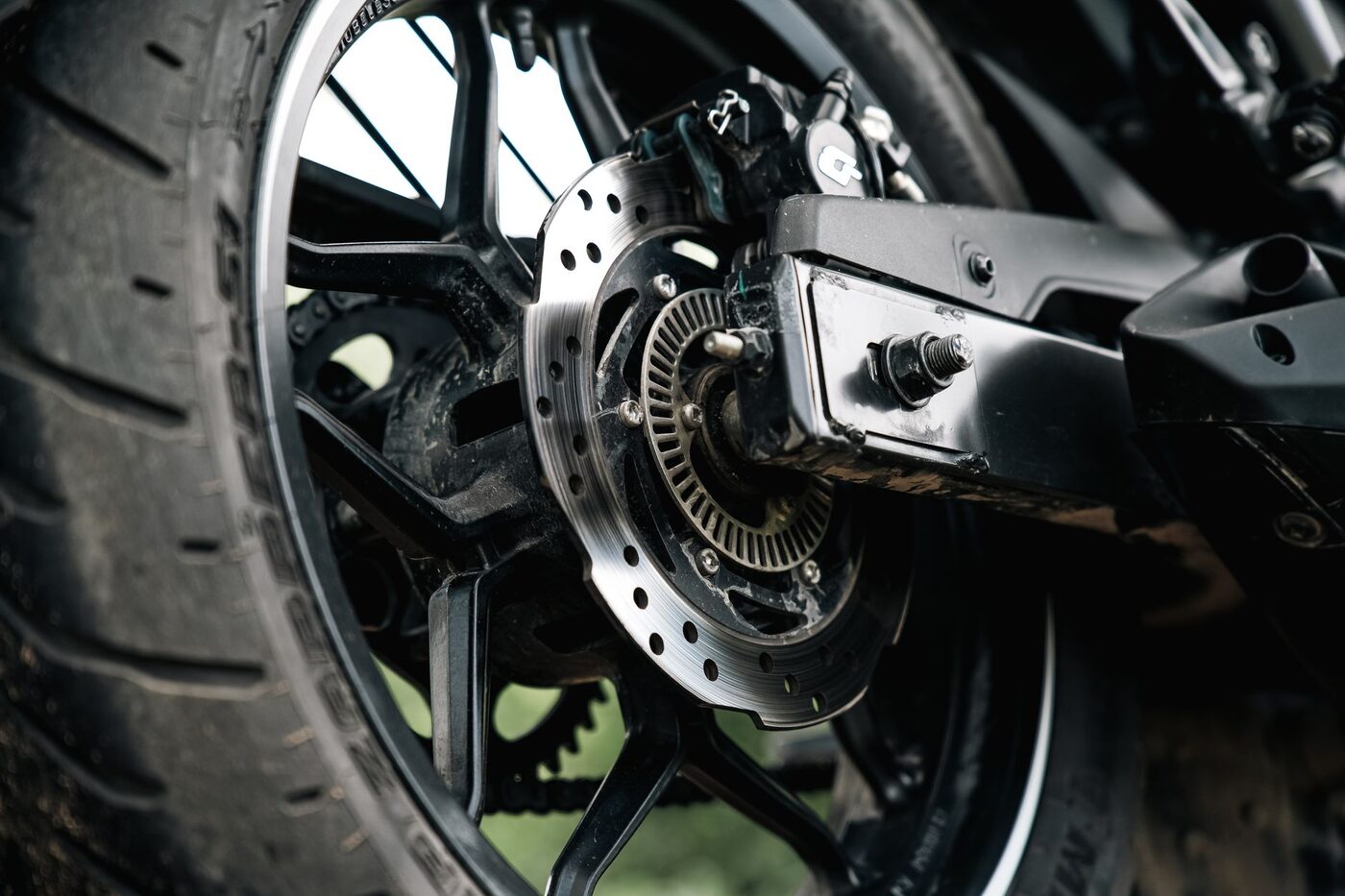
Every new tyre made for the US market carries a tire identification number of 13 symbols molded into one sidewall, and the rule for it, 49 CFR 574.5, fixes the last four as a date code: two digits for the week of manufacture, two for the year. The regulation’s own example is 0109, the first full week of 2009.
Tread depth says nothing about age, and low mileage bikes keep their tyres a long time. Michelin’s guidance on when to change motorcycle tyres is to have them inspected by a professional every year after five years, and to replace them ten years from the date code whatever the tread depth. Michelin counts shelf time too. As an illustration, a bike advertised in late 2026 on a tyre stamped 2419 has rubber from mid 2019: seven years old, and a tyre to price into your offer.
Then the tread. The DVSA’s motorcycle MOT manual asks for at least 1.0 mm in a band covering three quarters of the breadth, all the way round, and only a visible pattern at 50 cc or less. Michelin’s US page puts its tread wear indicators at 2/32 of an inch and advises changing before the tread reaches them; the legal limit itself is set by your state. Tread scrubbed right out to the edges on a sports bike sold as “never tracked” deserves a question.
Brake fluid: the text on the cap and the colour behind the window
US federal standards make this one quick. FMVSS 122, the motorcycle brake system standard, requires a warning on or within 4 inches of the reservoir cap reading “Use only ___ fluid from a sealed container”, with the grade filled in, and a fluid level visible without taking the cover off. You can check both without touching anything.
The colour tells you which family is in there. FMVSS 116, the brake fluid standard, requires DOT 3, DOT 4 and DOT 5.1 to be colourless to amber, DOT 5 silicone to be purple, and hydraulic mineral oil to be green. Purple fluid behind a window marked DOT 4 is someone’s improvisation.
The same standard explains why old fluid matters. It sets a minimum boiling point for DOT 4 straight from the bottle of 230 °C, and a minimum “wet” boiling point of 155 °C, measured after the fluid has sat in a warm, humid chamber alongside a reference fluid until the reference has absorbed 3.7 percent water. That gap is the cost of water in the fluid, and the brakes only find it when they are working hard, not in a car park. Fluid that has gone dark brown is a reason to ask when it was last changed, and to look for that job in the receipts.
Lock to lock, with the front wheel down and then up
Steering head bearings are what a short test ride hides most easily. The steering section of the DVSA’s motorcycle MOT manual describes the tester’s check, and you can copy it. Turn the bars from lock to lock with the front wheel on the ground, then again with the front wheel lifted clear. They should move smoothly through the middle without a notch that wants to hold the bars straight ahead. Then hold the front brake on and push the bars forward and back. A clunk you can feel through the grips is play in the bearings.
The manual’s failure wording is “excessively stiff, notchy, or with excessive wear or play”, which covers what you are feeling for. A notch is a repair, not a reason to panic, and a fair reason to adjust the price, because the seller cannot argue with the MOT’s own test.
Wheels and forks, with the bike on a stand
The wheels, tyres and suspension section of the DVSA’s MOT inspection manual checks wheel bearings with each wheel raised clear of the ground, rocking it by hand to feel for play. Spin it as well and listen for a gravelly sound.
On most bikes the front shock absorbers sit inside the forks, so the fork legs are where leaks show up. The manual draws the line sensibly: a light misting that leaves a thin film of fluid is not a defect, while a shock absorber leaking severely is. Wipe the legs clean, pump the forks a few times and look again. A ring of fresh oil means fork seals.
While you are crouched there, measure the chain slack against the figure in that model’s owner’s manual rather than guessing. Hooked sprocket teeth mean a chain and sprocket set.
The receipts, and the questions they answer
A service history is not proof of good maintenance. It is proof of dates and odometer readings, which is more useful. To take an illustrative example, a receipt for an oil change at 11,800 miles in March 2024 tells you when the next one is due. A receipt for a valve clearance check tells you that a job which is easy to put off was done, and by whom.
Ask for them before you travel. If the seller has none, the NMVTIS buying tips suggest asking the dealership or repair shop that did most of the work, which may share its files. A shop printout with the VIN on it beats a stamped book, because you can phone the shop.
Look hardest for the time based jobs. Where the manual puts brake fluid and coolant on a calendar interval, a low mileage bike with no fluid change in five years was ignored, whatever the odometer says. The intervals behind those jobs, by mileage and by month, are in our guide to a motorcycle maintenance schedule by mileage and time.
After you buy, start the log at the seller’s last service

The receipts are only useful if the dates on them keep counting once the bike is yours.
MotoGarage, a motorcycle service log that counts from the seller’s last service, is built for that hand over. You add the bike with its VIN, plate, purchase date and odometer, then enter the intervals from that model’s owner’s manual. It offers nine common rows and preloads no numbers. Then you log each of the seller’s receipts as a service entry with its real date, its odometer reading, the shop’s name and up to three photos of the paper. Reminders take their starting point from the most recent entry for each item, so the next brake fluid change is due two years after the seller’s receipt if two years is what your manual says, not two years after the day you bought the bike. An item turns to due soon with 10 percent of its mileage left or 30 days to go, and overdue past either.
If this bike is joining one you already own, adding it opens the one-time unlock for unlimited bikes with no ads, and after that each machine keeps its own odometer, intervals and history. When you sell, the per bike CSV export lists the services, fuel, mods and intervals your own buyer will ask about.
What to take on the day
A torch for the tyre codes and the reservoir window, a rag for the fork legs, a tread depth gauge, and the title or MOT history you printed. Ask to see the bike before it has been started that day. Ask for the owner’s manual too, because the chain slack figure and every service interval for that model are in it.
This checklist is general information, not professional advice. Rules differ by country and state, so check them with NHTSA, the FTC, your state motor vehicle agency or the DVSA, and have a qualified motorcycle mechanic inspect any bike you are unsure about.
Once the bike is yours, put the seller’s receipts into the MotoGarage service log the same evening, while you still know which envelope is which, and let the first reminder come from the seller’s last oil change.
Common questions
How do I tell how old a motorcycle tyre is?
Find the code beginning DOT on the sidewall and read its last four digits. The first two are the week of manufacture and the last two are the year, so 2419 would mean week 24 of 2019. Michelin advises a yearly professional inspection once a tyre passes five years and replacement at ten years from that date, whatever the tread looks like.
Does a used motorcycle need a full service history?
Not every bike has one, but it is the only evidence of what was done and when. Ask for receipts with dates and odometer readings on them. If the owner has none, the shop that did most of the work may share its records, which is a step the US Justice Department's NMVTIS buying tips suggest.
What should I check on a used motorcycle's VIN?
On a modern bike, check that it has 17 characters with no letter I, O or Q, that the number on the frame matches the title or V5C, and that a decoder returns the same make, model year and engine the seller described. Then run it through a title history check and a recall check before you hand over money.
Is a little oil on the fork legs a reason to walk away?
Not on its own. The UK motorcycle MOT manual says a light misting that leaves a thin film is not a defect, while a shock absorber leaking severely is. Wipe the legs clean, compress the forks a few times and look again. Fresh oil running down the leg means replacement seals at the least.