















































































































































































Flat vs Eggshell vs Satin Paint: Which Finish Where
Flat, eggshell, satin or semi-gloss: what each sheen measures, where each belongs, how it cleans and touches up, and whether it changes how much paint you buy.
Eggshell on most walls, flat on ceilings, satin where walls get touched or steamy, semi-gloss on trim and doors. That is the standard split, and it holds up. The interesting part is why, because once you know what the names measure you can break the rule on purpose. Eggshell is not a mood. Under the Master Painters Institute scale it is Gloss Level 3, a paint that reads between 10 and 25 units on a gloss meter held at 60 degrees. Flat reads 5 or less. Semi-gloss reads 35 to 70.
Those numbers explain almost every trade-off in this guide.
What the sheen names mean on a meter
Paint companies name sheens however they like. Pearl, velvet, eg-shel and matte all appear on tins. The Master Painters Institute cuts through that with seven numbered levels, G1 for flat up to G7 for high gloss. The US military’s painting specification, UFGS 09 90 00 on the Whole Building Design Guide, reprints the table and says the federal government has historically used flat (G1 or G2), eggshell (G3), semi-gloss (G5) and gloss (G6).
The test behind the levels is ASTM D523, the standard method for specular gloss. A glossmeter shines light at a fixed angle and compares how much bounces straight back against a polished black glass reference. The 60 degree reading is the everyday one. For the lowest levels MPI adds an 85 degree reading, a raking angle that catches the faint shine of a flat wall seen along its length.
One detail in the table is worth knowing before you shop. Eggshell runs 10 to 25 units and satin runs 20 to 35, so the two bands overlap. One brand’s satin can measure flatter than another brand’s eggshell. If you are matching an existing wall, match the product, not the word on the label.
Why flat hides a bad wall
Light does the work. A low-gloss film has a microscopically rough surface, and the Master Painters Institute’s newsletter on gloss levels puts it plainly: a rough surface will diffract light and appear duller. Scattered light cannot pick out a ridge of joint compound or a shallow dent.
Gloss does the opposite. A smooth, shiny film reflects light in one direction, like a mirror, and every bump in the wall bends that reflection. MPI notes that critical lighting, meaning light skimming along a wall from a window or a ceiling light, will accentuate every imperfection. A long hallway lit from one end is the classic case.
So flat goes where the wall is least perfect and least touched, and ceilings are both: nobody wipes them, and window light rakes straight across them. The federal specification says the same thing in its own dry language, telling specifiers to use lower gloss levels in non-contact areas such as ceilings.
Why shine wipes clean
The smooth surface that shows every flaw is also the one that gives dirt nowhere to sit. MPI calls it a balancing act between abrasion resistance and hiding power: low gloss coatings have enhanced hiding power, while high gloss coatings have better abrasion resistance and are easier to clean.
How washable a wall paint is gets measured too. ASTM D2486, the scrub resistance test for wall paints, runs a brush back and forth over a painted panel and counts the cycles until the film wears through. The standard explains why: paints get soiled near doorways, near windows, and in work and play areas. That is your list of walls that need a washable finish.
Benjamin Moore’s guide to choosing a paint finish states the consumer version of this: stains are harder to remove from low-sheen paint. That is the real cost of flat: a scuff tends to come off only with the paint around it, and then you are touching up.
Flat, eggshell, satin and semi-gloss side by side
The gloss units below are the MPI 60 degree ranges. The rooms column is from Benjamin Moore’s product pages for one line, Regal Select, which list the projects each sheen is recommended for. Other brands draw the lines a little differently.
| Finish | MPI level | Gloss at 60° | Hides wall flaws | Wipes clean | Some projects the manufacturer lists |
|---|---|---|---|---|---|
| Flat | G1 | 0 to 5 | Most | Least | Ceilings, bedrooms, living rooms, basements, bathroom ceilings |
| Eggshell | G3 | 10 to 25 | Well | Fairly well | Bedrooms, living rooms, kitchens, basements |
| Satin | G4 | 20 to 35 | Less | Well | Kitchens, bathrooms, trim, doors, cabinets |
| Semi-gloss | G5 | 35 to 70 | Least | Most | Trim, doors, cabinets, kitchens, bathrooms |
Two things stand out. Flat is listed for bathroom ceilings but not bathroom walls. And trim and doors only appear once you reach satin.
Flat vs eggshell: the living room question
For a living room or bedroom with walls in decent shape, eggshell wins for me. Benjamin Moore describes it as suited for most areas of a home, including family rooms and hallways, and that matches what you see in practice: enough shine to survive a wipe with a damp cloth, little enough that a wall with a few old patches looks uniform.
Flat earns its place in two situations. The first is a wall in poor condition, such as an old plaster wall with hairline repairs or a drywall job where the seams were never feathered out properly. The second is a room nobody touches, such as a formal dining room or the upper half of a stairwell. Some matte paints now claim to withstand frequent washing, which narrows the gap. Check the tin.
Eggshell vs satin: hallways, kids’ rooms and kitchens
Satin is the step up for walls that get hands on them. Benjamin Moore says satin offers better stain resistance and durability than lower sheens, which is exactly what a hallway with a stroller, a child’s bedroom or a kitchen wall beside the stove needs.
The cost is visibility. Satin shows roller marks, lap lines and repairs more than eggshell, so the prep has to be better: fill, sand, spot-prime the patches and roll in long, steady passes.
My rule of thumb is to put satin on the walls that get cleaned at least once a month and eggshell everywhere else.
Bathrooms: sheen helps, the fan helps more
The federal specification treats bathrooms, laundry rooms and similar high humidity rooms as corrosive locations that require more durable coatings. That is why satin and semi-gloss are the usual bathroom finishes.
No sheen fixes a bathroom that stays wet, though. The EPA’s guide to mold and moisture in your home recommends keeping indoor humidity below 60 percent, ideally between 30 and 50 percent, and running the bathroom fan or opening a window when you shower. It also warns that paint applied over moldy surfaces is likely to peel. Clean and dry the wall first, then pick the finish.
Satin vs semi-gloss on trim and doors

Trim takes more abuse than any wall. Baseboards meet vacuum cleaners and door casings meet shoulders. Semi-gloss has long been the default, and Benjamin Moore’s semi-gloss page lists trim, doors and cabinets among its recommended projects.
Satin is the softer choice. It cleans well, it hides brush marks better on old, much-painted woodwork, and it looks less like a rental apartment. Benjamin Moore’s guide suggests satin’s luster for windows, shutters, trim and interior doors.
Choose semi-gloss for trim that gets kicked, scrubbed regularly or sits in a kitchen or bathroom. Choose satin for trim in a living room or bedroom where the woodwork is old and wavy. Leave full gloss for doors and woodwork that are smooth, because Benjamin Moore’s advice on high gloss is to avoid it on any surface that is not completely smooth.
One practical difference shows up on the label. Regal Select’s flat, eggshell and satin list a recoat time of 1 to 2 hours, while the semi-gloss lists 3 hours. Plan the second coat of trim for after lunch.
Touch-ups are where sheen bites back
Every finish touches up worse than you hope. The coatings maker Diamond Vogel, in its Touch-up Factors sheet, says higher sheen paints (eggshell, satin, semi-gloss) tend to show sheen differences more than flats when touched up. One cause it names: satin over unprimed, porous wallboard dries to a lower sheen than the same satin over itself, so unprimed filler shows as a dull spot.
That dull, blotchy look is called flashing. Sherwin-Williams’ guide to paint flashing defines it as an uneven appearance of a paint coating’s gloss, sheen or luster, and gives the fixes that work: spot-prime patched areas to level the porosity, thin the touch-up paint slightly, or roll a full coat over the whole wall. Diamond Vogel adds two smaller habits. Keep the touch-up layer thin, and touch up within about 5°F of the temperature the wall was first painted at.
The higher the sheen, the likelier a repair means repainting the wall corner to corner. Keep the leftover tin and label it with the room. Our guide on when primer is worth it and how much to buy covers the spot-priming step in more detail.
Going from shiny to flatter
Old glossy trim going to satin, or a semi-gloss kitchen going to eggshell, is a common change. New paint grips a slick surface poorly, so the federal specification tells painters to sand existing glossy surfaces to reduce the gloss, then wipe them clean with a damp cloth.
The same specification puts another step ahead of the sanding: test existing finishes for lead before sanding, scraping or removing them. The EPA’s page on sources of lead explains why trim is the place to worry. The federal government banned the sale of lead-based paint for use in homes in 1978, so a house built before then is more likely to have it. Old paint also turns to dust fastest on surfaces subject to constant friction, and the EPA names doors and window sills.
If you hire someone, the rules change too. Under the EPA’s Renovation, Repair and Painting rules, firms that disturb lead-based paint in homes built before 1978 must be EPA or state certified, and the EPA treats work that disturbs more than six square feet of painted surface per room indoors as covered. Sanding the trim of a whole room passes six square feet quickly.
Does the sheen change how much paint you buy?
Less than most people expect. Benjamin Moore lists 400 to 450 square feet per gallon for all four Regal Select sheens alike. Coverage belongs to the product, so the data sheet for your exact tin is the number to use.
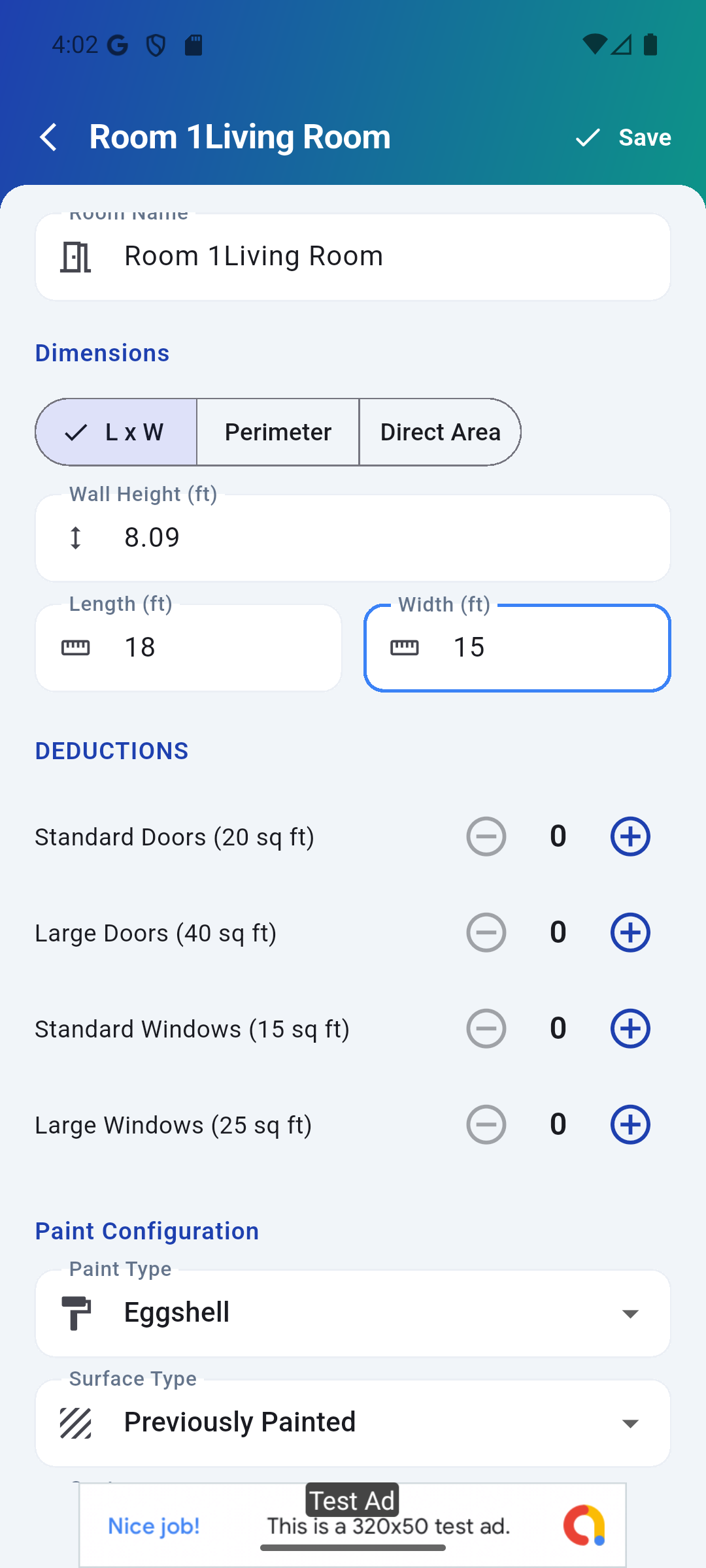
A room paint calculator that sets the coverage rate by finish and surface, PaintCalc, takes the cautious route when you have no data sheet to hand. Its built-in table gives flat and eggshell 400 square feet per gallon on previously painted walls, and satin, semi-gloss and gloss 350. On textured drywall it drops to 300 for flat, eggshell and satin, and 250 for semi-gloss and gloss. If your tin says something different, the custom coverage field on the room screen overrides the table for the walls.
An illustrative example shows how little this usually moves the shopping list. Say a room has 600 square feet of wall after the doors and windows come out, painted in two coats with a 10 percent touch-up allowance. At 400 square feet per gallon that is 3.3 gallons. At 350 it is about 3.8 gallons. Both round up to four gallons, so the sheen changes nothing here. On textured drywall the gap opens: 4.4 gallons at 300 against 5.3 at 250, five gallons against six.
A whole house on one list
Where sheen does complicate the shopping is a whole-house job. Living rooms in eggshell, a bathroom and kitchen in satin, every ceiling in flat, every door and baseboard in semi-gloss: that is four products before color enters it.
This is the job PaintCalc’s paid shopping list is built for. Give each room its paint type, color label, ceiling finish and trim finish, and the list groups wall paint by finish and color, ceiling paint by finish and trim paint by finish. Each line names the rooms it covers and the volume to buy, with a checkbox for the store and a share button that sends it as text. The room defaults already follow the usual split: eggshell walls, and when you switch the ceiling and trim on, flat at one coat and semi-gloss at two.
For the quantity side of a single room, our room-by-room guide to how much paint you need walks through the measuring.
Before you open a tin
This guide is general information, not professional advice. Before sanding old paint in a pre-1978 home, check the EPA’s lead pages or your state’s lead program.
For the rest, the decision takes two minutes. Walk each room and ask two questions: will anyone touch or wash this wall, and how flat is it really? Write the answer down as a finish per surface, walls, ceiling and trim separately. Then measure the rooms and put each one into PaintCalc with its finish, so the shopping list comes out grouped the way the store sells it.
Common questions
Is eggshell or satin better for a bedroom?
Eggshell, for most bedrooms. It wipes clean well enough for a room that sees little traffic, and its lower shine forgives a wall that is not perfectly flat. Pick satin for a child's bedroom where the walls get hands, crayons and furniture knocked against them.
What is the most washable interior paint finish?
The glossier the finish, the easier it is to clean, so semi-gloss and gloss wash better than satin, and satin better than eggshell or flat. The trade-off is that shine shows every dent, ridge and patch on the wall. That is why semi-gloss usually goes on trim and doors rather than whole walls.
Can I put eggshell paint over semi-gloss?
Yes, once the old surface has been cleaned and sanded to take the shine off, because new paint grips a dull surface far better than a slick one. In a home built before 1978, have the old paint tested for lead before you sand it, since sanding lead paint makes hazardous dust.
What paint finish is best for a bathroom?
Satin or semi-gloss is the usual choice for bathroom walls because both stand up to wiping and damp better than flat. Benjamin Moore also says bathrooms can be painted in a matte finish, so check what the product you are buying is made for. Whatever the finish, run an exhaust fan while you shower, because paint over damp, moldy plaster is likely to peel.
Do shinier paints cover less area per gallon?
Not always. Benjamin Moore lists the same 400 to 450 square feet per gallon for the flat, eggshell, satin and semi-gloss versions of its Regal Select line. Read the coverage figure on the tin or the data sheet for the exact product you are buying rather than assuming the sheen sets it.