













































































































































































How Much Liquid Chlorine to Add to a Pool, Worked Out
One 19,150 gallon pool taken from 1 to 4 ppm: the per-ppm sum, what the jug's strength changes, the retest that catches weak bleach, and the pH it leaves.
Somewhere between 57 and 63 fluid ounces of 12.5 percent liquid chlorine, a little under half a gallon. That is what it takes to lift a 19,150 gallon pool from 1 ppm of free chlorine to 4 ppm. The sum behind it is short: the rise you want in ppm, times the pool’s volume in units of 10,000 gallons, times the fluid ounces your product needs to raise 10,000 gallons by 1 ppm.
The spread in that first number is not sloppiness. It comes from three respectable methods that disagree slightly, and it is smaller than the error a tired jug or a guessed depth will introduce. This post follows one pool from the tape measure to the second test, with every figure shown.
The pool, the jug and Saturday’s reading
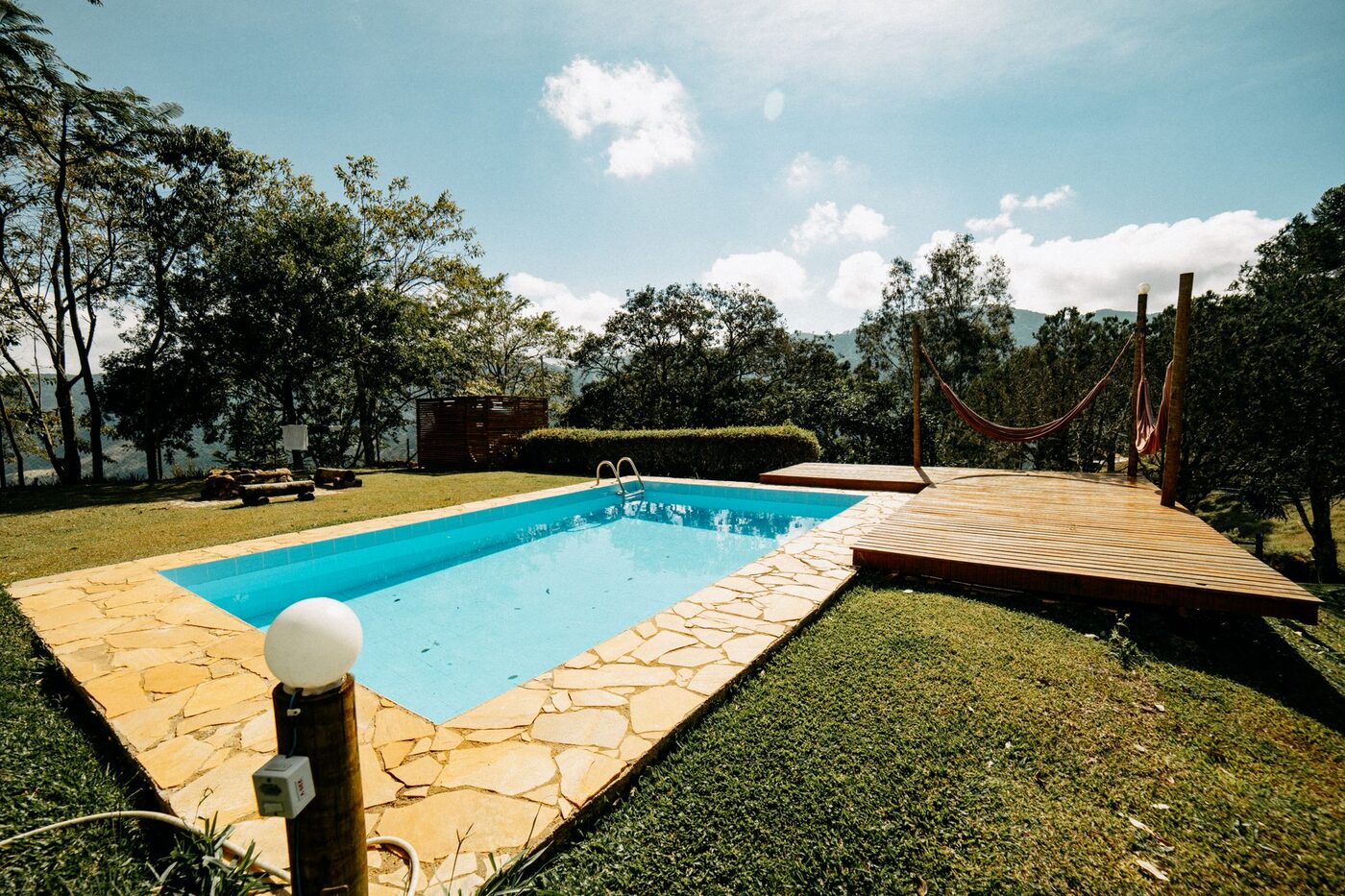
The pool here is illustrative, and deliberately dull. A rectangular in-ground pool, 16 by 32 feet, 3.5 feet at the shallow end and 6.5 at the deep end. It runs stabilised water with cyanuric acid at 40 ppm. The Saturday evening reading: free chlorine 1.0 ppm, pH 7.5, total alkalinity 90.
The jug is pool-store liquid chlorine. Its label, like the EPA-accepted label for EPA Reg. No. 58232-1, lists 12.5 percent sodium hypochlorite with 11.9 percent available chlorine.
Why aim for 4? The CDC’s home pool guidance sets at least 1 ppm for an unstabilised pool and at least 2 ppm for one using cyanuric acid. That same 58232-1 label says stabilised pools should hold 1 to 4 ppm, and it prohibits entry above 4 ppm. Dosing to 4 in the evening leaves the level inside the label’s window, with the night for it to ease back. So the job is a 3 ppm rise.
Gallons first, because everything scales off them
Start with the area: 16 times 32 is 512 square feet. The average depth is the two ends added and halved: 3.5 plus 6.5 is 10, so 5 feet. That gives 2,560 cubic feet.
The 58232-1 label’s estimating line for a rectangle is length times width times average depth times 7.5, which makes 19,200 gallons. The more exact conversion is 7.48 gallons per cubic foot, which makes 19,150. Fifty gallons either way changes nothing you could measure.
The depth is where volumes go wrong. Measure only the deep end and you get 24,895 gallons, 30 percent too many, and every dose you work out from it is 30 percent too strong. A pool with a long sloped floor deserves a few depth readings averaged along its length.
Round pools have a problem of their own. The same label gives “Diameter x Diameter x Average Depth x 7.5” for a round pool, while the area of a circle works out to a factor of about 5.9, the figure that label uses for an oval. Use 7.5 on a round pool and you overstate it by more than a quarter.
Three ways to the per-ppm figure, and why they disagree
The Indiana Department of Health’s chemical adjustment guide has a method for any liquid: divide 1.3 by the available chlorine on the label, written as a decimal. With 11.9 percent, that is 1.3 divided by 0.119, or 10.9 fluid ounces per ppm per 10,000 gallons. Its own worked example, with a 12 percent product, lands on 10.8.
The label’s dosage chart says 10.0 fluid ounces of product per 1 ppm in 10,000 gallons. ClearPool, the app this site makes, uses 10.2 for 12.5 percent liquid.
Run the pool through each, with 1.915 as its volume in units of 10,000 gallons:
- Label chart: 10.0 times 1.915 times 3 is 57.5 fluid ounces.
- ClearPool: 10.2 times 1.915 times 3 is 58.6 fluid ounces.
- Indiana method: 10.9 times 1.915 times 3 is 62.6 fluid ounces.
The gap comes from how strength is written down. The Chlorine Institute’s Pamphlet 96, its sodium hypochlorite manual, separates trade percent, which is grams of available chlorine per 100 millilitres, from weight percent, and says you get the second by dividing the first by the solution’s specific gravity. Its table puts a 12 percent solution at a specific gravity of about 1.16. So a figure by weight understates what each fluid ounce carries, and a method built on it asks for more.
Five fluid ounces between the lowest and highest answers is about 0.3 ppm in this pool. The Indiana guide decides it: always follow the manufacturer’s label for exact dosage amounts. The label in your hand outranks every chart, this one included.
The pour itself
About 58 fluid ounces is 7.3 cups, measured into a jug kept for that one job. Indiana’s guide asks for large amounts to go in gradually, in thirds over two hours, while the pool is not in use, and never through vacuum filter tanks, skimmers or gutters. Here that means three pours of about 20 fluid ounces, and two chances to stop if something looks wrong.
The National Pesticide Information Center’s pool chemicals fact sheet adds the two rules that matter most: add chemicals to the water, never water to the chemicals, and never mix products with acids or other pool chemicals unless the label says to.
Timing is where people get hurt. A 2019 CDC report on pool chemical injuries counted a median of 4,535 emergency department visits a year in the US from 2008 to 2017. In its closer look at 2015 to 2017, at least 56.3 percent of the injuries happened at a residence, and one of the common stories was chemicals added to the water just before the patient got in.
What the strength on the jug does to the dose
Liquid chlorine is sold at several strengths, and household bleach sits at the bottom of the range. Here is the same 3 ppm rise in the same 19,150 gallons. The Indiana column divides 1.3 by the strength in the first column, so its 12.5 percent row uses 12.5 and not this jug’s 11.9.
| Strength on the label | Indiana method, fl oz per ppm per 10,000 gal | ClearPool’s factor | This pool, 1 to 4 ppm |
|---|---|---|---|
| 6% | 21.7 | 21.3 | 122.4 fl oz |
| 8.25% | 15.8 | 15.5 | 89.0 fl oz |
| 10% | 13.0 | 12.8 | 73.5 fl oz |
| 12.5% | 10.4 | 10.2 | 58.6 fl oz |
Six percent bleach needs just over twice the pour of 12.5 percent liquid. That is close to a gallon for this pool, against half a gallon. The NPIC sheet points out that pool chemicals require registration with the US EPA, so read the bottle and make sure pool use is on it before a household product goes in.
The retest that shows how strong the jug really is
Give the water time to mix, then test again. Say, for illustration, the reading comes back at 3.4 and not 4.0. The dose delivered 2.4 of the 3 ppm it was meant to, which is 80 percent.
There are two suspects. One is the water using chlorine faster than expected. The other is the jug. The 58232-1 label puts it in one line: this product degrades with age, so test and increase the dosage as necessary.
Pamphlet 96 puts numbers on why. The decomposition rate of sodium hypochlorite rises 3 to 4 times for every 10°C, and a solution stored at 15°C decomposes 14 times slower than one stored at 35°C. UV light breaks it down too, and stronger solutions are less stable than weaker ones. A 12.5 percent jug that spent July in a hot shed is not a 12.5 percent jug any more. The EPA-accepted label for Reg. No. 33981-20001 asks for storage in a cool, dry area away from direct sunlight and heat.
To tell the suspects apart, test in the evening, when the sun is not burning chlorine off, and compare the old jug against a fresh one of the same strength, dosed the same way in similar conditions. If the fresh jug lands on target and the old one keeps giving about 80 percent, the old jug is the problem, and the next dose from it is 58.6 divided by 0.8, about 73 fluid ounces for the same 3 ppm rise (illustrative). The CDC also notes that test strips are less accurate than a DPD test kit, which matters when you are reading differences of half a ppm.
Stabiliser decides how high the target sits
The 4 ppm target only makes sense because this pool has cyanuric acid at 40. The CDC page states that disinfection times are longer in the presence of cyanuric acid, and it doubles the floor for stabilised pools, from 1 ppm to 2.
How much longer is not a small effect. In a 2015 CDC laboratory study by Murphy and colleagues, the chlorine exposure needed for a 3-log kill of Cryptosporidium at 20 mg/L free chlorine went from 17,800 to 31,500 mg·min/L when cyanuric acid rose from just 8 to 16 mg/L. The NPIC sheet gives the other side of the bargain: cyanuric acid slows the breakdown of chlorine in sunlight. You keep some, and you raise the chlorine target to match it. The guide to how chlorine and stabiliser interact has the full table.
This is one reason the jug here is liquid. Work out a dichlor or trichlor dose in ClearPool and the result carries a warning that stabilised chlorine also raises cyanuric acid, which moves the target up with every dose.
The pH bill that follows liquid chlorine
Pamphlet 96 says sodium hypochlorite adds alkalinity to a solution, and Indiana’s guide warns that chlorine compounds will significantly change the pH. Weeks of liquid chlorine tend to push pH up, and the label wants it held between 7.2 and 7.8.
Suppose, for illustration, that two weeks later the pool reads pH 7.8 with total alkalinity at 90, and you want 7.5. ClearPool’s acid formula gives 16.5 fluid ounces of 31.45 percent muriatic acid for this pool, and its result card says to add half the dose, wait 30 minutes and retest before adding more. Indiana’s limit is one quart of acid per 10,000 gallons at one time, about 61 fluid ounces here, so this dose sits well inside it.
Acid and chlorine go in on separate trips. Pamphlet 96 leaves no room on this: sodium hypochlorite must not be mixed with acids, because excess acidity lets the hypochlorite form chlorine gas. Two products poured into the same patch of water in the same five minutes is the backyard version of that mistake.
Where the gallon per 10,000 rule comes from, and where it misleads
Plenty of advice says a gallon of liquid chlorine per 10,000 gallons. The 58232-1 label’s superchlorination direction is 50 to 100 fluid ounces of product per 10,000 gallons, to give 5 to 10 ppm. A full gallon is 128 fluid ounces, which by that label’s chart is about 12.8 ppm in 10,000 gallons, past the top of its own range.
In this 19,150 gallon pool the same gallon gives about 6.7 ppm. The label’s 5 to 10 ppm range here is 96 to 192 fluid ounces, three quarters of a gallon to a gallon and a half. A rule stated per 10,000 gallons is only a rule once you have done the multiplication for your own pool. Whatever the target, nobody swims until the reading is back at or below 4 ppm. If the water has already turned green, the green pool clear-up sequence works at different targets and over several days.
Letting your phone carry the arithmetic
None of this is hard on a calm Saturday. Two pools, a new jug and fading light make it harder. ClearPool, a pool dosing calculator that works from your own gallons, takes the shape (rectangular, round, oval, kidney, L-shaped or freeform), the shallow and deep ends, and shows the volume as you type. The dosing screen asks for the reading, the target and the chlorine you are using, with 6, 8.25, 10 and 12.5 percent liquid to choose from, and gives the amount in fluid ounces with cups and millilitres underneath. For this pool and this jug it says 58.6 fluid ounces. The screenshot below is a different pool’s test, with every adjustment it needed on one list.

The retest is where the paid unlock comes in. Its Water Trends chart plots each reading over 7, 30 or 90 days against the ideal range, with the average, minimum, maximum and the direction of travel. A fading jug shows up as post-dose readings that land lower each time. A pool that eats chlorine shows up as a steeper slide between tests.
This is general information, not professional advice. Follow the label on your product and your local health code. ClearPool’s own screens call its results estimates for guidance, to be checked against a second source before anything goes in the water.
Before the next bottle, measure the pool once properly and write down the strength printed on the jug. Then put both into ClearPool, so the next dose and the retest that checks it are a few taps from the test kit.
Common questions
How much liquid chlorine raises a pool by 1 ppm?
For 12.5 percent liquid chlorine, roughly 10 to 11 fluid ounces per 10,000 gallons. One EPA-accepted 12.5 percent label puts it at 10 fluid ounces, and the Indiana Department of Health method gives about 10.9 from that label's 11.9 percent available chlorine. Multiply by your gallons divided by 10,000 and by the number of ppm you need.
Can I use household bleach instead of pool liquid chlorine?
The chlorine is the same chemical, but the strength is lower, so you need more of it: about twice as much 6 percent bleach as 12.5 percent liquid for the same rise. Pool chemicals are EPA-registered products, so check that the label on the bottle lists pool use and follow its directions.
How long after adding liquid chlorine can you swim?
Until a retest shows the level is back where the label allows. Two EPA-accepted 12.5 percent labels prohibit entry to a pool above 4 ppm, and one sets 5 ppm for a hot tub. A CDC review of injury reports found people were hurt when chemicals went in just before they got in the water, so dose when nobody is swimming and test before anyone does.
How much liquid chlorine does a hot tub need?
Far less, because the volume is small. One EPA-accepted 12.5 percent label says 5 fluid ounces per 1,000 gallons gives 5 ppm in a spa or hot tub. The CDC asks for at least 3 ppm in hot tubs and recommends no cyanuric acid or stabilised chlorine in them.