













































































































































































How to Find a Hadith From Its Reference Number
Why Bukhari 6018 can point to three places, how to tell which numbering a citation uses, and how to look it up, check its grade and cite it properly.

Type the collection and the number into sunnah.com, as bukhari:6018 or muslim:2564a, and you land on the hadith. That works only if your number came from the same numbering system, and most failed lookups happen because it did not. Sahih al-Bukhari 6018 on sunnah.com is also listed on that page as Book 78, Hadith 49, and again as Vol. 8, Book 73, Hadith 47 in the older English numbering. One narration, three addresses. Work out which address your citation is using and the search takes a minute.
Why one hadith has three addresses
Open the page for Sahih al-Bukhari 6018 on sunnah.com and scroll to the box under the text. It lists a Reference (Sahih al-Bukhari 6018), an In-book reference (Book 78, Hadith 49) and a USC-MSA web (English) reference (Vol. 8, Book 73, Hadith 47), with the last one marked as a deprecated numbering scheme.
The first is a single running number through the whole collection. The second gives the book, meaning the subject section such as Good Manners, and the hadith’s position inside it. The third comes from the English translation by Dr. Muhsin Khan as the Muslim Students Association at the University of Southern California first put it online, which is where the name USC-MSA comes from.
Why would a translation need its own numbers? The sunnah.com notes on sources, numbering and grading give the reason plainly: the translator sometimes split or combined the Arabic books, and sometimes split or combined hadith, which produced a new numbering for the English while the Arabic stayed as it was.
The drift shows without opening a single hadith. In the online index of the Muhsin Khan translation, Book 9 is “Virtues of the Prayer Hall (Sutra of the Musalla)” and the list stops at Book 93. On sunnah.com, Book 9 of Sahih al-Bukhari is “Times of the Prayers” and the list runs to 97. Anyone who gets “Book 9” from one source and looks it up in the other reads the wrong chapter.
Step 1: Copy the citation exactly as written
Write down every part of the reference you were given. Small details decide its system.
Look for the collection name (Bukhari, al-Bukhari, Sahih al-Bukhari, Muslim, Sahih Muslim, Sunan Abi Dawud and so on), the number itself, any letter after the number, and any mention of a volume or a book. Keep the punctuation too. “Vol. 8, Book 73, No. 47” and “6018” carry very different information.
A bare “al-Bukhari (6018)” in a talk handout or a social post tells you the collection and a number and nothing else. In most cases that is the main running number, but not every time, so treat it as a guess until the text on screen matches the passage you heard quoted.
Step 2: Work out which numbering system it uses
The format gives most of them away. Every example below is copied from a sunnah.com reference box.
| What the citation looks like | Numbering system | Real example |
|---|---|---|
| Collection plus one number | sunnah.com main reference | Sahih al-Bukhari 6018 |
| Book number plus a small hadith number | In-book reference | Book 78, Hadith 49 |
| Volume, book and hadith | USC-MSA English, Muhsin Khan translation of Bukhari | Vol. 8, Book 73, Hadith 47 |
| Sahih Muslim number with a letter | sunnah.com main reference | Sahih Muslim 2564a |
| Muslim book plus a hadith number in the thousands | USC-MSA English, Abdul Hamid Siddiqui translation | Book 32, Hadith 6219 |
| A Sunan book with “English translation” | sunnah.com’s label for the older English numbering | Book 41, Hadith 4590 (Sunan Abi Dawud 4607) |
Two tells cover most cases. A volume number almost always means the Muhsin Khan English numbering of Bukhari, because, as the introduction to that translation on the IIUM site explains, the work is split into nine volumes and the hadith are numbered consecutively per volume. So “No. 47” means the 47th hadith of volume 8, not of the collection.
The second tell is a big number sitting next to a small book number in a Muslim citation. The introduction to the Siddiqui translation of Sahih Muslim says it is divided into 43 books and numbered consecutively and uninterrupted for the entire collection. That is why Book 32, Hadith 6219 looks the way it does. Sunnah.com, by contrast, lists Sahih Muslim in 57 books, so the book numbers will not line up either: Zakat is Book 5 in the translation’s index and Book 12 on sunnah.com.
Step 3: Look it up by the number that matches
For a main reference, the address bar is the fastest route. The pattern is sunnah.com/ followed by the collection, a colon and the number, so bukhari:6018, muslim:2564a or abudawud:4607. Sunnah.com also says its search has accepted a collection and a hadith number since February 2024, and adding collection:bukhari to a query keeps the results inside Sahih al-Bukhari.
For an in-book reference, open the collection, open the book by its number, and count down to the hadith. The collection’s contents page on sunnah.com lists the range of main reference numbers in each book (Book 9 of Bukhari covers 521 to 602, for instance), which is a quick check that you are in the right place.
The volume references take one more step. Open the translation on the IIUM site, go to the book, and find the hadith by its number. Then copy a short, distinctive phrase from the English and search it on sunnah.com, which supports full-text search of the English as well as the Arabic. When the result comes up, its reference box will show the same Vol., Book and Hadith you started with. If it does not, you have a similar narration, not the same one.
That check matters. Many narrations repeat with small changes of wording, and a phrase search will happily return a near neighbour.
Step 4: Watch for the letter at the end
Plenty of Sahih Muslim citations on sunnah.com end in a letter. The entry for Sahih Muslim 2564a sits between 2563e and 2564b in the page navigation: several entries share the number 2564 and the letter tells you which one.
So a citation of “Muslim 2564” with no letter is pointing at a group. Read every lettered entry until the wording matches what was quoted to you. If the person who quoted it is around, ask them which one they meant. It saves a second argument later.
The same entry shows how far apart the systems can drift. In-book it is Book 45, Hadith 40. In the older English numbering it is Book 32, Hadith 6219. None of those three numbers can be derived from another; you have to read them off the page.
Step 5: Read the book and chapter, not only the line
Once you have the right page, look up before you look down. The breadcrumb names the book (for 2564a, the Book of Virtue, Enjoining Good Manners, and Joining of the Ties of Kinship) and the heading above the text names the chapter.
A sentence quoted on its own can read very differently from the same sentence sitting under its chapter title, next to the other narrations the compiler placed with it. When a quotation seems to say something odd, the chapter heading tends to explain it better than a second translation would.
Then read the chain. Encyclopaedia Britannica’s article on Hadith describes the standard form that settled by the second century of Islamic history: the isnad, a chain of narrators in order from the Prophet and his Companions onward, followed by the matn, the body text. On sunnah.com the Arabic gives the full chain, with each narrator’s name linked to a narrator page, while the English beside it can be much shorter: on Sahih al-Bukhari 1 it names only the Companion, ‘Umar bin al-Khattab.
Step 6: Check the grade, and who gave it
A reference number is an address. It says nothing about strength.

Grading is a judgement scholars make about a narration, mostly by examining its chain. Britannica’s entry on the science of hadith sets out the three broad categories: sahih (sound), hasan (good) and daif (weak), and notes that six collections came to be recognised as canonical, with the books of al-Bukhari and Muslim holding the highest standing among them.
The finer definitions belong to named scholars. In his paper on authenticating hadith and the history of hadith criticism for Yaqeen Institute, Dr. Jonathan Brown explains that Ibn al-Salah (d. 643/1245) and Ibn Hajar al-Asqalani (d. 852/1449) defined a sahih hadith as one with an unbroken chain of reliable transmitters, with no hidden flaws and not contradicting a more reliable source. He also traces the hasan category to al-Tirmidhi (d. 279/892), and describes how each transmitter was judged on two counts: being upright and being accurate.
On sunnah.com, the place to look is the line above the reference box. For many hadith outside the two Sahihs it shows a grade and the scholar who gave it, so Sunan Abi Dawud 4607 reads “Sahih (Al-Albani)”. The site’s notes say it currently displays the grading decisions of Shaykh al-Albani and of Darussalam (Hafiz Zubair Ali Zai), and hopes to add others. For Sahih al-Bukhari and Sahih Muslim no per-hadith grade appears in that line.
Two habits help here. Always repeat the grader’s name when you repeat a grade, because a grade belongs to the scholar who gave it, and sunnah.com already shows the work of more than one. And never upgrade a narration yourself because it sits in a famous book or has a tidy number.
Why the totals never agree
People sometimes check a reference by asking how high the numbers go. That test fails, because nobody agrees on the total.
For Sahih al-Bukhari, the sunnah.com page about the collection gives 7,563 hadith including repetitions and around 2,600 without them. Encyclopaedia Britannica’s biography of al-Bukhari says he selected about 7,275 from roughly 600,000 reports he gathered. The introduction to the Muhsin Khan translation says 2,602, or 9,082 with repetition. They count different things: with or without repeats, with splits and merges, by one edition or another.
Sahih Muslim behaves the same way. Sunnah.com describes roughly 7,500 hadith with repetitions in 57 books, while the Siddiqui translation is arranged in 43 books.
So a number above 7,563 does not prove a Bukhari citation is wrong. It may simply be a translation’s count, or a typing slip. Check the format first (Step 2), then look it up.
Step 7: Cite it so the next reader can find it
When you pass a hadith on, give the next person more than you were given. A citation that survives every numbering change looks something like this:
Sahih al-Bukhari 6018 (in-book: Book 78, Hadith 49), English translation by Dr. Muhsin Khan.
The main reference lets anyone type it into sunnah.com. The in-book reference finds it again by book and position, the way the collection itself is arranged. Naming the translator tells the reader whose English they are reading, which matters because Bukhari and Muslim were translated by different people. For anything from the Sunan collections, add the grade and the grader’s name in brackets.
Sunnah.com shows a reference in bold once the text and numbering of that book have been checked against printed editions. If the number is not in bold, the notes say the Arabic reference numbers may not be exact yet, so it is worth keeping the in-book reference alongside it.
Doing the lookup on a phone, offline
All of the above needs a connection. If you mainly read Bukhari and Muslim and want the lookup to work in a mosque basement with no signal, a reader that stores the text on the phone helps.
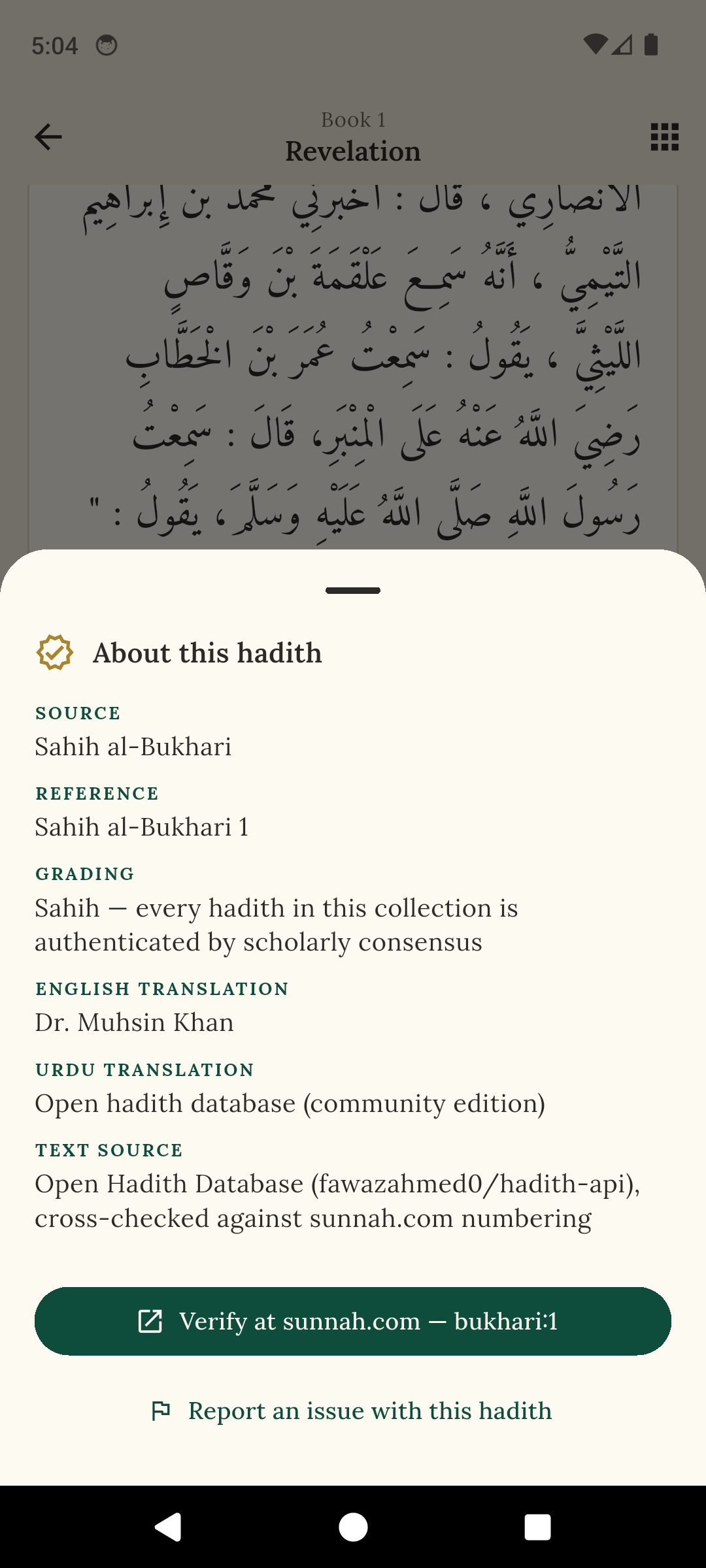
HadithPal is one option, and it is ours. It holds only Sahih al-Bukhari and Sahih Muslim, with Arabic, English (Dr. Muhsin Khan for Bukhari, Abdul Hamid Siddiqui for Muslim) and Urdu, all stored on the phone. Its search box takes a number as well as words: typing 2564 returns 2564 and its lettered entries, and chips filter the results to Bukhari or Muslim. Every hadith has an About this hadith panel listing the source, the reference and the translators, with a button that opens the same hadith on sunnah.com to check it. Its grading line marks every entry Sahih on the standing of the two collections as a whole, not on a named grader per hadith. Its reference numbers follow sunnah.com’s main numbering, so a Vol. reference from the old English edition needs converting first (Step 3), and an Abu Dawud or Tirmidhi reference needs sunnah.com.
If that suits how you read, an offline Sahih hadith reader with number search is on the app page.
This guide explains how hadith are referenced and how scholars grade them. It is general information about using the collections, not a ruling: for any question of practice, ask a qualified scholar.
Next time someone sends you “Bukhari” and a number, run it through Step 2 before you search. Then save the full citation, main reference and in-book reference together, so you never have to hunt for it twice. HadithPal keeps Bukhari and Muslim on your phone, with the main reference on every hadith and a button to open it on sunnah.com.
Common questions
Why does the Bukhari number in my book not match sunnah.com?
Probably because your book uses the English numbering of Dr. Muhsin Khan's translation, which counts hadith per volume and moved some books and hadith around. Sunnah.com keeps that number on each page as the USC-MSA web (English) reference, so Vol. 8, Book 73, Hadith 47 there is Sahih al-Bukhari 6018 in its main numbering.
What does the letter after a Sahih Muslim number mean?
On sunnah.com several entries can share one Sahih Muslim number and are told apart by a letter, so 2564a is followed by 2564b. The letter picks out one entry in the group. A citation that drops it sends you to the group, and you need to read each entry to find the one meant.
How many hadith are in Sahih al-Bukhari?
It depends on who is counting and how. Sunnah.com gives 7,563 including repetitions and around 2,600 without them. Encyclopaedia Britannica says about 7,275, and the introduction to the Muhsin Khan translation says 2,602, or 9,082 with repetition.
Does a reference number mean a hadith is authentic?
No. A reference only says where a narration sits in a collection. Grading is a separate judgement made by scholars, and on sunnah.com many hadith outside Sahih al-Bukhari and Sahih Muslim carry a grade with the grader's name beside it, for example Sahih (Al-Albani).
Photos: Defrino Maasy / Pexels , Pixabay / Pexels