


















































































































































































Can You Carry Over Unused Annual Leave?
When UK holiday can roll into next year: the 4 weeks after sickness or employer failure, the 1.6 weeks your contract controls, and how US states differ.

If you work in the UK, the honest answer is: some of it, sometimes. The first 4 weeks of your statutory 5.6 weeks has to be used inside the leave year unless one of three things went wrong, and the remaining 1.6 weeks (eight days for a five-day week) can roll over only if your contract or a workplace agreement says so. Anything above 28 days is whatever your employer chose to offer. In the US the starting point is that no federal law gives you paid vacation at all, so carry-over is a matter for your employer and your state.
That split is why two colleagues on the same contract can get two different answers from HR in the same week. One was off sick in March. The other never got round to booking.
The short answer, if you work in the UK
Start with the default. Acas’s guidance on carrying over holiday puts it plainly: if there is no relevant agreement, workers must take the 5.6 weeks during the leave year, unless there is a good reason they cannot.
A relevant agreement means a workforce agreement, a collective agreement with a recognised union, or something legally enforceable between you and your employer, which in practice means your contract or the handbook it points to. So the first document to open is not a government page. It is the holiday section of your own contract.
If that section is silent, the statutory rules below apply. A clause letting some days into the next holiday year is normally letting through the 1.6 weeks, plus any extra days your employer gives on top.
Your 5.6 weeks is two allowances stitched together
The 5.6 weeks is built from two separate regulations, and they carry over under different rules.
Regulation 13 of the Working Time Regulations 1998 gives a worker four weeks’ annual leave in each leave year. Regulation 13A adds 1.6 weeks of additional leave, and caps the combined total at 28 days. That cap is why someone working six days a week still gets 28 days, not 33.6.
For a full-time, five-day worker, GOV.UK’s holiday entitlement page translates it into days: at least 28 days a year. Part-timers get the same 5.6 weeks pro rata, so a three-day-a-week worker is owed at least 16.8 days.
The split shows up in pay as well. GOV.UK’s holiday pay guidance says regular-hours workers must be paid at least 4 weeks at their normal rate, which includes regular overtime and commission, and the remaining 1.6 weeks at a basic rate. So the law already treats the two chunks differently. Carry-over is one more place it does.
The 1.6 weeks is the easy one. Regulation 13A(7) says a relevant agreement may let it be carried into the leave year immediately following. Only the next year, mind. A contract cannot use this clause to let you stockpile it indefinitely.
When can the first four weeks roll over?
Read this part slowly. The four weeks can only be taken in the year it is due, says regulation 13(9), with three exceptions written into the same regulation:
- You could not take it because you were on statutory leave, maternity leave being the example Acas gives. You are entitled to carry it into the following leave year.
- You could not take it because you were off sick. You can carry it forward, with a deadline (covered below).
- Your employer failed in its duty around your leave. Then the untaken leave carries forward too.
Being busy is not on that list, and neither is saving days for a big trip next year. A manager who kept saying “not this month” might be, under the third exception.

What counts as an employer stopping you?
The text of regulation 13 on legislation.gov.uk sets out the employer’s side in paragraph (16). The carry-over right kicks in if, in a leave year, the employer fails to give you a reasonable opportunity to take your leave or to encourage you to, or fails to tell you that leave not taken by the end of the year, and which cannot be carried forward, will be lost.
That last part carries weight. An employer who never mentions the year-end deadline is the one in breach, not you. Acas suggests ways an employer can meet the duty: a written policy saying untaken holiday will be lost, reminder emails, raising it in one-to-ones, and a note on the holiday booking form or system. If none of that happened where you work, keep a record of it.
There is a limit. Under paragraph (18), leave carried forward this way cannot be carried beyond the end of the first full leave year in which the employer does meet its duties. To put illustrative dates on it: with an April to March leave year, an employer that sends the warnings and gives a fair chance all through the year starting 1 April 2027 has made 31 March 2028 the last day for the old backlog.
Acas puts the maximum carried over in this situation at 4 weeks for a regular-hours worker.
How long do you get after a long sickness?
Eighteen months, counted from the end of the leave year in which the holiday was earned, not from the day you return to work. That wording in regulation 13(15) catches people out.
An illustration, with dates invented for the example: say your leave year runs January to December and you were signed off from February 2026 until well into 2027. The leave you could not take in 2026 has to be used by the end of June 2028, which is 18 months after 31 December 2026. Come back in late 2027 and assume the clock started then, and you could lose most of it.
Two more points from Acas. The carried amount for regular-hours workers is a maximum of 4 weeks, so the 1.6 weeks is not protected by this rule unless your contract adds it. And Acas’s sick pay guidance confirms you keep building up holiday while off sick, so a long absence leaves a bigger balance than the calendar suggests.
Irregular hours and part-year workers get a wider rule
Workers whose hours change from pay period to pay period, or who have unpaid weeks off during the year, moved onto an accrual system for leave years starting on or after 1 April 2024. The regulation 13 rules above apply to everyone else.
For this group, Acas’s carry-over guidance is more generous in two of the three situations. On long-term sick leave, or where the employer did not let them take their holiday, they can carry over any accrued holiday not taken, up to the full 5.6 weeks rather than 4. The 18-month deadline after sickness is the same. If your hours vary or you have unpaid weeks in the year, check which set of rules your employer is applying, because the gap between them is 1.6 weeks of leave.
Can your employer pay you for the days instead?
Not while you are working there, at least for the statutory 5.6 weeks. Regulation 13(9)(b) says the four weeks may not be replaced by a payment in lieu except where your employment is terminated, and regulation 13A(6) says the same of the 1.6 weeks. An offer to “buy back” untaken days at the end of the year sounds generous. For days your employer gives above the 5.6 weeks it can be agreed, but for the statutory minimum it is not a substitute for time off.
When you do leave, regulation 14 kicks in. Untaken leave for the current year is paid, and paragraph (6) adds that any leave still owed from an earlier year that was carried forward under the sickness, statutory leave or employer-failure rules has to be paid as well. Someone leaving after a long illness can be owed more than one year’s worth.
Which date does your leave year end on?
Not always 31 December. Under regulation 13(3), your leave year starts on whatever date a relevant agreement sets. If nothing sets one, it starts on the day your job started and each anniversary after that.
So someone who started in September with a contract that never mentions a holiday year has a September to August leave year, whatever the HR system assumes. Check, because “use it by the end of the year” means nothing until you know which year.
How the rest of the world handles unused leave
The UK sits somewhere in the middle. Here are the statutory rules elsewhere, as each government’s own pages or statute set them out. Contracts, collective agreements and court rulings can add to them.
| Where | Statutory minimum | What happens to unused statutory leave |
|---|---|---|
| UK (regulations 13 and 13A) | 5.6 weeks, capped at 28 days | 4 weeks lapses at year end except after sickness, statutory leave or employer failure; 1.6 weeks rolls one year if an agreement allows |
| United States (federal) | None | No federal rule; set by employer policy and state law |
| California | None required | Earned vacation cannot be forfeited; a cap on accrual is allowed; unused vacation is paid out on leaving |
| Germany | 24 working days (Mon to Sat) | Under the Act: taken in the calendar year; carried over for urgent business or personal reasons, then used by 31 March |
| Ontario, Canada | 2 weeks, 3 after five years | Must be taken within 10 months of the end of the entitlement year |
| Australia | 4 weeks | Accumulates and rolls over from year to year |
Germany’s Federal Leave Act, section 7, is where the end of March deadline for leftover leave comes from: leave carried over for urgent business or personal reasons has to be granted and taken in the first three months of the following calendar year. The 24 days in section 3 count every day except Sundays and public holidays as a working day, so on a five-day week they come to 20.
Australia sits at the other end. The Fair Work Ombudsman’s annual leave page says leave accumulates gradually and any unused annual leave will roll over from year to year. In Canada, Ontario’s guide to vacation under the Employment Standards Act gives employees 10 months after the end of each entitlement year to take it, and makes scheduling it the employer’s job.
Use it or lose it in the US depends on your state
The US Department of Labor’s vacation leave page is short: the Fair Labor Standards Act does not require payment for time not worked, including vacation, and such benefits are matters of agreement between employer and employee. So at federal level there is no right to vacation and no ban on losing it.
States fill the gap, and California has the clearest published position. The California Labor Commissioner’s vacation FAQ treats earned vacation as wages that vest as you work. A policy that wipes out unused vacation on a set date is, in the FAQ’s words, illegal under California law.
What a California employer can do is cap accrual. The FAQ’s own example is a ceiling of 200 hours: once you reach it, you stop earning more until you take some, which pushes you to use the time without taking away what you have already earned. Calling the bucket PTO instead of vacation makes no difference, and on leaving, Labor Code section 227.3 requires every earned, unused day to be paid at your final rate.
Outside California, read your handbook first and then your own state labor department’s pages, because the California rule is a state rule and travels no further than the state line.
Spending carried days before the deadline
The better move, most of the time, is to skip the carry-over argument and spend the days before they lapse, which starts with the notice rules.

GOV.UK’s guidance on booking time off sets the default notice at twice the length of the leave, plus one day, so four days off means asking at least nine days ahead unless your contract says otherwise. Your employer can refuse a particular date with as much notice as the leave you asked for, plus one day, and can also tell you to take leave on given days, such as over Christmas, with twice as much notice as the leave. Leave a request until the last fortnight and both of those rules start working against you.
Then pick days that stretch furthest. A worked illustration for England and Wales, assuming a handbook deadline of 31 March 2027 for four carried days (your own date and number will differ): GOV.UK lists Good Friday on 26 March 2027 and Easter Monday on 29 March. Book Monday 22 to Thursday 25 March and those four days run from Saturday 20 March to Monday 29 March, ten days in a row, all before the deadline. Expect colleagues to have had the same idea, which is one more reason to ask early.
In HolidayStack, an annual leave planner that stacks bank holidays and weekends, you set your leave balance and any carried-over days when you start, and the leave bar on the home screen shows how many of your days are carried over. The Plan a break screen takes the number of days you want to spend, a minimum break length and optional preferred months, so ticking January, February and March narrows the results to breaks that start or end in those months. Check the last day of anything it offers against your deadline, since a break that starts on 30 March can run into April.
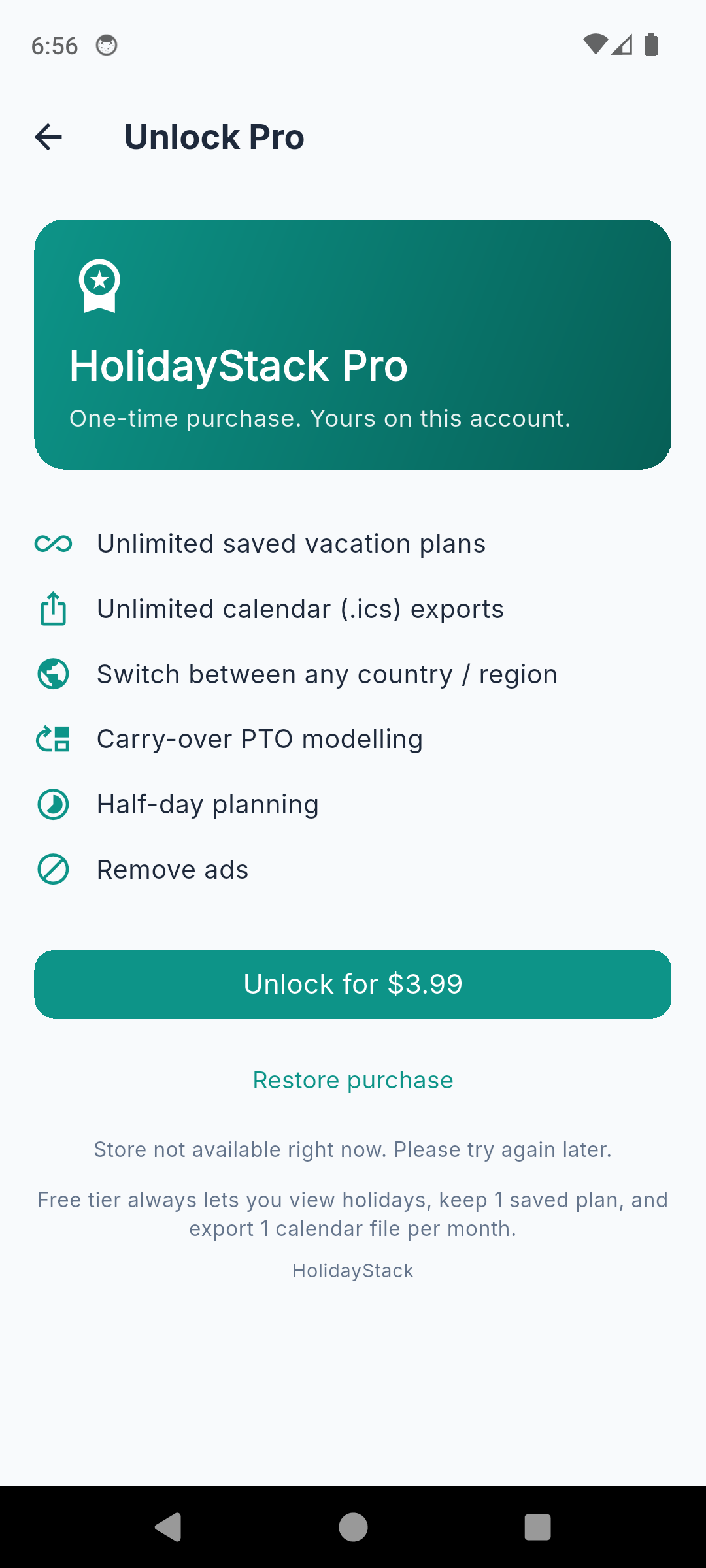
Without the unlock, the app keeps one saved plan and one calendar export a month. The one-time unlock removes both caps, which is where it earns its place here: carried-over days often mean two breaks to juggle, the one that spends them before they lapse and the one you were planning anyway. Mark a saved break as Booked and the app schedules a “Time to book time off” reminder 14 days before it starts, which clears the nine-day notice for a four-day break with time to spare. It does not book anything with your employer; it exports the dates as a .ics file you can send or add to a calendar.
For the wider question of which holidays give the most days off per day of leave across a whole year, the earlier post on how to stack public holidays into longer breaks walks through the arithmetic.
This post is general information about statutory rules, not legal advice. Your contract, a collective agreement or your state’s law can change the answer, so check with your employer, Acas or the relevant labour authority before relying on it. Then open your contract’s holiday section, write down your leave year end and how many days carry over, and put those days into a leave planner that finds the longest breaks while there is still enough notice to book them.
Common questions
Can I carry over annual leave to next year in the UK?
Only part of it, and only in certain cases. The first 4 weeks must normally be taken in the leave year, unless sickness, maternity or other statutory leave stopped you, or your employer did not give you a fair chance to take it or did not warn you it would be lost. The other 1.6 weeks can roll into the next leave year if your contract or a workforce or collective agreement allows it.
How long do I have to use holiday carried over after sick leave?
Under regulation 13(15) of the Working Time Regulations, holiday you could not take because you were off sick can be carried forward if it is used within 18 months of the end of the leave year it was earned in. Acas puts the maximum at 4 weeks for regular-hours workers. Irregular-hours and part-year workers can carry up to 5.6 weeks in the same situation.
Can my employer pay me for unused holiday instead of letting me take it?
Not for the statutory 5.6 weeks while you are still employed. Regulation 13 says the four weeks, and regulation 13A says the extra 1.6 weeks, may not be replaced by a payment in lieu except where employment ends. When you leave, any untaken leave for the year, and any leave you carried forward under the sickness, statutory leave or employer-failure rules, has to be paid.
Is use it or lose it holiday legal?
In the UK, losing untaken statutory leave at the end of the leave year is lawful only if your employer gave you a reasonable chance to take it, encouraged you to and told you it would be lost. In the US there is no federal rule either way, so it depends on the state. California treats earned vacation as wages and calls use it or lose it policies illegal, although a cap on how much you can build up is allowed.
Do bank holidays count towards my 28 days?
They can. GOV.UK says an employer can choose to include bank holidays as part of your statutory annual leave, so a 28-day allowance may already contain the eight bank holidays in England and Wales. Your contract will say whether your days are on top of bank holidays or include them.
Does unused annual leave roll over in Australia?
Yes. The Fair Work Ombudsman says annual leave accumulates through the year and any unused annual leave rolls over from year to year. Full-time and part-time employees get 4 weeks a year based on their ordinary hours.
Photos: RDNE Stock project / Pexels , Ketut Subiyanto / Pexels , Pavel Danilyuk / Pexels