











































































































































































Fire Extinguisher Tags and Labels: What Each One Means
How to read the annual service tag, the punched month and year, the collar on the neck, the six-year label and the hydro stamp, and what each says is due next.
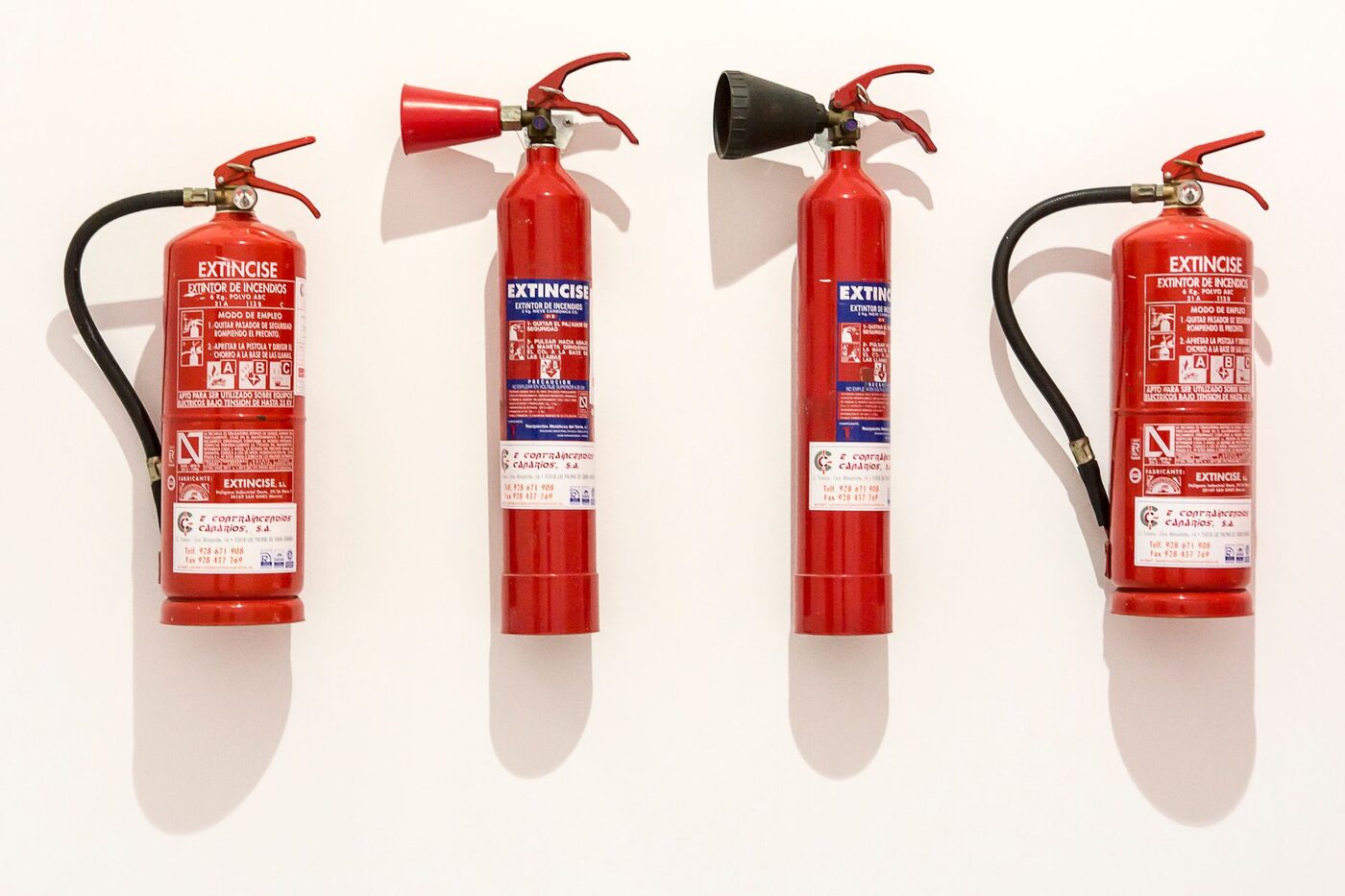
A commercial dry chemical extinguisher can carry five separate service records at once, and each answers a different question. The hanging tag gives its last annual maintenance, and the monthly checks may be logged on it too. The plastic ring around the neck says when it was last opened. A label on the back records its six-year internal examination. A second back label, or a stamp in the metal, dates the last pressure test of the shell. Then there’s the year it was made, which can decide whether it may stay on the wall at all.
Read only the tag and you miss the two dates on the longest clocks, which are the easiest to forget.
Five marks and what each one records
| Mark | Where to look | What it records | When it changes |
|---|---|---|---|
| Annual service tag | Hanging from the neck or handle | Month and year of maintenance, the technician, the company | Every 12 months |
| Monthly inspection record | The tag, a separate label, or a log kept off the cylinder | Month, year and the inspector’s initials | At least once a calendar month |
| Verification-of-service collar | Around the neck, under the valve | Month and year it was opened, the company | Each internal exam, or a recharge with the valve off |
| Six-year internal examination label | Back of the shell | Month and year, technician, company | Every 6 years on stored-pressure types with a 12-year hydro |
| Hydrostatic test label or stamp | Back of the shell, or stamped into the shoulder | Month and year, the tester, the test pressure | Every 5 or 12 years, by type |
The first two say whether the extinguisher is ready today. The other three say whether the cylinder is still fit to hold pressure.
The hanging tag is the annual maintenance record
Once a year a certified technician does what NFPA 10 calls maintenance, and afterwards the extinguisher gets a tag or label saying so. NFPA’s guide to extinguisher inspection, testing and maintenance lists the minimum the tag must identify: the month and year the maintenance was done, the person who did it, and the name of the agency they work for. NFPA’s draft text for the 2026 edition also asks for the agency’s address.
For an employer the tag is also evidence. OSHA’s rule for portable fire extinguishers, 29 CFR 1910.157, says the employer “shall record the annual maintenance date and retain this record for one year after the last entry or the life of the shell, whichever is less.” The same paragraph says stored-pressure extinguishers don’t need an internal examination at the annual, and NFPA’s guide describes the annual as an external examination. So a fresh annual tag on an ABC unit says nothing about the inside of the cylinder.
Reading the punch holes
The date on a tag is punched out, not written in. Florida’s rule asks for the month and year to be shown “by means of perforation so that only the specific month is indicated”. Utah’s state fire marshal wants the year, month and day of service punched “using a hand punch into the tag or sticker”.
Read the punched year, then the month, and add 12 months for the next annual. A tag with a month punched and no year punched tells you nothing, and I’d treat it as no tag at all.
Both states limit a single tag to five service years, so a tag there never shows more than five. Florida goes further and wants a new tag “each time a service is performed”, so a Florida tag with two different years punched suggests it was reused.
What your state may add to the tag
The NFPA minimum stops at the month and year, the technician and the agency. Utah and Florida each ask for more.
Utah’s service tag specification requires tags between 4.5 and 5.5 inches tall, printed with “DO NOT REMOVE BY ORDER OF THE STATE FIRE MARSHAL”, the company’s license number, the technician’s certificate number, and the type of service performed. Tags there “may be any color except RED”; separately, a major deficiency is either written on the tag or flagged with a red tag, or the extinguisher comes out of service.
Florida’s standard service tag rule, 69A-21.241, asks for the extinguisher’s serial number, the servicer’s permit number, the type of extinguisher and the type of service, and the name of the person who did the work. “Initials are not acceptable.” Check that serial against the cylinder. If they differ, the tag was hung on the wrong bottle, or moved.
Where the monthly inspection gets written down
An owner can do the monthly check: NFPA says any knowledgeable, competent person can carry it out, at least once a calendar month and no more than 31 days apart.
Its record doesn’t have to live on the cylinder. NFPA’s guide says it can go on a tag or label, or on paper or electronic files, kept for at least 12 months. The standard asks for the month, the year and the inspector’s initials.
So a blank back on a tag is not proof the checks were skipped. Ask where the log is. If there isn’t one anywhere, that’s the finding.
The plastic ring around the neck
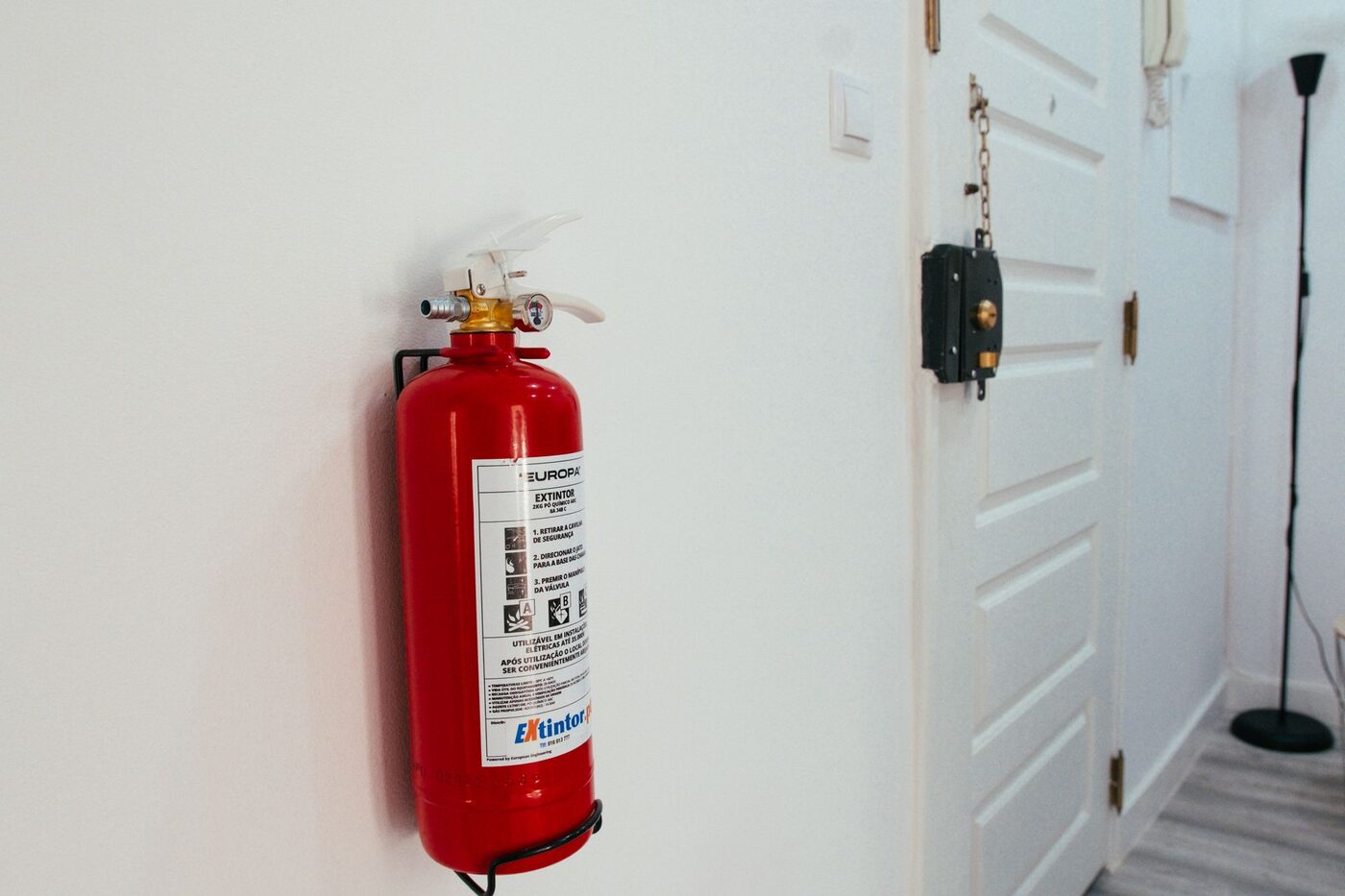
That ring is the verification-of-service collar. In the 2026 draft of NFPA 10 that NFPA published for public comment, the collar has to be “a single circular piece of uninterrupted material” with a hole too small to pass over the neck “unless the valve is completely removed.” So it can’t be slipped on without taking the head off the cylinder, which makes it harder to fake than a tag.
A collar is required after any maintenance that included an internal examination, and after any recharge that needed the valve removed. It shows the month and year and the company. Some don’t need one: cartridge-operated units, and CO2, halon and other liquefied-gas units after a recharge that left the valve on. Florida wants a new collar every time the cylinder is opened and bans any advertising on it.
Compare the collar date with the six-year label. If the collar is newer, the cylinder was opened again since. Under NFPA 10 and OSHA, when the six-year procedures are done during a recharge or a hydro test, the six-year clock restarts from that date.
The six-year label on the back
Every six years, stored-pressure extinguishers that need a 12-year hydrostatic test are emptied and examined inside. That covers the ordinary ABC and BC dry chemical units and halon. When the cylinder passes, NFPA 10 wants a weatherproof label at least 2 by 3.5 inches, applied without heat, that self-destructs if peeled off. It carries the month and year, the technician and the company, and the previous six-year label has to be removed when the new one goes on.
Don’t look for it on the front. NFPA 10 bans six-year labels, hydro labels and hazard labels from the front of the extinguisher, which is kept for the operating instructions. Turn the cylinder around. The full interval rules by agent are in our guide to NFPA 10 extinguisher inspection requirements.
Hydrostatic test labels on low-pressure cylinders
In NFPA 10’s terms a low-pressure cylinder holds its agent or gas at 500 psi or less at 70°F. A typical 5 lb ABC unit sits well under that line: Kidde’s catalog sheet for its Pro 5 MP gives an operating pressure of 195 psi. When one passes its hydro test it gets a label of at least 2 by 3.5 inches showing the punched month and year, the test pressure used, and the name or initials of the tester and the agency. The annex suggests black print on a silver background, and Utah’s sticker rule repeats it.
NFPA 10’s Table 8.3.1 and OSHA’s Table L-1 agree on the common types. Stored-pressure dry chemical in mild steel, brass or aluminum shells and the halon agents run 12 years. Carbon dioxide, wet chemical, water and foam run five. One that catches people out: dry chemical in a stainless steel shell is on the five-year cycle, not twelve.
The retest only has to happen within the calendar year the interval ends, so, for example, a label punched March 2014 on a 12-year unit is good until the end of 2026.
Stamps in the metal on CO2 cylinders
CO2 extinguishers are high-pressure cylinders, over 500 psi, and they are normally stamped rather than labeled. NFPA 10 says the retester’s identification number and the month and year are stamped into the shoulder, top, head, neck or foot ring.
The layout comes from the federal hazmat rules. 49 CFR 180.213, the DOT rule on requalification markings, puts the tester’s four-character RIN in a small square “between the month and year of the requalification date”. Its own example is a cylinder requalified in September 2006 by the holder of RIN A123: a 9, then A123 set as a two-by-two square, then 06. The characters are at least a quarter inch high and the RIN characters at least an eighth.
Earlier marks may not be obliterated except in narrow cases, and the original manufacturing test date always stays, so an older CO2 shoulder carries a row of dates. Count from the latest. The same rule lets a DOT cylinder used as a fire extinguisher carry its marks on a pressure-sensitive label instead.
Finding the year it was made
Kidde’s support page on extinguisher refills says its manufacturing date “can be located on the bottom of the unit (2 digits) or stamped directly into the cylinder (4 digits)”. NFPA 10 requires the owner to be given an instruction manual for the extinguisher, and that manual is where to look when the date isn’t obvious.
Until a cylinder has had its first internal exam and hydro test, the date it was made is the only date to count from.
Dates that mean it has to go
A stored-pressure dry chemical extinguisher with a manufacturing date of 1984 or earlier has to be removed from service, wheeled units excepted. The reason is in the standard’s annex: the 1984 edition of UL 711 set a minimum discharge time of 13 seconds for anything rated 2-A or higher, and before then almost all 2-A dry chemical units emptied in 8 to 10 seconds. NFPA 10 also lists any extinguisher made before 1955 as obsolete.
Disposable units have a hard limit. NFPA 10 says non-rechargeable extinguishers get no six-year exam and no hydro test, and must be removed from service no more than 12 years after the date of manufacture. Kidde’s own advice lines up: if the gauge reads in the green and the manufacture date is less than 12 years ago, the extinguisher is still good.
If the label names carbon tetrachloride or chlorobromomethane, OSHA bans the unit from the workplace outright. And any shell that fails its hydro test, or isn’t fit to be tested, is removed “from service and from the workplace.”
A worked reading, with sample numbers
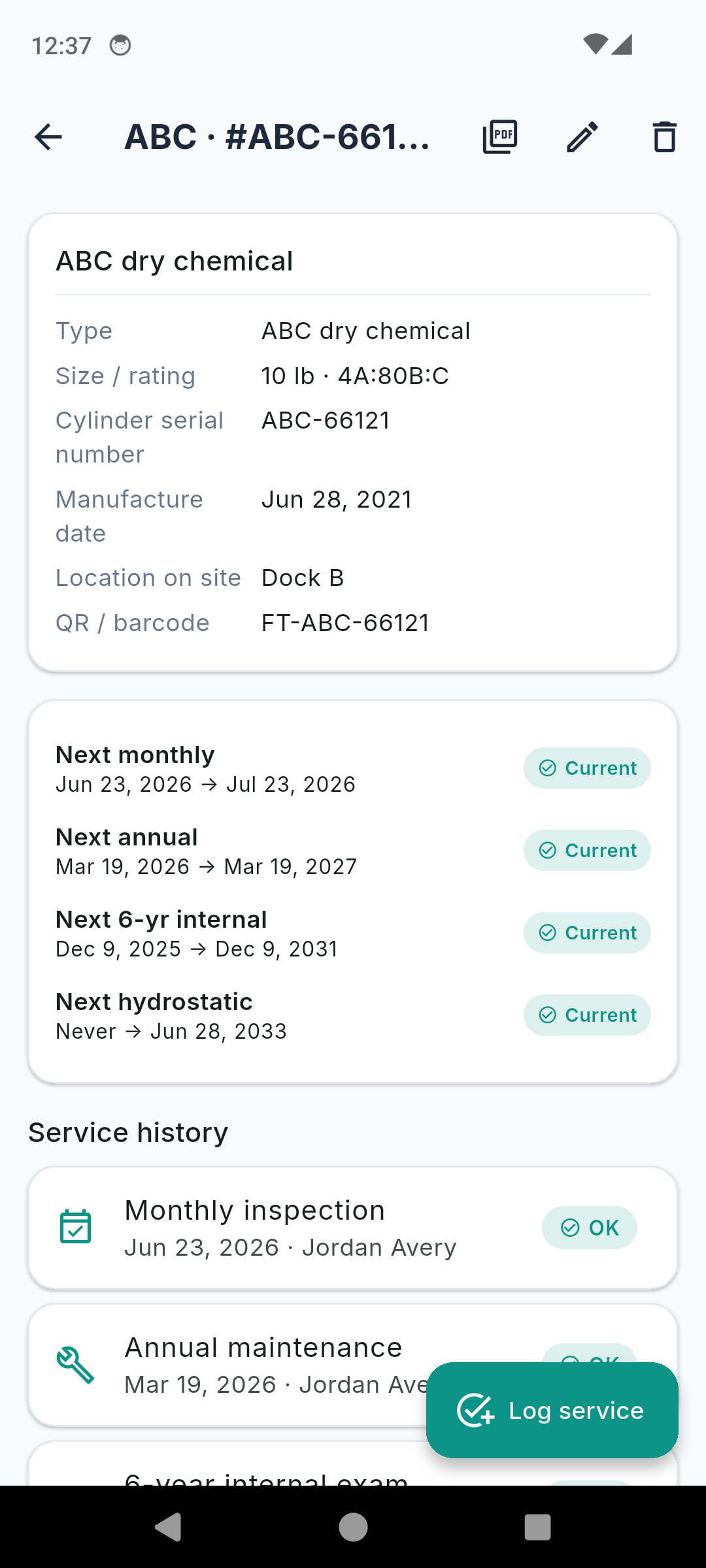
One cylinder, read end to end. The numbers are illustrative, from the sample data in the screenshot below.
| What you find | Reading | What it means next |
|---|---|---|
| Nameplate | 10 lb ABC, 4A:80B:C, made June 2021 | Stored pressure, so a 6-year internal and a 12-year hydro |
| Annual tag | Punched March 2026 | Next annual due March 2027 |
| Collar and six-year label | Both December 2025 | Next internal exam December 2031 |
| Hydro label | None yet | First hydro due in 2033, 12 years from manufacture |
| Monthly record | Initialled June 2026 | Next check within 31 days, and in July |
The cylinder shouldn’t be the only record
Every mark on a cylinder can be lost. Tags tear off, and the six-year label is removed by design each time a new one goes on. NFPA 10’s annex recommends a permanent file record for each extinguisher as well as the tag, holding the maintenance dates, recharges, hydro tests with who did them, any dents left after a hydro, and the six-year date. It also accepts that “an electronic bar coding system is often acceptable to the authority having jurisdiction” in place of a tag for maintenance records.
OSHA separately wants a hydro certification record with the test date, the tester’s signature and the cylinder’s serial number, kept until the next retest.
That file is what an extinguisher inspection log that keeps every cylinder’s dates is for. FireTag stores each cylinder’s type, size and rating, serial, maker, manufacture date, location and a QR or barcode from your own label stock. It logs monthly inspections against a six-item checklist, annual maintenance, internal examinations, hydro tests and recharges, with photos and a signature, and works out the next date on each clock by type: a six-year internal for ABC, BC and halon or clean agent, five years for CO2, Class K and water. NFPA 10 puts foam on a three-year internal, so check a foam unit’s internal date against the standard rather than the water schedule. An unknown type gets monthly and annual dates only, and until a service is logged the long clocks count from the manufacture date.
It produces an Extinguisher Service History PDF for a single cylinder (type, rating, serial, maker, manufacture date and next-due dates, then each event with its date, outcome, technician and notes) and a Fire Extinguisher Service Report for a whole site, one row per cylinder with its next dates and status. The first report is included; after that, reports need the paid tier. Either way it’s a record, not a certification, and says so on every tag and report.
When the marks don’t add up
An annual tag punched this year on a stored-pressure dry chemical unit whose six-year label is more than six years old, with no newer collar, points to an internal exam skipped while the annual tags kept coming. A hydro label whose year plus 5 or 12 is behind you marks an overdue shell. Fresh dents or corrosion trigger a hydro test under OSHA whatever the label says. And NFPA 10 says improperly labeled extinguishers, including those with service labels on the front, are replaced or taken out of service until corrected.
This is general information, not professional or legal advice. States adopt different editions of NFPA 10 and add their own tag rules, so check what applies to your building with your authority having jurisdiction or state fire marshal, and leave maintenance, recharging and hydro testing to certified technicians.
If you service extinguishers, or you’re asked for the records, start keeping each cylinder’s manufacture, collar, six-year and hydro dates somewhere that can’t fall off: FireTag is an extinguisher inspection log built for that job.
Common questions
What do the punched holes on a fire extinguisher tag mean?
They are the date of the last annual maintenance. The technician punches out the month and the year rather than writing them in. Read the punched year first, then the punched month, and add 12 months to get the next annual service.
Where is the hydrostatic test date on a fire extinguisher?
On a low-pressure cylinder (500 psi or less), it is on a label on the back of the shell that shows the punched month and year, the test pressure and who did the test. On a high-pressure cylinder such as CO2, it is stamped into the metal of the shoulder, neck or foot ring as the month, the tester's ID number set in a small square, and the year.
What is the plastic ring around the neck of a fire extinguisher?
It is the verification-of-service collar. NFPA 10 requires one after any maintenance that included an internal examination, or a recharge that needed the valve taken off. It is sized so it can't be fitted or removed without taking the valve off, and it shows the month and year the cylinder was opened and the company that did it.
How do I find out when my fire extinguisher was made?
Check the bottom of the cylinder and the shell itself. Kidde, for example, says its manufacturing date is either two digits on the bottom of the unit or four digits stamped into the cylinder. If you can't find it, the maker's instruction manual for that model will say where it is.
Do fire extinguishers expire?
For rechargeable units, NFPA 10 ties retirement to failed hydrostatic tests and to manufacturing dates: stored-pressure dry chemical units made in 1984 or earlier, and any extinguisher made before 1955, must come out of service. Non-rechargeable (disposable) extinguishers must be removed from service no more than 12 years after the date of manufacture.
Who is allowed to sign the annual maintenance tag?
A certified person. NFPA describes certification as passing a test acceptable to the authority having jurisdiction, and states such as Utah and Florida require a license, certificate or permit number on the tag as well. The monthly inspection is different: any knowledgeable, competent person can do it.
Photos: Jan van der Wolf / Pexels , Jaycee300s / Pexels , Levi Damasceno / Pexels