








































































































































































Does Part 107 Require a Drone Flight Log?
No rule in Part 107 makes you log flights. What 107.7 really asks, the dates and reports that do bind a drone pilot, and where a log pays for itself.
No. Nothing in 14 CFR Part 107 requires a remote pilot to log flights, flight hours or a flight history. The rule has five subparts, from General through Waivers, and none of them creates that duty. The clause people point to, 107.7, only makes you hand over records that some other rule already requires you to keep. There are good reasons to keep a logbook anyway if you fly for money, but they are your client’s reasons and your own, not the FAA’s.
The longer answer is about what Part 107 does put on you, a handful of documents and deadlines that get blurred with a logbook.
What 107.7 says, word for word
Here is the sentence that gets quoted as a logging rule. Under 107.7 in the eCFR, a remote pilot in command, owner or person on the controls must “make available, upon request, to the Administrator any document, record, or report required to be kept under the regulations of this chapter.”
Read the end of that sentence again. Required to be kept under the regulations. The clause does not create a record. It points at records that other rules create, and for a pilot flying ordinary Part 107 operations, no other rule creates a flight log. So there is nothing for it to reach.
Two other parts of the same section do bite. Paragraph (a)(1) says you must have your remote pilot certificate and identification “in that person’s physical possession and readily accessible” while you exercise its privileges. Paragraph (a)(2) lets the FAA, the NTSB, the TSA or any federal, state or local law enforcement officer ask to see them. Paragraph (b) lets the FAA inspect the aircraft and the pilot to check compliance.
That is the whole of it. A certificate in your pocket and an inspection you have to allow.
The papers you carry are not a log
Part 107 asks for a short list of documents instead, and the FAA spells out the registration half on its drone registration page: “You must have your registration certificate (either a paper or digital copy) in your possession when you fly,” and every drone carries its registration number on a label before it flies.
| Record | Required for ordinary Part 107 flying? | Where the rule is |
|---|---|---|
| Remote pilot certificate and photo ID, carried | Yes | 107.7(a)(1) |
| Registration certificate, carried | Yes | FAA registration rules, 107.13 |
| Recurrent training within 24 calendar months | Yes, as recency, not a log | 107.65 |
| Accident report within 10 calendar days | Only after a qualifying event | 107.9 |
| Flight log of times and hours | No | none |
| Maintenance records | Only for Category 4 | 107.140(c) |
The last row is the one that gets left out.
Is there any Part 107 drone that does need records?
Yes, a narrow one. Section 107.140 covers Category 4 operations over people, and an aircraft flying them must “have an airworthiness certificate issued under part 21.” Its owner, or an operator who takes the job on by agreement, must keep records of maintenance, preventive maintenance and alterations, and those records “must contain the description of the work performed, the date the work was completed, and the name of the person who performed the work.”
There is a retention period too. Work records stay for one year after the work, or until it is repeated or superseded. Records of life-limited parts, airworthiness directives and inspection status are kept and transferred with the aircraft when ownership changes. And all of it must be available on request to the FAA or the NTSB.
So if someone tells you Part 107 has a records rule, they are right about one case: an aircraft with a part 21 airworthiness certificate flying over people. Even there the rule covers maintenance and says nothing about flight times.
The date that does run out
Your certificate never expires. Your recency does.
Section 107.65 says you may not act as remote pilot in command unless, “within the previous 24 calendar months,” you passed the initial knowledge test, completed recurrent training, or, as a part 61 pilot with a current flight review, completed the training in 107.74. Since 6 April 2021 the recurrent piece has been training rather than a second test. The FAA’s page on becoming a drone pilot names the courses: ALC-677 for any Part 107 certificate holder, and ALC-515 for remote pilots who also hold a part 61 certificate with a current flight review, both online at no cost.
As an illustration, a pilot who finished ALC-677 on 9 March 2026 is current through 31 March 2028, not 9 March 2028. Count from the day instead of the month end and you will tell yourself you lapsed three weeks early, which costs nothing legally but either three weeks you could have flown or three weeks off your next window.
Whatever the course gives you as proof of completion, with its date, is the record to keep here. No rule says so. It is simply the only proof of the date your recency runs from.
Registration runs on a different clock
Under 48.100 of the federal aviation rules, the registration for a drone flown for anything other than limited recreation “expires 3 years after the date of issue unless it is renewed.” You can renew “at any time within the six months preceding the month in which the Certificate of Aircraft registration expires,” and the renewed certificate “expires three years from the expiration date of the previous certificate.”
That last clause catches people. In an illustrative case, a certificate expiring on 14 August 2027 can be renewed from 1 February 2027, and the renewed certificate runs to 14 August 2030 whatever day in that window you renewed. Work the expiry out from your renewal date and you will be wrong by as much as six and a half months.
One more Part 48 rule, 48.115, gives you 14 calendar days to update the registry when a drone is sold, destroyed or exported, and a crash that writes off the airframe counts as destroyed.
When does a crash become paperwork?
This is the reporting duty Part 107 does impose, and the first place a log pays for itself.
Section 107.9 requires a report to the FAA no later than 10 calendar days after an operation involving serious injury to any person, any loss of consciousness, or damage to property other than the drone. Property damage is reportable unless the repair cost, materials and labor included, is 500 dollars or less, or the fair market value of the property is 500 dollars or less if it is a total loss.
The FAA’s Advisory Circular 107-2A, listed by the FAA as active, fills in both halves. A serious injury is one that “qualifies as Level 3 or higher on the Abbreviated Injury Scale,” and the circular’s example is a person who needs hospitalization but can fully heal: head trauma, broken bones, or a cut that needs stitches. For property it gives two cases, neither reportable: a thing worth 200 dollars that would cost 600 to fix, because its value is under 500, and 200 dollars of damage to a thing worth 600, because the repair is under 500.
The report goes in through FAADroneZone, or by contacting your nearest Flight Standards District Office. The circular lists what it should contain:
- Your name and contact details.
- Your FAA airman certificate number.
- The aircraft’s FAA registration number.
- Where it happened.
- The date.
- The local time.
- Whether anyone was seriously injured or killed.
- What property was damaged, and how badly.
- What happened.
Look at the first six. A routine flight record already holds every one of them before anything goes wrong. The last three are what you write afterwards, ideally that evening rather than on day nine.
Does the NTSB want to hear about a small drone?
Not for damage to the drone itself, and knowing the threshold saves you a call.
The NTSB’s definitions in 49 CFR 830.2 make an unmanned aircraft accident an event where “any person suffers death or serious injury,” or where “the aircraft holds an airworthiness certificate and sustains substantial damage.” A Part 107 drone with no airworthiness certificate never qualifies on damage to itself alone.
The NTSB’s serious injury is also not the FAA’s. It includes hospitalization for more than 48 hours beginning within seven days, any fracture other than a simple one of a finger, toe or nose, and a short list of others such as internal organ injuries and serious burns. Separately, 830.5 lists serious incidents that need immediate notice, and that list is written for every civil aircraft. It includes a collision in flight, a propeller blade, or part of one, coming off in flight, and damage to property other than the aircraft estimated above 25,000 dollars.
When it does apply, it is immediate. The NTSB’s reporting page gives its Response Operations Center number, 844-373-9922, and says a phone call is enough at first, with a written follow-up possibly required. Both reports can be owed for the same event, because they come from different rules.
The report nobody makes you file
There is a third channel. NASA’s Aviation Safety Reporting System takes reports from people who use the airspace and strips out anything that identifies them, except where an accident or a criminal offense is involved, and its program text, reproduced on the ASRS immunity policy page, lists “unmanned aircraft operations” among the operations it covers. There is a dedicated form, 277U, for unmanned operations.
The draw is what the FAA promises in return. If you inadvertently broke a rule, say a brief bust into airspace you had not cleared, the FAA may still find a violation but will impose neither a civil penalty nor a suspension, provided the violation was not deliberate, involved no accident or criminal offense, you have no enforcement finding against you in the previous five years, and you can prove you filed within 10 days.
Prove is the operative word. Keep the receipt with the flight it belongs to. And the program says outright that it “does not eliminate responsibility for reports, narratives, or forms presently required,” so an event that meets 107.9 goes to the FAA as well.
So who asks for the log?
The people paying for the work, or covering it. A client wants hours and dates against an invoice, a site manager wants to know who flew over their roof and when, and an insurer wants the aircraft’s history after a claim. What each of them can demand depends on your contract and your policy wording, so read both. Nothing in federal law sets the format.
The FAA’s own circular makes the safety case. Section 7.3.5 of AC 107-2A says owners and operators “may find recordkeeping to be beneficial,” and that “for operators that rapidly accumulate flight operational hours/cycles, recordkeeping of a small UAS may provide an essential safety support.” With no schedule from the manufacturer, it says, the operator should build one by recording each repair with the time in service at that moment.
That is advice. It is also a fair description of what a working pilot needs.
Batteries are where a log earns its keep
“DO NOT use a battery if it is involved in a crash or heavy impact.” That line, in capitals, is from DJI’s own safety guidelines for the Mini 2 SE. Simple advice, until you are standing in a field with a bag of identical grey packs and a drone that clipped a fence an hour ago. Which ones were in it? Without a record of which packs flew which flight, the honest answer is to retire the lot, and nobody does that.
The same document warns against storing a pack fully discharged for a long time, which can cause “irreparable damage to the battery cell,” and says charging between 22 and 28 degrees Celsius can prolong battery life. AC 107-2A, for its part, notes that manufacturers may set replacement limits by flight hours, cycles or calendar days. The last of those needs a count somebody kept.
What a useful record holds
Strip it to what each of the requests above needs and a Part 107 flight record is short: the date, start and end times, the aircraft and its registration, where you flew, the packs used, any LAANC reference, and a note when something went wrong. Per aircraft, hours to date and the last service. For you, your certificate number and the date your recency runs from.
That is what DroneLog 107 is built around. A flight is started and ended in the app or entered after you land, and you type the location, since the app takes no location permission. Each pack ticked on a flight gains a cycle, so a crash note sits beside the packs that were in it. The incident field names 107.9 and its 10 calendar day window, and states that the app does not decide whether an event is reportable. Flights group into a job, and the job builds one client document in English with your certificate number, each flight’s date, times, location, LAANC reference and packs, the aircraft with its registration and serial, and the incident notes. Its disclaimer says in plain words that Part 107 does not require a flight log.
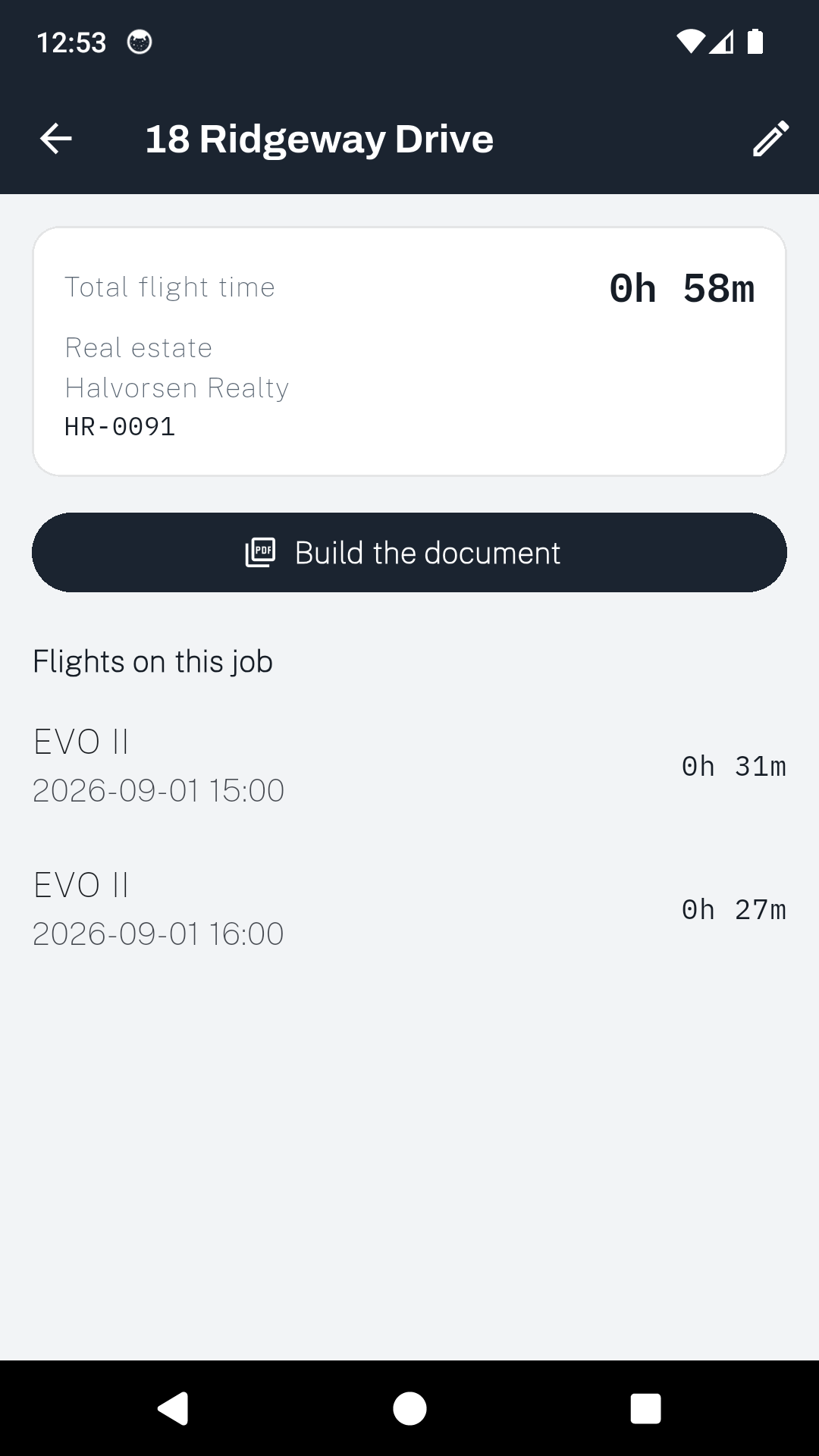
The standard tier holds fifteen flights. The paid plan lifts that cap and puts your flight photos into the client document. If that is the job you need done, the Part 107 flight log that builds the client document is on Android, and nothing you have already recorded is hidden or locked whatever you choose.
Where to start this week
None of this is a legal requirement for ordinary flying, so start with the parts that have a date on them. Put your recency month end and each registration expiry somewhere you will see them. Write down the hours already on each airframe and the cycles already on each pack, because a log that starts at zero on a drone with seasons behind it tells an insurer nothing true. Then log the next flight before you fold the props, packs included.
This is general information about the federal rules as published on the date above, not legal advice. Rules and FAA guidance change, waivers and contracts add their own conditions, and the FAA is the authority on what applies to your operation, so verify with the FAA before you rely on any of it.
When you are ready to keep the record on your phone, DroneLog 107 holds the flights, packs, airframe hours and both dates in one place.
Common questions
Do I have to show the FAA my drone flight log?
Only if some rule required you to keep it. Section 107.7 lets the FAA ask for any record required to be kept under its regulations, and no Part 107 rule requires a flight log, so for ordinary operations there is nothing for that clause to reach. You do have to carry your remote pilot certificate and photo ID, and your registration certificate, whenever you fly under Part 107.
Does my Part 107 certificate expire?
No. The remote pilot certificate does not expire. What lapses is aeronautical knowledge recency under 107.65, which needs the initial test or recurrent training within the previous 24 calendar months. The FAA's recurrent course for most remote pilots is ALC-677, taken online at no cost.
How long should I keep drone flight records?
Part 107 sets a retention period only for Category 4 operations over people, where maintenance records are kept for one year after the work, and records of life-limited parts, airworthiness directives and inspection status go with the aircraft when it is sold. For everyone else there is no federal period, so the contracts and the insurance policy you work under are the things to read.
Do I have to report a crash that only damaged my drone?
Not under 107.9. The FAA report is triggered by a serious injury, a loss of consciousness, or damage over 500 dollars to property other than the drone itself. The NTSB definition of an unmanned aircraft accident covers death or serious injury, and damage to the aircraft only when it holds an airworthiness certificate, which Part 107 requires only for Category 4 operations over people. A short list of serious incidents, such as a collision in flight, needs immediate NTSB notice whatever the damage.
Is a NASA ASRS report the same as reporting to the FAA?
No. An ASRS report is voluntary and confidential, and the program says plainly that it does not replace reports required by existing rules. Its protection from a civil penalty or suspension also excludes accidents, so a crash that meets 107.9 goes to the FAA within 10 calendar days regardless.
Photos: JESHOOTS.com / Pexels , Magda Ehlers / Pexels , cottonbro studio / Pexels