





































































































































































Homeschool Hours Requirements by State, Read From the Law
Homeschool hours required by state, from the statutes: 180 days or 900 hours in Pennsylvania, 1,000 in Missouri, 4 a day in Tennessee, none in Florida.

In the eight states read for this guide, the answer runs from no hours at all to 1,000. Pennsylvania asks for 180 days or 900 hours a year at the elementary level and 990 at the secondary level. New York wants 900 hours for grades 1 through 6 and 990 for grades 7 through 12. Missouri wants 1,000, with 600 in core subjects. Tennessee and North Dakota count four hours a day for 180 and 175 days. Florida and Texas set no hour count at all.
The details below come from the statutes and education department pages, because figures copied from site to site go stale.
The shapes an hours rule takes
Before the states, look at the shapes. Among these eight, a law counts hours only (Missouri), days or hours at your choice (Pennsylvania), days and hours together (New York), hours per day times days (Tennessee, North Dakota), an average borrowed from the private school rules (Washington), or nothing at all (Florida, Texas). Each shape changes what your log needs to show.
A days-or-hours rule like Pennsylvania’s means a parent who schools 180 days never has to total a single hour. A days-and-hours rule like New York’s means both numbers matter. A per-day rule like Tennessee’s means a short day may not count as a day. And a law with no number, like Florida’s, can want a written log all the same, which surprises people.
NCES puts the share of US students who were homeschooled at 1.7 percent in 1999 and 3.4 percent in 2012, and says the 2019 rate was lower than 2012’s.
The eight states at a glance
| State | What the law counts | What you keep or send | Where it says so |
|---|---|---|---|
| Pennsylvania | 180 days, or 900 hours (elementary) / 990 (secondary) | Portfolio with a contemporaneous log; evaluator certification by June 30 | 24 P.S. 13-1327.1 |
| New York | Substantial equivalent of 180 days, and 900 hours (grades 1 to 6) / 990 (grades 7 to 12) | Attendance records; hours in each quarterly report | 8 NYCRR 100.10 |
| Missouri | 1,000 hours, 600 core, 400 of the core at home | Plan book or diary, work samples, record of evaluations | RSMo 167.012 |
| Washington | Hours equal to private school program hours (180 days or a 1,000-hour average) | Declaration by September 15; annual test or assessment | RCW 28A.225.010, 28A.195.010, 28A.200.010 |
| Tennessee (independent home school) | 4 hours a day, 180 days | Attendance records to the district at year end | Tenn. Code Ann. 49-6-3050; TDOE guidance |
| North Dakota | 4 hours a day, 175 days | Annual record of courses and assessments | NDCC 15.1-23-04, -05 |
| Florida | No hour or day count | Portfolio with a contemporaneous log, kept 2 years | Fla. Stat. 1002.41 |
| Texas | No hour or day count | No state filing | TEA guidance |
Pennsylvania: 180 days or 900 hours, and a log written as you go
The Pennsylvania home education statute, section 1327.1 of the Public School Code, gives you a choice: a minimum of 180 days of instruction, or 900 hours a year at the elementary level, or 990 at the secondary level.
Run the arithmetic and the choice gets clearer. 900 hours over 180 days is 5 hours a day, and 990 is 5.5. The hour route suits a family that schools long days on fewer of them.
The part that catches people is the portfolio. The law says it “shall consist of a log, made contemporaneously with the instruction, which designates by title the reading materials used”, plus samples of writings, worksheets, workbooks or creative materials, plus test results in grades 3, 5 and 8. Contemporaneously means at the time. A log rebuilt in May from memory is the thing the word was written to exclude.
At the end of the year an evaluator (a licensed psychologist, a certified teacher, or a qualifying nonpublic school teacher or administrator) interviews the child, reviews the portfolio, and certifies whether an appropriate education is occurring. You hand that certification to the district superintendent by June 30. The affidavit for the next year is due August 1.
New York: hours reported four times a year
New York is the state where hours stop being a private record. Under New York’s home instruction regulation, 8 NYCRR 100.10, “the substantial equivalent of 180 days of instruction shall be provided each school year”, and the cumulative hours are 900 a year for grades 1 through 6 and 990 for grades 7 through 12.
Then come the quarterly reports. Each one carries the number of hours of instruction during the quarter, a description of the material covered in each subject, a grade or a written narrative, and a written explanation if less than 80 percent of the planned material in any subject was covered. The annual assessment goes in with the fourth report.
Attendance records stay with the parent but must be made available to the school district on request. So a New York log has to answer two questions at any moment: how many days, and how many hours this quarter.
Missouri: 1,000 hours, and 400 of them at home
Missouri’s numbers are the most layered. Missouri’s home school section, RSMo 167.012, says the parent shall offer at least 1,000 hours of instruction, at least 600 of which are in reading, language arts, mathematics, social studies, science, or related academic courses. At least 400 of those 600 must happen at the regular home school location.
As arithmetic: up to 200 core hours can happen away from home, at a co-op or a library, and the remaining 400 hours of instruction carry no subject or location rule in that section.
The records are a plan book, diary, or other written record of subjects taught and activities, a portfolio of work samples, and a record of evaluations, or other credible evidence equal to those. Two more lines in that section matter more than they look. A daily log showing a qualifying course of instruction is a defense to prosecution under the attendance law and to an educational neglect charge. And the records are subject to review only by the local prosecuting attorney, not the school district.
The rules stop at 16: subsection 2 does not apply to any pupil sixteen years of age or older.
Section 167.012 does not say over what period the 1,000 hours run. The attendance section next to it, 167.031, defines the year: “A school year begins on the first day of July and ends on the thirtieth day of June following.” A log that totals from July 1 to June 30 lines up with that definition, where a September to June total would not.
Washington: an average borrowed from private schools
Washington never writes an hour figure into its home-based instruction rule. RCW 28A.225.010 describes home-based instruction as planned and supervised instructional and related educational activities, provided for a number of hours equivalent to the program hours set for approved private schools.
Follow that reference to RCW 28A.195.010 and you find the private school rule: no less than 180 school days or the equivalent in hours, with a school-wide annual average of 1,000 hours for grades 1 through 12 and at least 450 for kindergarten. Under RCW 28A.200.010 the parent also files a declaration of intent by September 15 and arranges an annual standardized test or a written assessment by a certificated person, which becomes part of the child’s permanent records.
That phrase “related educational activities” is wider than the wording in the other seven laws here, and it is the closest any of these laws comes to answering whether a museum visit counts.
Tennessee and North Dakota: hours a day, times days a year
Tennessee states it in one line. The Tennessee Department of Education’s independent home school requirements, revised June 2026, set the rule for an independent home school: students “must receive a minimum of four (4) hours of instruction per day for 180 days per school year.” Attendance records go to the director of schools (or designee) at the end of each school year and can be inspected at any time. Students in grades 5, 7 and 9 take a standardized test, and a fresh notice of intent goes in before each school year.
North Dakota is close. North Dakota’s home education chapter, NDCC 15.1-23, requires “at least four hours each day for a minimum of one hundred seventy-five days each year.” The parent keeps an annual record of courses and academic progress assessments and hands it over on request if the child transfers to a public school district.
Multiply them out and Tennessee’s floor is 720 hours and North Dakota’s is 700. Both are lower totals than Pennsylvania’s or New York’s, but on a plain reading neither lets you bank, for example, a 7-hour Monday against a 1-hour Friday. A per-day rule is a rule about every day.
Florida and Texas: no hour count, though Florida wants a log

Florida drops the count entirely. Florida’s home education statute, section 1002.41, says a home education program “shall be excluded from meeting the requirements of a school day.” No hours, no days.
Yet the log survives. The portfolio holds “a log of educational activities that is made contemporaneously with the instruction and that designates by title any reading materials used,” plus samples of the student’s work. You preserve it for 2 years and show it to the district superintendent if asked, on 15 days’ written notice. There is an annual educational evaluation too, by a Florida-certified teacher’s review of the portfolio, a nationally normed test, a state assessment, a licensed psychologist, or another tool the superintendent agrees to.
Texas sits at the far end. The Texas Education Agency’s home schooling page says the agency “does not regulate, index, monitor, approve, register, or accredit” home school programs. The one content requirement it names is a course of study that includes good citizenship.
What counts as an hour?
Not one of these eight laws defines an hour of instruction minute by minute. New York says “cumulative hours of instruction”. Missouri ties its 600 to named subjects “consonant with the child’s age and ability”. Washington’s wording, quoted above, is the broadest.
So the definition is yours, and the risk is inconsistency rather than strictness. A workable rule: time spent on a planned learning task counts, at the length it took, and breaks and lunch do not. Read-aloud can count as reading. A cooking lesson can count as math if fractions were the point. Write the rule in the front of your records in September and follow it all year. An evaluator or a district asking questions in June will care far more that your method is steady than that it is generous.
Log in minutes, not rounded hours. Twenty-five minutes of spelling rounds to nothing in an hour-based log, yet as an illustration, 25 minutes on each of 180 days is 75 hours.
Logging so the count survives a question
Pennsylvania and Florida both use the word contemporaneously, and Missouri treats a daily log as a defense. Between them they describe the habit that holds up: write it down the same day, by subject, and name the material.
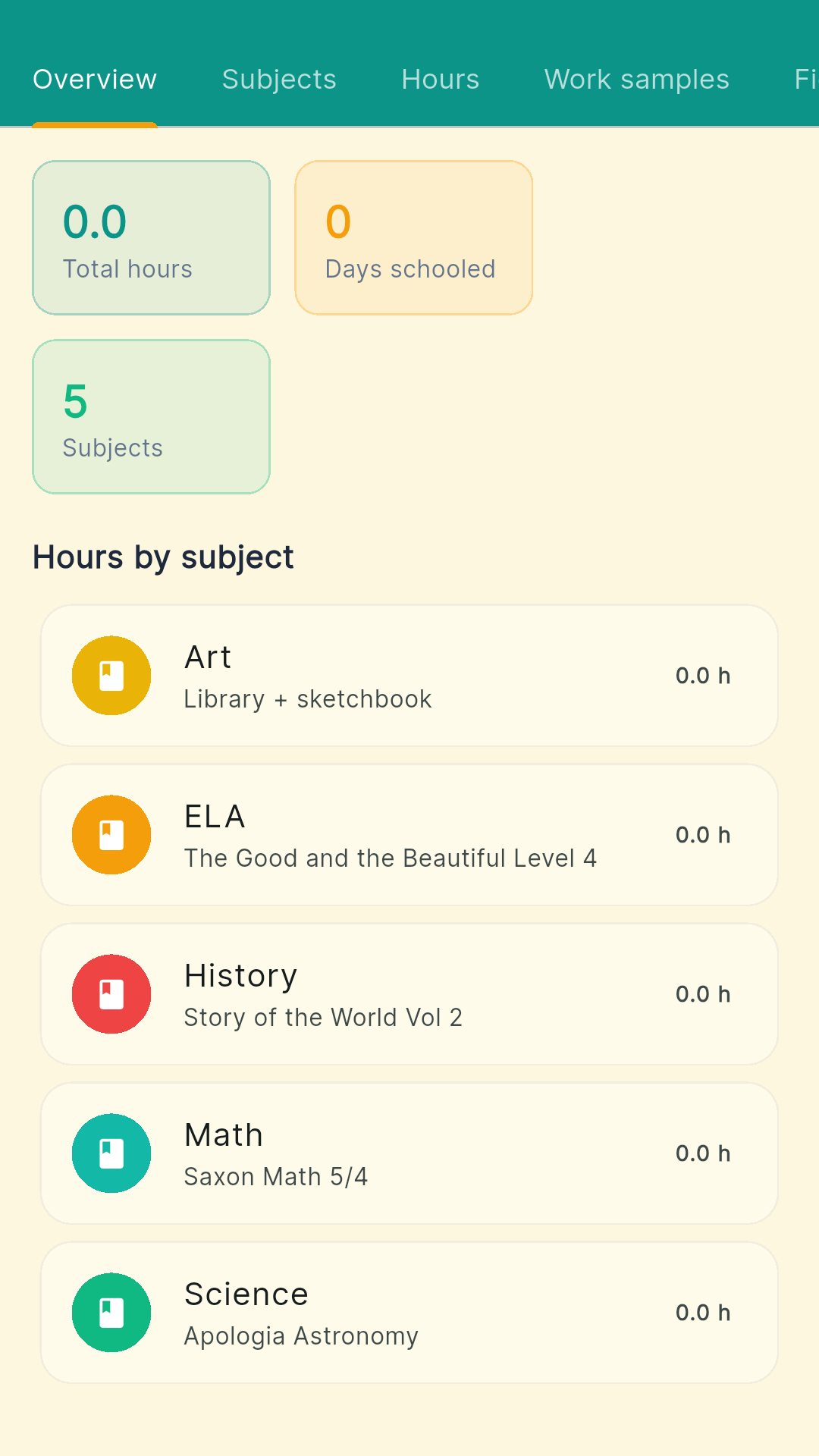
This is where a homeschool hours log that totals by subject and builds the year-end records saves the June scramble. In HomeschoolBook each child has their own subjects, each with the curriculum you name (Saxon Math 5/4, say). You log time by tapping 15, 30, 45, 60, 90 or 120 minutes or typing your own, and the date can be set back if you are catching up last night’s entry. There is a notes line on every entry, which is the place for a book title if your state wants reading materials named. Any day with logged time counts as a day schooled, so the day total and the hour total come from the same entries and cannot disagree.
Each child carries a school year start and end date, and the totals on their overview count inside that window. Set it to match your state. A Missouri family might use July 1 to June 30, the school year section 167.031 defines.
At the end of the year the Pro tier builds the annual records PDF for one child: days schooled and total hours, an hours-by-subject table with the curriculum beside each subject, the field trip list, up to 12 work sample photos with their dates, and a signature and date line. Every page carries a footer saying the document is the parent’s personal record and not a state-compliant submission. For a New York quarterly report, the CSV export gives you four columns, date, subject, minutes and notes, to total by quarter.
Two gaps to cover by hand
Field trips are logged as their own records with their own hours, and the year total counts subject hours alone. If a museum morning belongs in your hours, log its time against a subject as well.
Entries also have no location field. A Missouri family tracking the 400 core hours at the home location should write the place in the entry notes on days spent at a co-op or library, so the split can be totaled from the CSV later.
And the app will not tell you whether you are on track for your state, because it stores no state rules at all. Its state information screen links out to the education department site for all 50 states and DC, and your statute is the thing to compare your totals against.
The rules move, so check each summer
Missouri’s home school section comes from a 2024 law and was amended again in 2025. Tennessee’s requirements sheet carries a June 2026 revision date. Any number above can change in a single legislative session, and a blog post (this one included) is always a step behind the statute.
August is the natural time to check, since Pennsylvania’s affidavit is due August 1 and Washington’s declaration by September 15. Open your state’s statute or education department page, read the current hour and day rule, and set your log up to answer it before the first lesson.
This is general information, not legal advice. Homeschool law differs by state and changes. Confirm what applies to your family with your state department of education or the statute, and with your school district where it handles filings.
If your state counts hours or days, start the log on the first day of the school year rather than the first time someone asks for it. A minute-level, same-day record by subject answers every version of the rule in this guide, and HomeschoolBook keeps that record per child and turns it into a year-end PDF when June comes.
Common questions
Do I have to log hours if my state counts days instead?
It depends on the state. Pennsylvania lets you meet its rule with 180 days or with 900 hours at the elementary level and 990 at the secondary level, so a day count alone can do the job there. New York asks for both the substantial equivalent of 180 days and 900 or 990 cumulative hours, and its quarterly reports ask for the hours. A log kept in minutes can produce both totals, since every day with logged time is also a day schooled.
How long do I have to keep homeschool records?
Florida is the clearest: the portfolio is preserved for 2 years and shown to the district superintendent, if requested, on 15 days' written notice. Washington makes the annual test or assessment part of the child's permanent records. Many statutes name no period at all, so keeping every year until the child graduates is the safe habit.
Do field trips count toward homeschool hours?
Most statutes do not say. Washington describes home-based instruction as planned and supervised instructional and related educational activities, which reads broadly, while Missouri counts its 600 core hours only in named academic subjects or courses related to them. Decide your rule at the start of the year and apply it the same way every time.
Do I send my hours log to the state?
Usually not the log itself. New York parents report the number of hours in each quarterly report, and Tennessee parents submit attendance records to the district at the end of each school year. In Pennsylvania the evaluator reviews the portfolio and the parent sends the evaluator's certification by June 30. Missouri records are subject to review only by the local prosecuting attorney.
Does Missouri's 1,000-hour rule apply to a 16-year-old?
No. Section 167.012 says the record and hour requirements in its subsection 2 do not apply to any pupil sixteen years of age or older. Logging past 16 is worth keeping up if the same hours will feed a high school transcript.
Photos: Nicola Barts / Pexels , Towfiqu barbhuiya / Pexels , photoGraph / Pexels