











































































































































































How to Set Up a Running Shoe Rotation
A step-by-step way to build a running shoe rotation: which second pair to buy, what each pair is for, how to stagger their ages and when to retire one.
Recreational runners who used more than one pair of shoes had a lower risk of running injury than runners who used a single pair. That comes from a 2015 study by researchers in Luxembourg who followed 264 runners for 22 weeks, and it is the reason “rotate your shoes” now turns up so often in running advice. What the advice usually skips is how to do it: which pair to buy second, what each one is for, and how to stop a rotation turning into a pile of half-dead shoes by the front door.
What the study found, and what it did not
The research, published in the Scandinavian Journal of Medicine and Science in Sports, asked recreational runners to log every session, every other sport and every injury on a website for 22 weeks. An injury counted if it was pain in the legs or lower back caused by running that stopped a planned run for at least one day. A third of the group, 87 runners, picked one up.
After adjusting for other factors, using more than one pair at the same time came out as protective, with a hazard ratio of 0.614. In plain terms, the multi-shoe runners were injured at about a 39% lower rate over the study period. A previous injury pushed risk the other way, with a hazard ratio of 1.722. You can read the abstract on PubMed.
It was one observational study, so it shows an association, not proof. Runners who own several pairs may simply be more careful in other ways. The authors’ own explanation was variety: different shoes, and other sports, load your legs in slightly different ways. That is the clue for building a rotation: aim for difference, not duplication.
Step 1: Start with the pair you already run in
You do not need to buy two pairs at once. The pair you already own is the first shoe in the rotation, and the useful thing to know about it is how many miles it has done.
If you have never counted, estimate. Take your usual weekly distance and multiply it by the weeks since you bought them. Twenty miles a week for five months is around 430 miles (about 690 km), which puts the shoe inside the range where most guidance says to replace it. That number decides what you buy next. A shoe near the end of its life should be replaced soon, so your second pair is its successor. A shoe with 100 miles on it can stay as your main trainer while the second pair takes a different job.
Step 2: Make the second pair different on purpose
Many runners start a rotation by buying a second pair of the model they love, and it gives you the least variety.
Pick a second shoe that differs in one or two clear ways. A firmer, lighter shoe if your main pair is soft and high-stacked. A different heel to toe drop. A trail shoe if you sometimes run on grass or gravel. You want a second shoe that feels distinctly different on the same route.
Expect the second pair to start out feeling odd. Run your first two or three outings in it on easy days and short distances, not on your long run.
Step 3: Give each pair a job
A rotation without rules drifts. You reach for the comfiest pair every morning and the other one gathers dust. Giving each shoe a job fixes that.
A simple two-pair split for a runner doing four or five days a week:
- The cushioned pair takes the long run and most easy runs.
- The lighter pair takes the faster sessions and one or two easy runs, so it still gets regular use.
A third pair might take trails or wet days. The detail matters less than deciding once and sticking to it. Alternating day by day works too, as long as no pair sits unworn for a fortnight.

Step 4: Stagger the ages
If every pair in your rotation was bought in the same month, they all wear out in the same month, and you are back to buying two or three pairs at once. Staggering keeps one fairly fresh pair in the mix at all times.
The cushioning figures explain why. In a 1985 study published in the American Journal of Sports Medicine, Cook, Kester and Brunet tested running shoes on a machine that simulated heel strikes. The shoes kept close to 75% of their initial shock absorption after 50 miles and about 67% after 100 to 150 miles, and between 250 and 500 miles they were below 60%. Shoes worn by real runners lost less, keeping around 70% at 500 miles. They also found no difference by price or by manufacturer model. You can read that abstract on PubMed too.
So a shoe loses a lot of cushioning early and then declines more slowly. Foams have changed since 1985, but the pattern is a fair guide, and a pair at 80 miles feels different from one at 380. Aim to buy your next pair when the oldest one in the rotation is about two thirds of the way to the mileage you plan to retire it at.
Step 5: Log every run against the pair you wore
This is where most rotations fall apart. With three pairs, you cannot remember which one did Tuesday’s six miles, and the guesses compound until every pair is “about 300, probably”. The fix is boring and it works: after each run, put the distance against the shoe you wore. A notebook does it. So does a spreadsheet, if you will open it.
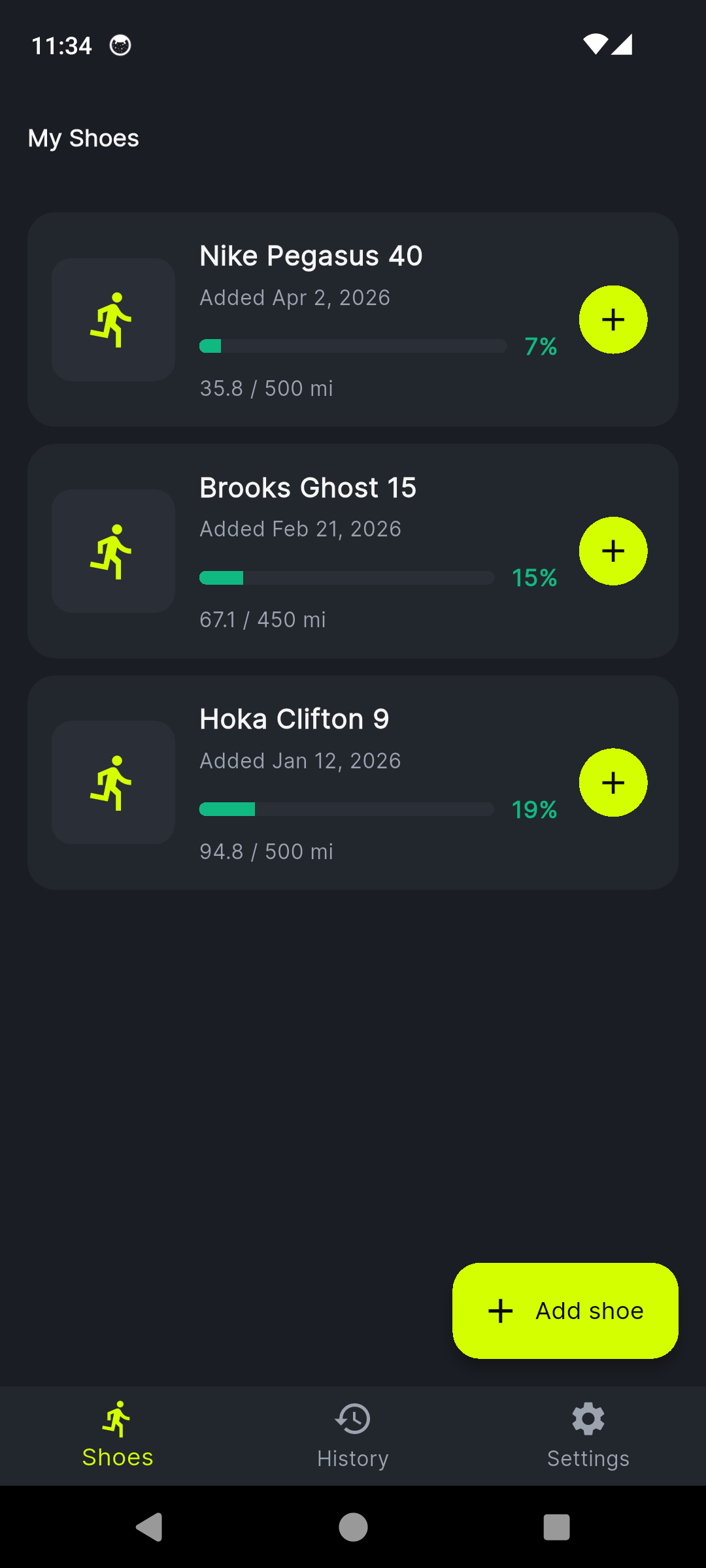
We built ShoeMile to do this. Each pair gets its own wear bar, which fills from green towards red as the miles add up. You tap the pair you wore and slide in the distance, or you track the run with GPS and the miles go to that shoe when you finish. Only the distance is kept, never the route. When you add a pair you have been running in for months, there is a field for the miles already on it, so you do not have to type every past run. The app tracks two active pairs as standard, and a rotation of three or more needs the one-time unlock.
Step 6: Retire on a number you set, then check it
The American Academy of Podiatric Sports Medicine puts the typical replacement point at 350 to 500 miles, about 560 to 800 km, and says heavier runners and hard foot strikers belong at the 350 end. Running surface and the type of foam matter as well, so treat the range as a place to start, not a verdict. Set a target for each pair. As an example, a light racing shoe might get 250 and a heavier daily trainer 500.
When a pair reaches its target, do the thumb and wrinkle check described in our guide on when to replace running shoes. If it still feels lively and nothing aches, give it another 50 miles and check again. If it feels flat, retire it, even if the number says it has more in it.
ShoeMile handles this with a target lifespan per pair, which defaults to 500 miles. When a shoe reaches it, the app says so and offers to retire it or extend it by 50 miles. It also projects a retirement date from your average weekly miles on that pair, which gives you a rough date to start shopping for the next one. Retired pairs move to History, so after a year you can compare how many miles each model lasted for you. That is a better guide than any general range.
When a rotation is not worth the bother
If you run twice a week, a second pair means each shoe gets worn once a week at most, and you will take years to put real miles on either. You also lose the main practical gain, which is a pair that has had a few days off before every run. One good pair, replaced on time, is the sensible setup at low mileage.
The same applies if money is tight. A single pair that you retire at the right mileage beats three pairs you run into the ground. The rotation is a refinement, and getting the replacement timing right matters more.
This article is general information, not medical advice. If you have pain that keeps coming back, see a physiotherapist or sports medicine doctor before changing your shoes or training.
Common questions
How many pairs of running shoes should be in a rotation?
Two is enough to start, and the injury study most people quote compared one pair against more than one. Three makes sense once you run five or more days a week or have a clear split between easy runs, fast sessions and trails. Past four, it gets hard to wear every pair often enough for it to earn its place.
Should the shoes in a rotation be different models?
Yes, if you can. The researchers behind the 2015 rotation study suggested the benefit may come from varying the load on your legs, and two identical pairs vary it very little. A second pair with a different midsole, drop or weight gives your legs something different to do.
Does rotating shoes make each pair last longer?
Each pair lasts longer in calendar time, because it carries only part of your weekly mileage. Whether each pair delivers more total miles is less clear, so judge each one by its own mileage and how it feels rather than by how long you have owned it.
Photos: Mikhail Nilov / Pexels , Alex Kinkate / Pexels