













































































































































































Which Supplements Should Not Be Taken Together?
Calcium and iron, iron and zinc, zinc and copper, vitamin E and blood thinners: the supplement pairs with real numbers behind them, and how to space them.
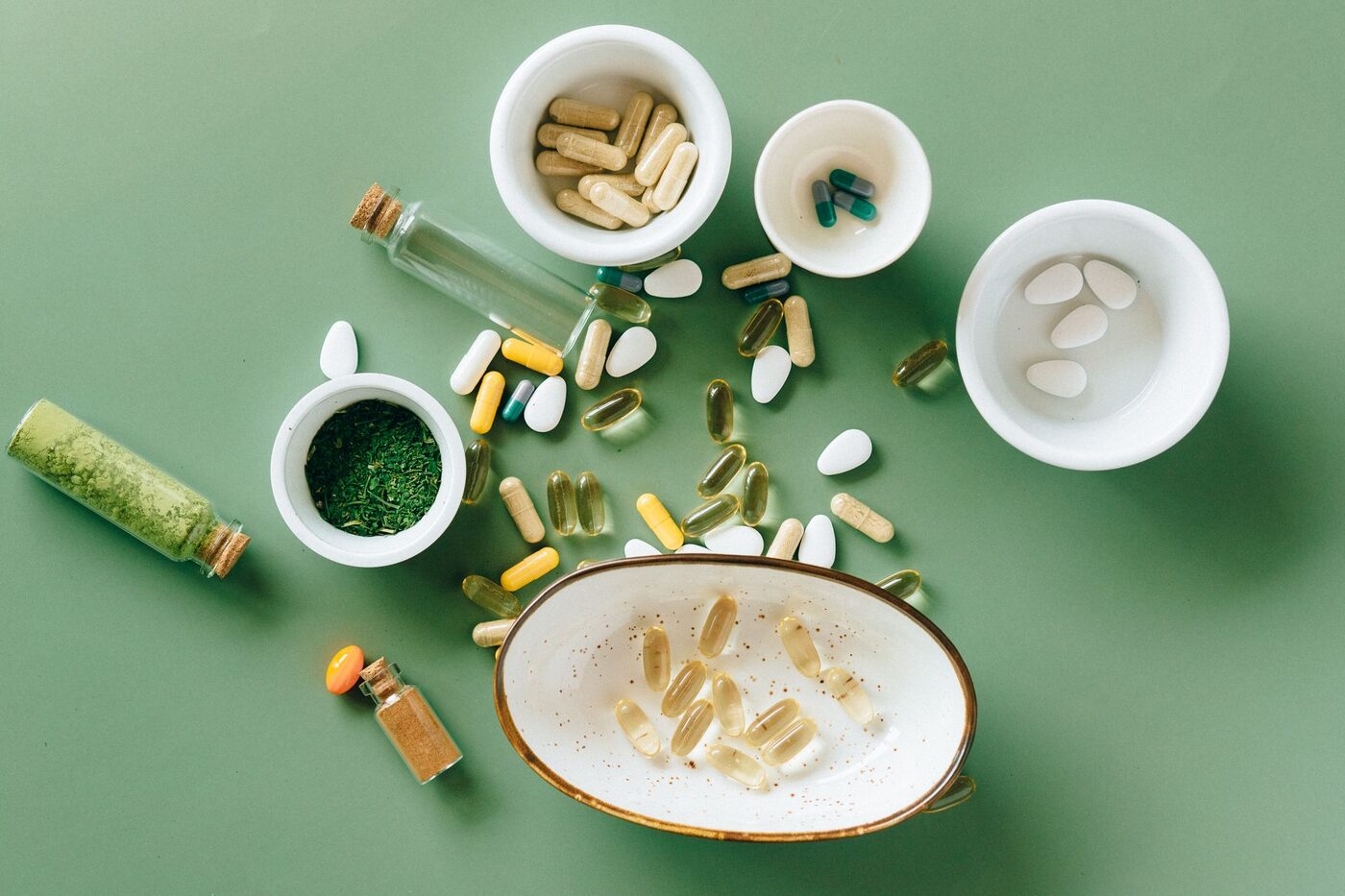
Four supplement pairings are worth planning around, and three of them have a measured dose behind them. Calcium and iron, taken in the same sitting. Iron at 25 mg or more taken with zinc. Zinc at 50 mg or more for weeks, which drains copper. And vitamin E alongside anything else that thins the blood, ginkgo and aspirin included. Most of the rest of the “never mix these” lists that circulate online is either a high-dose effect stretched to cover normal doses or a pairing nobody has put a number on.
That gap counts for more once the bottles pile up. The CDC’s data brief on dietary supplement use among US adults found that in 2017 to 2018, 13.8% of adults had taken four or more supplements in the previous 30 days, rising to 24.9% of those aged 60 and over. Four bottles is enough for a clash to sit in your kitchen unnoticed.
The pairs, with the numbers that matter
| Pair | What happens | Where it starts | What to do |
|---|---|---|---|
| Calcium and iron | Calcium lowers iron absorption | 300 to 600 mg calcium with food in studies; about 800 mg on an empty stomach in a 2011 study | Different times of day |
| Iron and zinc | Iron lowers zinc absorption | 25 mg elemental iron or more, taken at the same time | Separate time slots |
| Zinc and copper | Zinc blocks copper uptake over time | 50 mg zinc or more, for weeks | Keep the daily zinc total down |
| Zinc and magnesium | Zinc disturbs magnesium balance | 142 mg zinc a day in one study | Rarely relevant at label doses |
| Vitamin E and blood thinners | Added bleeding risk | Large vitamin E doses with ginkgo, aspirin or warfarin | Tell your pharmacist |
| Folic acid and B12 | Folic acid can hide a B12 shortfall | Above 1,000 mcg folic acid a day | Watch the total, not the timing |
| Vitamin C and iron | Vitamin C helps iron absorption | Any normal dose | Take them together |
Calcium and iron: the most studied clash
If you only change one thing, change this.
The NIH’s iron fact sheet for health professionals says calcium “might reduce the bioavailability of both nonheme and heme iron”, which makes it unusual. Phytate in grains and beans and polyphenols in some plant foods work on nonheme iron. Calcium also gets at the heme iron in meat. The fact sheet says the effect “has not been definitively established”, then advises anyway: take individual calcium and iron supplements at different times of the day.
One of the clearest tests is a 1991 study. Cook, Dassenko and Whittaker gave calcium and iron to 61 volunteers and traced the iron with radioactive labels. Their paper in the American Journal of Clinical Nutrition found every calcium supplement cut absorption of the iron supplement when taken with food. Without food the picture split by type: 600 mg of calcium as carbonate did nothing to 18 mg of iron, while calcium citrate and calcium phosphate at the same dose reduced iron absorption by 49% and 62%.
That last detail is the one to remember, because citrate is the form the NIH says can be taken without food.
How much calcium it takes
Dose decides most of this. In the 1991 study, calcium also cut absorption of the iron already in a meal, by 28% from a meal rich in available iron and low in calcium, and by 55% from a calcium-heavy breakfast with little usable iron. Breakfast is an easy place for both pills to end up.
A 2011 study in the Journal of Nutrition, run in 54 women on an empty stomach with calcium chloride, put the threshold much higher. Below about 800 mg of calcium there was no measurable effect on 5 mg of iron. At 1,000 mg or more, nonheme iron absorption fell by an average of 49.6%. The authors note the effect started at doses “higher than previously reported from single-meal studies”, so the two studies tested different situations, one with a meal and one without.
So plan around the calcium tablet you take with food.
Why your iron level might not move anyway
Absorption at one meal and iron stores over months are different measurements, and the usual advice blurs them.
In a 1998 study by Minihane and Fairweather-Tait, adding 400 mg of calcium, as calcium carbonate, to each meal dropped nonheme iron absorption from 15.8% to 4.7% in the short-term test. Yet when 11 adults who already had enough iron took 1,200 mg of calcium a day with meals for six months, their ferritin, the usual marker of iron stores, did not fall. The authors limit that result to iron-replete adults on a Western diet with calcium in most meals.
With healthy iron and a modest calcium dose, the clash may never show in a blood test. If you take iron because you are short of it, the absorption figure is the one that counts, and splitting the two costs nothing.
Iron and zinc compete above 25 mg
The NIH’s zinc fact sheet draws the line at 25 mg of elemental iron: supplements at or above that, taken at the same time as zinc, can reduce zinc absorption and blood zinc levels.
The figure is elemental iron, so read the label for that number, not the weight of the iron compound. Fortified food is not the problem: the same fact sheet says iron added to enriched foods does not significantly interfere with zinc, because the form used is poorly soluble in the gut.
Zinc and copper: a slow problem, not a same-day one
Timing does nothing for this pair. The zinc fact sheet says doses of 50 mg of zinc or more, taken over a period of weeks, can inhibit copper absorption, reduce immune function and lower HDL cholesterol. Used long enough, excess zinc can cause copper deficiency and neurological disease.
The AREDS eye study shows how the link is handled in practice. Its formula paired 80 mg of zinc with 2 mg of copper, and participants who took it daily for five years had a 25% lower risk of advanced macular degeneration than those on placebo. A high-zinc formula that leaves copper out is the version to be wary of.
Most people who reach 50 mg get there by stacking products, so add up every label.
Very high zinc and magnesium
Online lists love “never take magnesium and zinc together”. The NIH’s magnesium fact sheet cites one study in which zinc at 142 mg a day, more than three times the US upper limit, interfered with magnesium absorption. Under that 40 mg limit, this is not the pairing to lose sleep over.
Calcium on its own: split the dose, mind the form
Calcium also competes with itself. The NIH’s calcium fact sheet says absorption from supplements is highest at doses of 500 mg or less, and that absorption from food falls from about 45% at 200 mg a day to 15% above 2,000 mg. Two 500 mg doses at different meals beat one 1,000 mg tablet.
The form changes the food rule. Calcium carbonate dissolves less well in people with low stomach acid and is better taken with a meal; calcium citrate depends less on stomach acid and can be taken without food. Food helps absorption either way.
Calcium wants food. Iron wants to be away from calcium. The meal that suits one is the wrong meal for the other.
Vitamin E, ginkgo and anything that thins the blood
The pairs above are about absorption. This one is about bleeding, which is a different order of problem.
The FDA’s consumer page on mixing medications and dietary supplements names four products that can each thin the blood: warfarin, ginkgo biloba, aspirin and vitamin E. Taking them together, it says, “may increase the potential for internal bleeding or stroke.” The NIH’s vitamin E fact sheet explains why: vitamin E can inhibit platelet aggregation and works against vitamin K-dependent clotting factors, most of all when large doses meet low vitamin K intake.
If your stack includes vitamin E or ginkgo, and you also take a daily aspirin or a prescription anticoagulant, that is a conversation for a pharmacist. Spacing the doses does not answer it.
Folic acid and B12: the pair that hides a problem
Not a timing clash, which is why it gets lost. The NIH’s folate fact sheet describes the concern that high folic acid intake might mask a vitamin B12 deficiency until the neurological damage is irreversible: large amounts of folate can correct the anaemia a B12 shortage causes, but not the nerve damage. The US upper limit for folic acid is 1,000 mcg a day, and the fact sheet notes that about 5% of adults aged 51 to 70 already go over it, mostly through supplements.
Taking the two in one tablet is fine. Adding up folic acid across a multivitamin, a B-complex and fortified cereal is the real job.
Pairs that belong together
Vitamin C and iron are the pair to keep. The iron fact sheet notes that iron is absorbed at roughly 14% to 18% from mixed diets with meat, seafood and vitamin C, against 5% to 12% from vegetarian diets, and that vitamin C enhances absorption of nonheme iron. If you have been splitting everything apart out of caution, put these two back together.
Upper limits are per day, across every bottle
Most clashes above need high doses, and high doses come from stacking products that carry the same mineral. The US and the EU also disagree on where the ceiling sits. EFSA’s overview of tolerable upper intake levels defines the limit as total chronic daily intake from all dietary sources.
| Nutrient (adults) | US upper limit (NIH) | EU upper limit (EFSA) |
|---|---|---|
| Zinc | 40 mg | 25 mg |
| Iron | 45 mg | No UL; safe level of intake 40 mg |
| Calcium | 2,000 to 2,500 mg, by age | 2,500 mg |
| Magnesium, supplements only | 350 mg | 250 mg |
| Vitamin E | 1,000 mg (supplemental) | 300 mg |
Read the zinc row twice: a 25 mg tablet sits at the EU limit before you count a multivitamin. Magnesium is the exception to “all sources”. EFSA’s footnote applies its figure to magnesium in supplements, water and added forms, not the magnesium already in food.
An illustrative five-bottle day
An illustrative stack, not a recommendation: iron at 25 mg or more elemental, vitamin C, calcium carbonate at 1,000 mg a day, zinc and vitamin D. Spaced by the rules above:
- Iron and vitamin C together, first thing, away from breakfast’s dairy.
- Vitamin D with breakfast.
- Calcium carbonate 500 mg with lunch.
- Calcium carbonate 500 mg with the evening meal.
- Zinc at bedtime, well away from the iron.
Four times of day for five bottles. The arithmetic is easy. Remembering which bottle goes in which slot, a fortnight in, is not.
That is the job a supplement tracker with dose times and combination notes is built for. In DailyStack each supplement gets its own dose times and a food setting of any, with food, or empty stomach. Reminders come as one notification per time slot, and a dose can be pushed back 30 minutes. Add another supplement and the app checks it against your stack, showing a note if the pair is among its 43 common supplement pairings, cautions first.
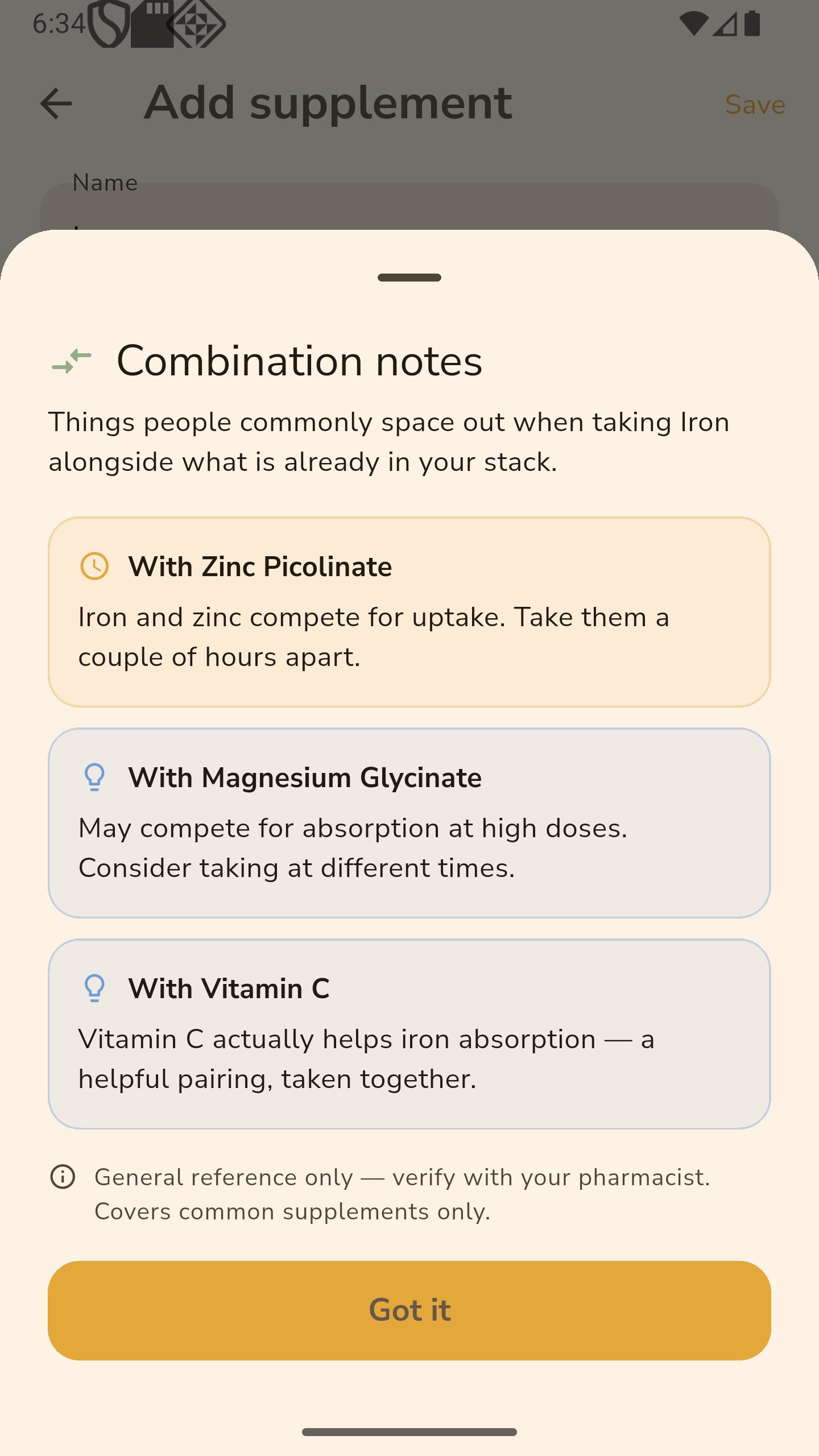
The notes cover supplements only, with no prescription medicines in the dataset, so they say nothing about warfarin, and each sheet ends with the same line: general reference only, verify with your pharmacist.
What to take to the pharmacist
The FDA’s advice: every time you see a health care professional, bring a list of every supplement and medicine you take, with the doses and how many times a day. You may also be asked to stop supplements two or three weeks before surgery.
A list written from memory in the waiting room misses the gummy and the lozenge. DailyStack’s paid tier exports a PDF of the last 30 days: your current stack with each dose, times per day and food setting, then a day-by-day table of doses due, taken, skipped and missed. That is the list the FDA describes, plus a record of whether the plan was followed.
This is general information about supplement absorption and safety, not medical advice. Your own doses, conditions and medicines change the answer, so check any change with your doctor or pharmacist and with the NIH Office of Dietary Supplements fact sheet for the nutrient in question.
Your next step is to lay the labels out, find the elemental iron, zinc and calcium figures, and give each its own time of day. To have the phone keep that schedule, set the stack up in DailyStack, the supplement and vitamin tracker and let it remind you slot by slot.
Common questions
How many hours apart should I take iron and calcium?
The NIH Office of Dietary Supplements does not set a number of hours. Its advice is to take individual calcium and iron supplements at different times of the day, which in practice usually means one with breakfast and the other with an evening meal. If you want a specific gap, ask the pharmacist who knows your doses.
Can I take zinc and iron at the same time?
At small doses it makes little difference, but the NIH says supplements with 25 mg of elemental iron or more, taken at the same time as zinc, can reduce zinc absorption and blood zinc levels. The iron added to fortified foods does not have the same effect. Check the elemental iron figure on your label, then put the two in different time slots if it is 25 mg or higher.
Do upper intake limits include the food I eat?
For most nutrients, yes. EFSA defines the upper level as total daily intake from all dietary sources. Magnesium is an exception: the EU limit of 250 mg covers supplements, water and added forms, and the US limit of 350 mg covers supplemental magnesium, so neither counts the magnesium already in food. The US vitamin E limit is also for supplements only.
Should I stop my supplements before surgery?
Tell your surgical team everything you take. The FDA notes that a health care professional may ask you to stop dietary supplements two or three weeks before a procedure, because some can change heart rate, blood pressure or bleeding risk. Do not stop or start anything on your own on the strength of a general article.
Is folic acid with vitamin B12 a bad combination?
Taking them together is not the issue. The concern the NIH describes is that high intakes of folic acid might mask a vitamin B12 deficiency until nerve damage becomes irreversible. The US upper limit for folic acid is 1,000 mcg a day for adults, and most people who go over it do so through supplements.
Photos: Nataliya Vaitkevich / Pexels , Towfiqu barbhuiya / Pexels