















































































































































































Does a Jewelry Repair Disclaimer Protect the Jeweler?
What a repair ticket can do for a jeweler: why owner's risk wording fails in the UK, how US courts read a liability cap, and what protects the shop instead.

Not much, and for a blanket “not responsible” line the British answer is a flat no. Section 57 of the UK’s Consumer Rights Act 2015 says a term excluding a trader’s liability for reasonable care and skill is “not binding on the consumer”, so “left at owner’s risk” buys a jeweler (or jeweller, in Britain) nothing. In the US a limit can hold if it survives a judge. In 1979 a New York appeals court refused to apply Tiffany & Co.’s $500 cap on summary judgment, after Tiffany lost a diamond ring whose owner had to sign under that very line.
What does the work is duller: a figure the customer gave you, and a record made while they stood at the counter.
The law’s word for you is bailee
While a ring sits in your safe you are holding someone else’s property for a paid purpose. The starting position favors you. The UK Supreme Court said so in 2018, in Volcafe v CSAV: “a bailee of goods is not an insurer. His duty is limited to taking reasonable care of the goods.”
American courts land in the same place. The case worth reading on a bad day is McKissick v. R. Connelly Jewelers, a 1979 North Carolina appeal. Burglars pried open a door from the vacant building next door, knocked the dial off the vault and ripped it open. A customer’s two rings, valued at $4,000, went with everything else. The shop owed her nothing, and it had no duty to insure the rings or even to tell her they were uninsured.
Read that again before paying a printer for tougher small print. A careful shop has most of what a disclaimer promises. The only extra loss a broad clause could shift is the one your own carelessness caused, and that is the loss judges and regulators are least willing to let you shift.
Who has to prove what when a ring goes missing?
Here the rules part, and US states vary. In England and Wales the shop carries it: at common law a bailee “bears the legal burden of proving the absence of negligence.” You need not explain exactly what happened, but you must show that you took reasonable care or that any lapse did not cause the loss. Volcafe was about coffee beans on a ship, yet the older passage it quotes uses your job as its example, a chattel handed over “to execute repairs on it and then redeliver it to the owner.”
North Carolina splits it differently. Delivery and failure to return are enough to take a customer’s case to a jury, but “the ultimate burden” stays with her.
California adds a rule for the shop that goes quiet. Under Civil Code section 1838, a depositary who refuses to say what happened, or willfully misstates it, is presumed to have permitted the loss willfully or through gross negligence. “We would rather not discuss it” is about the worst sentence available to you.
Why “not responsible for loss or damage” fails on a British ticket
Section 57 is short and it anticipated the rewrites. Subsection 5 extends the ban to wording that works by “preventing an obligation or duty arising”, which is what “accepted at owner’s risk” tries to do. A sign behind the till does no better. Section 61 catches any notice it is reasonable to assume a consumer was meant to see, and section 62 says an unfair consumer notice is not binding either.
The regulator is blunter. The Competition and Markets Authority’s CMA37 guidance, dated 22 July 2026, says a term that could relieve a trader of the obligation to take reasonable care in a consumer service “is prohibited as well as potentially unfair.”
A cap gets slightly different treatment. Section 57(3) strikes it down if it would stop the customer recovering what they paid for the service. Above that line, the Act’s fairness test can apply. A ticket capping an heirloom at £200 on a £60 repair (both figures illustrative) clears the first hurdle and then has to explain itself to a judge holding a photograph of the ring.
What a British ticket can say instead
CMA37 gives the test: a disclaimer is more likely to be fair if it is narrow and applies “only where the trader is not at fault”. For risky work, the guidance prefers prominent warnings that inform people without restricting liability. Its closest example comes from building work, so copy the shape. “All reasonable care will be taken but the company shall not be under any responsibility whatsoever” for decoration damage is unlikely to be fair. A version that carves out “damage caused by our negligence” is more likely to be, though the guidance warns that accepting negligence liability alone may not be enough.
In counter language, as an illustration and not a solicitor’s draft:
“Worn claws and old settings can fail during cleaning or repair even when the work is done with care. We will show you what we find before we start. This does not affect your legal rights.”
In the US, a limit needs notice and assent
New York set the rule out in 1946, in Klar v. H. & M. Parcel Room, over fur skins left at a railroad parcel room. The check said in fine print that “no claim shall be made in excess of $25.00.” To bind the customer, the court said, it must be shown “that the bailor has had reasonable notice of the terms and that he has assented to them.” The trial judge found no such agreement, so the $939.50 judgment stood.
Simon v. Tiffany & Co. is harder on the shop, because Simon had to sign. The trouble was placement. The $500 line sat straight after a warning that the article, “being of a fragile nature”, was accepted at the owner’s risk of damage. Her ring was lost, not damaged, and the court held the limit “may reasonably be interpreted as limiting liability only for loss due to damage done to the bailed jewelry.” The cap could not be applied without a trial on what the clause meant.
So a clause that hopes to survive needs a few things:
- Its own sentence, away from any warning about fragile pieces.
- The words loss, theft and damage, each named.
- The same printed text on the signed copy and the customer’s copy, where Tiffany’s receipt had the limit stamped on.
- A pause at the counter, with the customer’s signature beside it.
California draws an outer edge in Civil Code section 1668: no contract can exempt anyone from their own fraud, willful injury or violation of law. Beyond that the rules move by state, so have a lawyer licensed where you trade write this one.
The figure a California customer gives you can become the ceiling
Section 1840 of the California Civil Code needs no clause at all: “The liability of a depositary for negligence cannot exceed the amount which he is informed by the depositor, or has reason to suppose, the thing deposited to be worth.” For a California shop it is the most useful sentence in this article.
Windeler v. Scheers Jewelers, from 1970, shows it failing for lack of a number. A widow left six rings to have the stones reset. The jeweler mailed them to a Los Angeles manufacturer, insured for $50, and they never arrived. He pleaded section 1840, but all she had told him was that the rings meant a great deal to her. “Such a statement is merely a conclusion”, the court said, so no ceiling applied and she recovered their worth, $1,436.
She also kept $4,000 for personal injuries, because the sentimental value was “a special circumstance known to both of the parties”. California’s Supreme Court later limited emotional distress damages for negligent breach of contract in Erlich v. Menezes (1999, a house building case), but it cited Windeler as a case where they remain available, so that $4,000 is still a live risk.
The ceiling lifts if you had reason to suppose the piece was worth something else. Nothing in the UK sources above gives a British shop the same cap; there the number is at most evidence of what both sides understood.
Whose number is it?
A 1997 JCK column by the appraisal consultant Elly Rosen describes the failure better than any case. Take-in forms “often call for a client declaration of value” for the shop’s bailment insurance. The customer has no idea, the person at the counter says $3,000 should cover it, and the customer signs under $3,000. “It wasn’t the client’s declaration at all”, Rosen wrote, and whether the customer would be held to it was “at best questionable.”
So ask, write down what they say, and stop talking. If they want your view, note on the form that you gave one and that the decision was theirs.
Vagueness will not save you either. The same column reports a 1995 Jewelers Vigilance Committee bulletin about a jeweler who wrote “green stone” for a possible emerald, as the trade then advised. He was sued and, according to the bulletin, paid for an emerald.

A declared value is not a valuation
Keep the two apart on paper. For insurance, the National Association of Jewellers’ advice on valuations says you need “a professional valuer to examine your jewellery and to produce a formal document giving a precise description of each piece”. A number said aloud over your counter is none of that. A shop’s document with a figure beside a customer’s name can look like one to an insurer, so the page should say whose figure it is and that nobody assessed the piece.
What your block policy reads
FC&S’s analysis of the ISO jewelers block form, CM 00 59, sets out the wording. Customers’ pieces count as “similar property of others” in your care, custody or control. The form excludes “unexplained disappearance”, which FC&S says gives the adjuster “a means for demanding greater proof”. It requires records of property of others, kept for three years after the policy ends.
It also values a loss at the least of four amounts, and the fourth deserves a second reading: “the lowest figure you put on the property in your inventories, stock books, stock papers or lists”.
That analysis dates from 2000 and describes a US form, and a British policy will differ. Ask your broker whether an intake figure counts as one of those lists, before you need the answer.
The ring you send out stays your problem
Windeler’s rings left by insured mail, and the jeweler admitted registered mail was safer. An Ontario case, Punch v. Savoy’s Jewellers (1986), went the same way. A jeweler sent an heirloom to a manufacturer by registered mail at the customary $100 declared value. A postal strike brought it back with a rail carrier’s driver, and it vanished. According to the reported summary, the appeal court held all three liable, and the carrier lost its $100 limit because it never tried to explain the loss.

FC&S also reads the ISO form as not covering property in the mail “unless it is sent by registered mail.” Rosen wants the client’s consent if a piece goes anywhere they have not been told about. Write the trade shop’s name, the carrier and the insured amount on the job.
The clause that earns its place: collect by
The National Association of Jewellers’ code of practice on uncollected items calls this “the most effective deterrent”, and its example is short: “Goods must be collected within six months of notification that your repair is ready.” The clause starts a clock. It does not give you title to the ring.
In England, Wales and Northern Ireland the sale itself runs under the Torts (Interference with Goods) Act 1977. Schedule 1 wants a written notice sent by registered letter or recorded delivery, at least three months’ notice if money is owed, and no notice or sale while the customer is disputing the bill.
California gives a repairer a lien under Civil Code section 3051 and, under section 3052, a public auction route once the charge is 10 days overdue, with 10 to 20 days’ newspaper notice and 20 days afterward for the owner to redeem. Other states run their own version.
What does the job a disclaimer cannot
No statute I could find makes a shop keep an intake record. Connecticut’s repair law reaches the paperwork around the job instead: on request a repairer must give a written estimate and “shall not charge” above it without consent (section 42-110s), and work of $25 or more needs an invoice with a copy kept a year (section 42-110t). In the UK, sections 51 and 52 of the 2015 Act fill any silence with a reasonable price and a reasonable time, which is a polite way of promising an argument.
The burden, the unexplained loss, the number and the stone all turn on what you can show. Rosen’s 1997 advice holds up: take-in is done “in front of the client”, with a photo marking existing damage.
That is the job of a repair intake record that prints the customer’s copy. JewellerDesk runs seven steps at the counter: customer and ticket reference, the item, condition photographs numbered P1, P2, P3 before any work, each stone marked secure, loose, missing or not checked, the declared value in the customer’s words, the work with a quoted price frozen with its date, and a signature. It never refuses a job over an empty field. Whatever is missing prints on the receipt under “Not recorded at intake”. At handover, intake and handover photographs sit side by side above a second signature, and a reminder headed “Still in the safe” fires once finished work has been held past a limit you set, 30 days unless you change it.
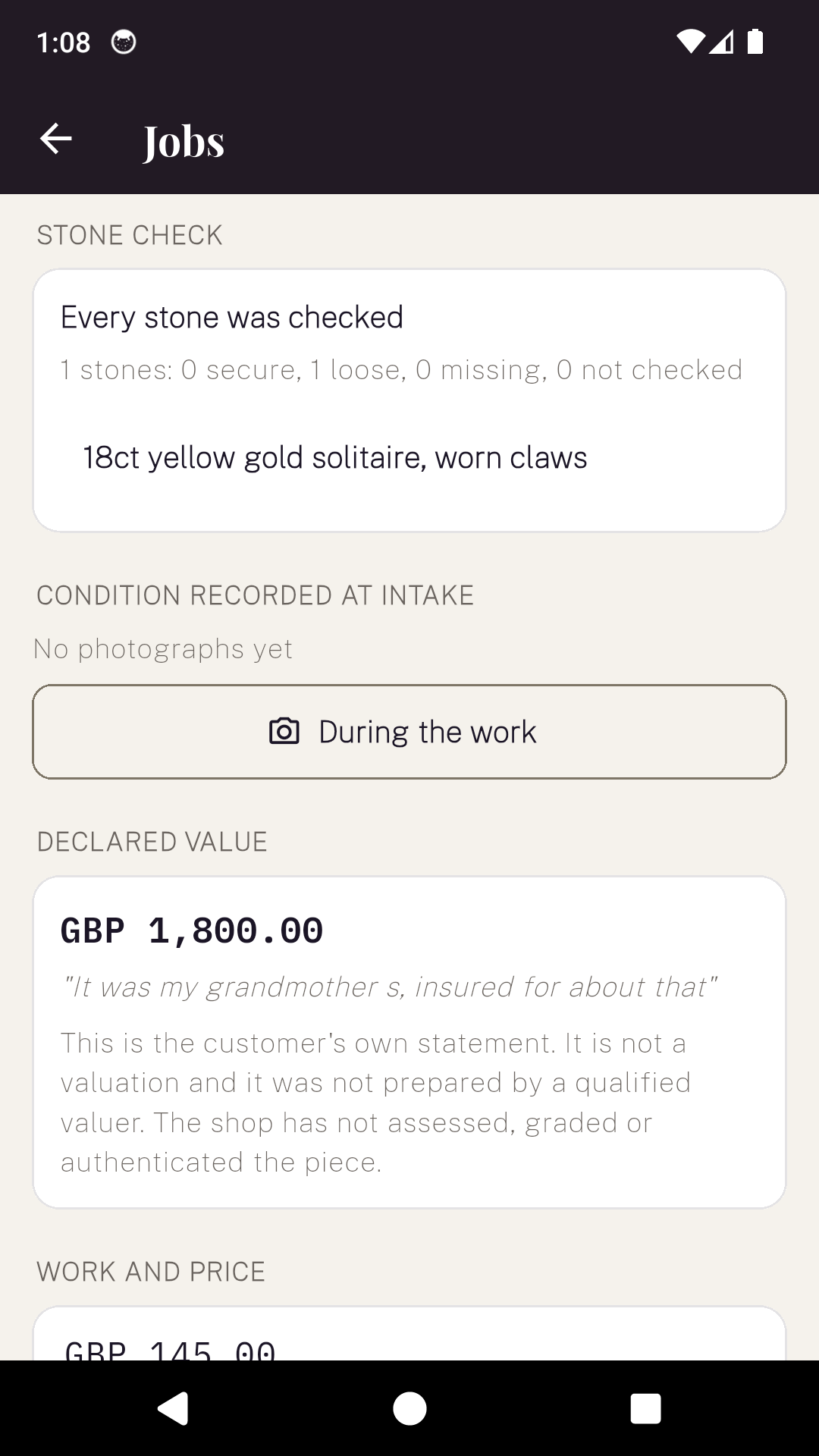
Two limits, plainly. Its receipt carries no exclusion of liability and has no field for shop terms, so an American clause your lawyer writes goes on your own paper. What it prints instead is “This record does not affect the customer’s legal rights.” A record also cuts both ways. If she tells you it was her grandmother’s and you write that down, the file shows you knew what it meant to her, which is roughly what cost Scheers $4,000. Write it down anyway. I would rather answer for a true record than explain a blank one.
This is general information, not legal or insurance advice. Have a solicitor or a lawyer licensed in your state read your ticket and your broker read your policy, and check the wording against the Consumer Rights Act, the CMA’s guidance or your state’s code.
Tonight, take one old ticket out of the drawer and read the sentence about loss the way the customer’s lawyer would. Then change what happens on the next job: ask for a figure, write it down in their words, and photograph the piece before anyone talks about the work. If you would sooner do that on a phone than on an envelope, JewellerDesk takes a piece in the same way every time.
Common questions
Can a jeweler be held liable for losing a ring left for repair?
Yes, if the loss came from a failure to take reasonable care. A jeweler holding a customer's ring is a bailee, which is not the same as an insurer, so a burglary through a properly kept vault can leave the shop owing nothing, as it did in a 1979 North Carolina case. In England and Wales the shop has to prove it took reasonable care. In North Carolina the customer keeps the ultimate burden of proof.
Does 'left at owner's risk' work on a repair ticket?
Not against a UK consumer, because section 57 of the Consumer Rights Act 2015 stops a term excluding reasonable care and skill from binding them. In the US it depends on the state and the drafting. A New York appeals court found Tiffany's wording ambiguous in 1979, partly because the $500 limit followed a warning about fragile pieces being damaged and the ring had been lost, not damaged.
Should a jeweler ask what a piece is worth when taking it in?
Yes, and the figure should be the customer's, written down as they said it. In California, section 1840 of the Civil Code limits a depositary's negligence liability to the worth it was told or had reason to suppose. If the take-in person suggests the number, the customer may not be held to it. Record a refusal too, so the file shows the question was asked.
Is a jeweler responsible if a stone falls out after a repair?
It can be. In the UK a repair has to be done with reasonable care and skill under section 49 of the Consumer Rights Act 2015. In a sale and setting case reported by the law firm RWK Goodman, a county court judge, applying the satisfactory quality test for goods, held that a diamond ring must withstand everyday wear without the diamond falling out. A condition photograph and a stone check from intake are what separates old wear from new work.
How long must a jeweler keep an uncollected repair?
No single period applies. In England, Wales and Northern Ireland the National Association of Jewellers treats six months as a reasonable time, and a sale runs under the Torts (Interference with Goods) Act 1977, with written notice by registered post or recorded delivery. In California, Civil Code sections 3051 and 3052 give a repairer a lien and a public auction route, with newspaper notice. Other states set their own steps.
Does a jewelers block policy cover customers' repairs?
Commonly it does. The ISO form CM 00 59 covers similar property of others in your care, custody or control, and JCK reports customers' goods among what these policies cover. The same form excludes unexplained disappearance and requires records of property of others, kept for three years after the policy ends. Your own policy decides, so read it or ask your broker.
Photos: Tima Miroshnichenko / Pexels , Tahir Xəlfəquliyev / Pexels , Plato Terentev / Pexels