











































































































































































Pre-Trip Inspection Checklist: The Limit Behind Each Check
A truck pre-trip inspection checklist in walk-around order, with the number behind each check: tread depth, steering lash, air loss, low air warning.

A pre-trip inspection checklist has eleven items the federal rule names: service brakes, parking brake, steering, lights and reflectors, tires, horn, wipers, mirrors, coupling devices, wheels and rims, emergency equipment. Several of them come with a number that decides whether the truck rolls. Steer tires need 4/32 of an inch of tread. With the foot brake held, an air system may lose 3 psi in a minute on a single vehicle and 4 psi on a combination.
“Check tires” is no help at five in the morning with a flashlight in your teeth. So here is the list in walking order, with the number where one exists.
What the rule asks before you move
Three duties are in 49 CFR 396.13, the driver inspection rule: be satisfied the vehicle is in safe operating condition, review the last inspection report if one was required, and sign it to acknowledge the repairs were certified. Section 392.7 supplies the eleven parts above and says the truck shall not be driven unless you’re satisfied they are in good working order.
Notice what’s missing. No form, no minimum time, no written record of a clean walkaround, although plenty of guides say you must keep one. The written report in 396.11 is an end-of-day job, and only when a defect was found or reported; our guide to what a DVIR has to contain goes through that chain. The time itself is on-duty, because 395.2 counts “all time inspecting, servicing, or conditioning any commercial motor vehicle at any time.”
Single-truck owner-operators tend to stop reading at the exception for a carrier running one vehicle. That exception is written into 396.11. Neither 392.7 nor the first duty in 396.13 carries one.
Read the last report first
Step one in Virginia DMV’s CDL manual, which uses the model text written for state licensing agencies, happens before you touch the truck. If the last report lists a defect, 396.11 wants a certification on it, repaired or repair unnecessary, before the vehicle runs again. Then you sign. No defect noted, no signature needed. A defect on a trailer you’ve since dropped doesn’t need your signature either.
An uncertified defect is the one thing on this list you can’t fix with a wrench.
Walk up slowly, then open the hood
Stop short of the truck. Is it leaning to one side? Anything fresh on the ground: oil, coolant, grease, fuel? Low wires or limbs overhead? A lean can show better from here than from beside the axle.
With the parking brake on or the wheels chocked, go under the hood:
- Oil, coolant, power steering and washer levels
- Belts (for power steering, 393.209 says not frayed, cracked or slipping)
- Hoses, wiring insulation and fresh leaks
- Battery connections and tie downs
In the cab: gauges, glass and the emergency kit
Set the parking brake and start the engine. Oil pressure should reach normal within seconds. The ABS lamp on the dash should come on and go out, and if it stays lit the system isn’t working.
Under the federal windshield rule, 393.60, the glass above steering wheel height must be undamaged, apart from a 2-inch border along the upper edge and a 1-inch border at each side. Two exceptions: a crack that no other crack intersects, and a damaged spot a 3/4-inch disc would cover, at least 3 inches from the next one. A US penny measures 0.750 inches across, so you already carry the gauge.
Most trucks need two outside mirrors, firmly attached. The horn has to give “an adequate and reliable warning signal,” which means pressing it. Wiper blades shouldn’t have gone stiff.
Section 393.95 asks for one extinguisher rated 5 B:C or two rated 4 B:C, or 10 B:C if you haul placarded hazmat. It has to show at a glance whether it’s fully charged, and it has to be mounted so it can’t slide or roll. Add three reflective triangles, or at least six fusees where 393.95(g) allows flame. The manual still lists spare fuses, while the current 393.95 has no such requirement.
The steering wheel has two numbers
The CDL manual warns about play of more than 10 degrees, about 2 inches at the rim of a 20-inch wheel. The steering table in 393.209 is looser: on that same wheel, 2 1/2 inches with manual steering and 5 1/4 inches with power. For sizes the table doesn’t list, the limit is 14 degrees manual and 30 degrees power.
So an illustrative power-steered truck with 3 inches of lash is inside the federal limit and outside the manual’s figure. I’d write it up at the manual’s number and park the truck at the regulation’s. The first tells you something has changed. The second is where you’re in violation.
Then grab the steering linkage at the front axle, as the manual says you must, and test for looseness, missing cotter keys and loose tie rods.
Tires, with a gauge in your hand
You can’t read 4/32 by eye. 49 CFR 393.75 sets that depth at any point on a major groove for the front tires of a truck, tractor or bus, and 2/32 for every other tire.
Depth doesn’t save a tire with ply or belt showing, a tread or sidewall separation, an audible leak, or a cut that reaches the ply. The manual adds duals touching each other, radial and bias-ply tires mixed, and cracked valve stems.
Tires drew 2,914 out-of-service violations, 20.9 percent of the vehicle total, in CVSA’s 2026 Roadcheck results, a three-day event of 54,575 inspections.
Wheels and rims
Wheels get three sentences in 393.205: wheels and rims not cracked or broken, stud holes not out of round, nuts not missing or loose. Rust around a wheel nut is the manual’s sign that it may be loose. It also says to recheck nuts a short while after a tire change, and it calls a rim with a welding repair unsafe.
Brakes you can see from the ground
Spend your time here. Brake systems and the 20 percent defective brakes category made up 39.1 percent of that Roadcheck’s vehicle out-of-service violations, and inspectors parked 23.5 percent of the vehicles they examined. FMCSA’s Large Truck Crash Causation Study ranked brake problems first among associated factors, coded on 29 percent of the trucks. Those crashes date from 2001 to 2003, and a coded factor isn’t proof of cause, but the ranking fits what inspectors still find.
On S-cam brakes, park level, chock the wheels, release the parking brakes and pull hard on each slack adjuster you can reach. More than about 1 inch of movement where the pushrod attaches means it probably needs adjustment. The manual calls out-of-adjustment brakes the most common problem found at roadside.
On an automatic adjuster, winding it back inside the limit is, in the manual’s words, generally masking a mechanical problem. Take it to a shop.
Section 393.47 gives the lining limits. An air drum brake off the steer axle needs 1/4 inch at the shoe center, and a disc needs 1/8. The steer axle needs 3/16 on a continuous strip or 1/4 with two pads.
Springs, air bags, frame and exhaust
One-fourth or more of the leaves missing from a leaf spring puts the vehicle out of service, according to the manual. An air suspension must sit level and lose no more than 3 psi in 5 minutes at normal operating pressure (393.207). The frame can’t be cracked, loose, sagging or broken.
A broken exhaust can put fumes in the cab or sleeper berth, so check for loose brackets and anything rubbing a tire or fuel line.
Lights, when you’re alone in the yard
The manual’s sequence saves walking. Low beams and four-ways first, then high beams; then parking, clearance and marker lamps with the right turn signal for the full walk round. Climb back in for the left signal and the stop lamps.
Stop lamps are awkward solo. On a combination you apply the trailer hand brake. A straight truck needs a helper.
Section 393.9 says required lamps can’t be obscured, dirt included, so wipe them as you pass. Lights were 11.9 percent of Roadcheck’s vehicle out-of-service violations.
Coupling and the trailer
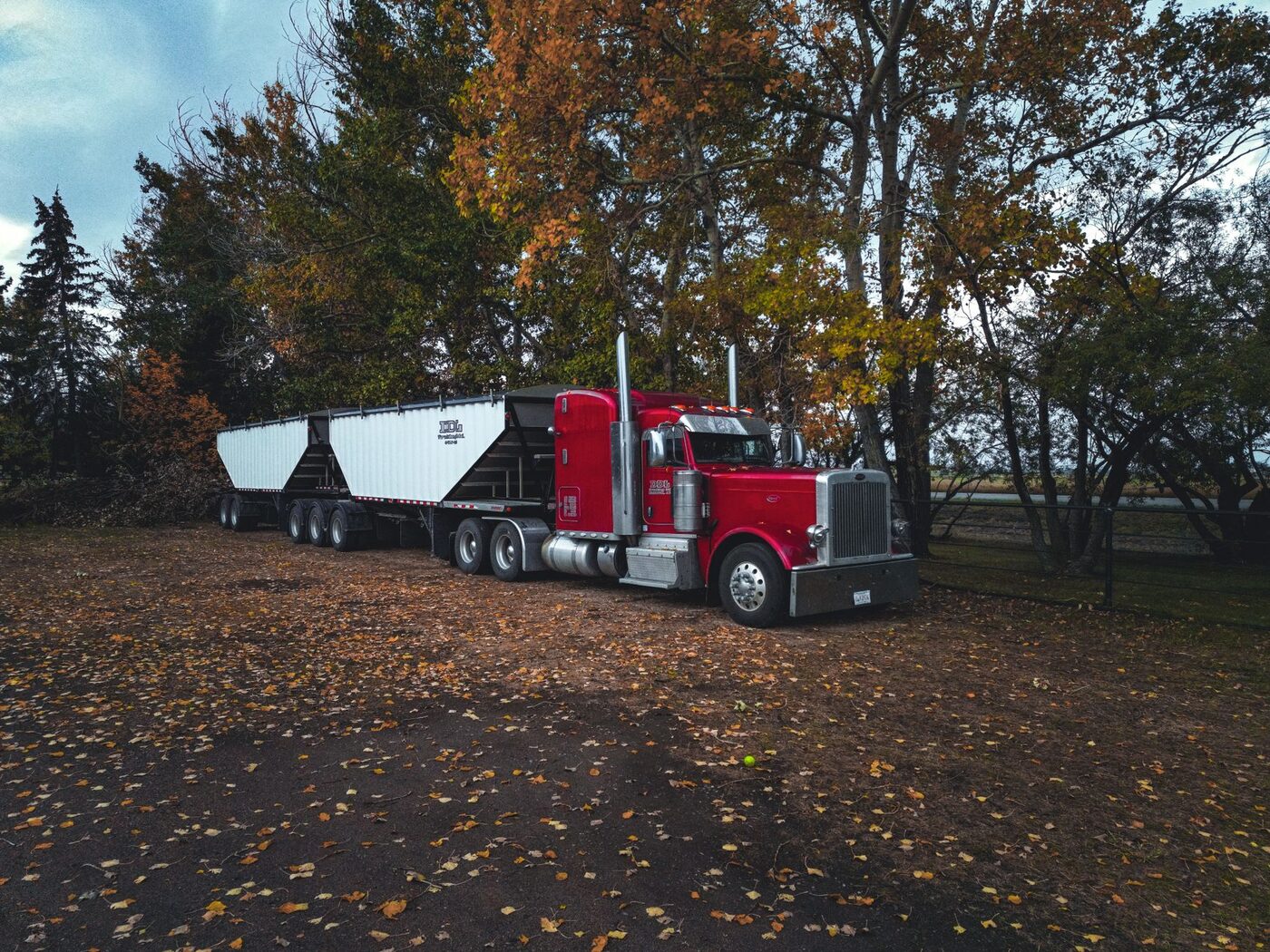
Get a flashlight on the fifth wheel. A gap between the upper and lower halves can mean the kingpin is sitting above closed jaws and the trailer will come loose. Then go under and check from the back: jaws closed around the shank, locking lever locked, safety latch over the lever.
Before you leave the coupling:
- Glad hand seals sound, air and electrical lines clear of anything that moves
- Landing gear all the way up and the crank secured, since gear left part way can catch on railroad tracks
- A gentle pull forward against the trailer parking brake, which tests the coupling as well
The air brake check, in numbers
These come from sections 5 and 11 of that CDL manual, which defers to the manufacturer.
| Check | How | Limit |
|---|---|---|
| Pressure build-up | Engine at operating rpm | 85 to 100 psi within 45 seconds (dual air) |
| Governor cut-out | Build to cut-out and watch the gauge stop | About 120 to 140 psi |
| Leak, brakes released | Engine off, parking brake released, time one minute | Under 2 psi single, under 3 psi combination |
| Leak, brakes applied | Engine off, foot brake held one minute after the needle settles | No more than 3 psi single, 4 psi combination |
| Low air warning | Key on, fan the pedal down | Before the gauge drops below 55 psi |
| Spring brakes | Keep fanning | Valve pops out between 20 and 45 psi |
That 55 needs a caveat. For trucks built on or after March 1, 1975, section 393.51 points to FMVSS 121, which as it now reads sets the warning below 60 psi. An illustrative warning that first sounds at 56 clears the manual’s figure and misses that standard. Write it up.
On hydraulic brakes, pump the pedal three times, apply firm pressure and hold for five seconds. The pedal shouldn’t move.
Two stops, then the load
Pull gently against the parking brake in a low gear to see it hold. Then roll forward at about 5 mph and brake firmly. A pull to one side means the brakes may not be right.
Your cargo check doesn’t end at the yard gate. Section 392.9 wants it secured before you drive, inspected within the first 50 miles, and checked again at each change of duty status, every 3 hours or every 150 miles, whichever comes first. A sealed load you’ve been told not to open is exempt. In FMCSA’s crash study, trucks with shifted cargo were 56.3 times as likely to be coded with the critical reason for the crash, against 2.7 for brake problems, though cargo shift appeared on only 4 percent of trucks.
When something fails
Section 396.7 is short: a vehicle shall not be operated in a condition likely to cause an accident or a breakdown. Found on the highway, it may go only to the nearest place repairs can safely be made, and only if that is less hazardous than leaving it on the highway. Marked out of service by an inspector, it stays put until repaired, and the roadside report has to be certified within 15 days and kept for 12 months (396.9).
Write down what you found in words a shop can act on. An illustrative note: “Left steer, 3/32 in the outer groove.” “Tire bad” says you knew and not much else.
That note is what a DVIR app that records the walkaround on your phone is built for. DVIRLog opens a report as pre-trip or post-trip and starts every item unanswered, so nothing reads OK until you say so. Each item takes OK, Defect or N/A, and a defect takes a note and photos. There’s a Mark the rest OK button for a clean truck. Press it after the walk, never before.
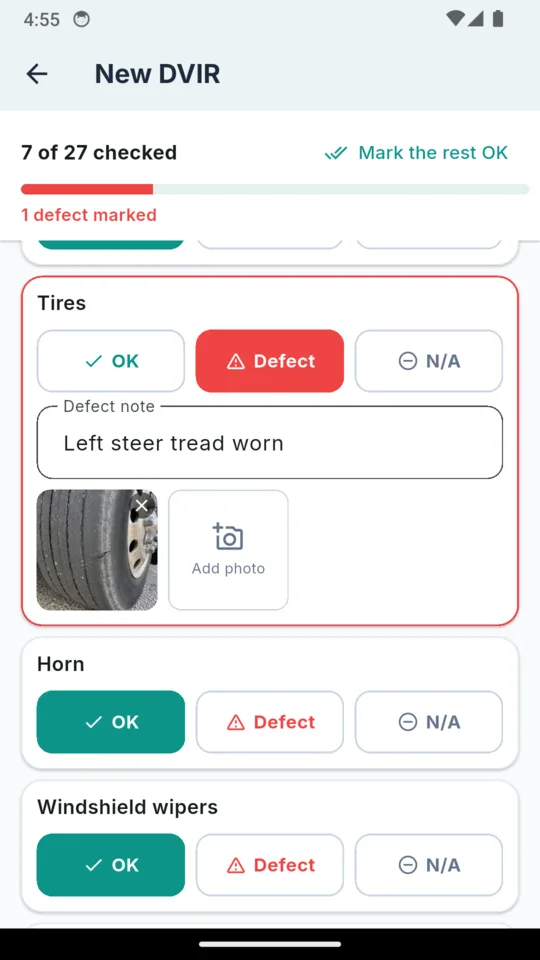
The eleven required items are locked on every truck or tractor report. A tractor starts with five extras: fifth wheel and kingpin lock, air lines and glad hands, fluid leaks, exhaust, frame and suspension. Slack adjusters aren’t among them, so add that check and keep it on the truck’s list. The paid plan saves each trailer as its own unit with its own checks, and pulling it adds a second section to the same report, 27 lines for tractor and trailer on the default lists. A trailer you only type the number of gets the default list.
A defect stays Open until it’s marked repaired or not necessary. The app is a record, not an ELD, and it won’t tell you whether 3/32 passes.
This is general information, not legal or compliance advice. State rules and carrier policy can ask for more and the regulations get amended, so check the current text of 49 CFR Parts 392, 393 and 396, or ask FMCSA or your state enforcement agency.
Tomorrow morning, time the applied-brake leak test with a watch and note the psi. Then set your truck up in DVIRLog with whatever your rig needs beyond the eleven, and the next walkaround leaves a dated record with your signature on it.
Common questions
Does a pre-trip inspection have to be written down?
Not under the federal rules. 49 CFR 396.13 requires you to be satisfied the vehicle is safe, review the last inspection report where one was required, and sign it. The written report in 396.11 is prepared at the end of the day, and only when a defect was found or reported. A carrier can require a written pre-trip as company policy.
How long should a pre-trip inspection take?
The federal rules set no minimum, and the time counts as on-duty under 49 CFR 395.2. On an air-braked truck the two leak tests are timed at one minute each, so build that in alongside the walk itself and the wait for pressure to build. You have to be satisfied the vehicle is safe, and that is the only clock the rule gives you.
What tread depth fails a truck inspection?
Under 49 CFR 393.75, front tires on a truck, tractor or bus need at least 4/32 of an inch at any point on a major tread groove, and every other tire needs at least 2/32. The measurement is not taken on tie bars, humps or fillets. A tire with exposed ply, a separation or an audible leak fails at any depth.
At what pressure should the low air warning come on?
The CDL manual says before the pressure drops below 55 psi. The federal build standard for trucks made on or after March 1, 1975, FMVSS 121 as it now reads, sets the warning below 60 psi. If yours stays quiet until the mid 50s, have it looked at. Spring brakes are a separate test and should apply between 20 and 45 psi or at the manufacturer's level.
Photos: Gustavo Fring / Pexels , Peter Buhler / Pexels