










































































































































































What Makes Tinnitus Worse? A Checklist to Work Through
Noise, earwax, some painkillers, jaw clenching, short sleep and stress have evidence behind them. Coffee mostly does not. What to check, in order, and how.

Loud noise and stress are the two things the NHS names when it tells you what can make tinnitus worse, and both hold up. Earwax, jaw clenching and some medicines have solid backing too. Coffee, the thing everybody tells you to give up first, does not: a blinded 30-day trial in 66 regular tea and coffee drinkers with tinnitus found no change at all when their caffeine was quietly taken away.
So the order matters. Here is the list I would work through, starting with the signs that mean you should stop reading and get seen today.
The signs that are not a checklist item
Some changes in tinnitus are a symptom of something that needs a doctor quickly, and no diary will help with those. The NHS page on tinnitus says to go to A&E or call 999 if you have tinnitus after a head injury, or tinnitus with sudden hearing loss, weakness in the muscles of your face, or a spinning sensation. Tinnitus that beats in time with your pulse needs an urgent GP appointment.
Sudden hearing loss is the sign that is easiest to explain away. It is tempting to put it down to a cold, or to wax, and wait a week. The NICE tinnitus guideline, NG155, tells clinicians to make sure anyone with tinnitus and hearing loss that came on over three days or less, within the past 30 days, is seen within 24 hours. That is the outer limit for a referral, not a reason to wait: the NHS says tinnitus with sudden hearing loss is an A&E visit.
NICE also asks clinicians to consider referral for tinnitus that is persistent and pulsatile, or persistent and in one ear only. If yours is either, say so at the GP rather than waiting to see if it settles.
The rest of this page is for the common case: tinnitus you have had a while that has become louder or harder to ignore.
Noise you did not notice at the time
Noise comes first on the list because you can measure it. The US National Institute on Deafness and Other Communication Disorders (NIDCD) draws the line plainly. Sound at or below 70 dBA, even after long exposure, is unlikely to cause hearing loss; long or repeated exposure at or above 85 dBA can. Concerts, sporting events and headphones at maximum volume sit between 94 and 110 dBA.
The World Health Organization’s safe listening guidance turns that into a weekly allowance: 80 dB is safe for up to 40 hours a week, while at 100 dB, about the level of a hair dryer, the allowance is 20 minutes for the whole week. The same page warns that persistent tinnitus can indicate your hearing has been damaged.
Look past the obvious gig. A spin class with the music up, a cordless drill, an evening of earbuds turned up to drown out a train. In a UK Biobank analysis of 168,348 adults, work noise exposure was one of the factors linked with both tinnitus and bothersome tinnitus, so a loud job is where to start.
Write down the exposure as well as the spike. The two can be hours apart, and a week later you will not remember which evening had the loud pub.
Earwax, and the cotton bud that made it worse
A blocked ear canal is one of the few causes here you can sort out in a week. The NIDCD’s tinnitus page says blockage of the ear canal by earwax, or by fluid from an ear infection, can trigger tinnitus, so a recent cold or ear infection belongs on the list too. The NHS lists ringing or buzzing among the symptoms of earwax build-up.
The NHS advice is specific. No fingers and no cotton buds, which push the wax further in. Instead, 2 to 3 drops of olive or almond oil, three or four times a day for three to five days, and a nurse at your GP surgery if it has not cleared after five days.
The medicine cabinet
Tinnitus is a listed side effect of a long list of medicines, and NIDCD notes it is more likely at high doses. The American Tinnitus Association names NSAIDs, certain antibiotics, certain cancer drugs, diuretics and quinine-based medicines among those that can cause it.
Everyday painkillers have the longest-running data. The Nurses’ Health Study II followed 69,455 women aged 31 to 48, none with tinnitus at the start, from 1995 to 2017. Frequent low-dose aspirin did not raise the risk of persistent tinnitus. NSAIDs taken four or five days a week came with a hazard ratio of 1.17, roughly a 17 percent higher risk, and paracetamol (acetaminophen) taken six or seven days a week with 1.18. The analgesic study on PubMed Central is careful to say the data was self-reported and causation still needs testing.
It looked at new tinnitus, not existing tinnitus getting louder, so treat it as a reason to mention painkillers to your GP. Never stop a prescribed medicine on your own; the American Tinnitus Association says to consult your healthcare provider first. Bring dates: when you started a medicine, changed the dose, or missed some.
Jaw and neck
Clench your back teeth now and listen. For some people the tinnitus changes pitch or volume while they do it, and a 2026 systematic review of tinnitus in people with jaw joint disorders found some patients could change their tinnitus with jaw or neck movements.
NIDCD says jaw clenching or tooth grinding can damage surrounding tissue, causing or worsening tinnitus. Night grinding is hard to catch in yourself. A partner who hears it, a sore jaw on waking or a dentist who spots wear on your teeth are the usual clues, and a dentist is the sensible first call.
Neck tension from long hours at a screen belongs on the same line. If that sounds familiar, these desk stretches for neck pain cover the posture side.
Short nights
Sleep and tinnitus feed each other. The sound is more noticeable when you lie in a quiet room trying to drift off, and Tinnitus UK describes how prolonged poor sleep raises anxiety, which then weighs on the tinnitus. The NHS self-help list suggests a bedtime routine and cutting down on caffeine.
One catch for anyone keeping notes: set each spike against the sleep that came before it, so a spike on Thursday afternoon sits next to Wednesday night.
Stress, and the attention that comes with it
Stress is on the NHS list alongside loud noise. Anxiety and depression appear on its list of things tinnitus is often linked to, and in the UK Biobank analysis neuroticism, a tendency to worry, was linked with bothersome tinnitus.
There is a quieter mechanism too. The NHS advises you not to focus on tinnitus, “as this can make it worse”. Checking the sound every hour and testing it in quiet rooms is attention, and attention turns a background hum into the loudest thing in the room. A trigger list can become one more way of listening for it, which is why the diary further down has an end date.
Coffee and tea

Most people cut this one first, and the evidence says leave it alone. In the 2010 trial, published in the International Journal of Audiology, 66 people with tinnitus who usually had at least 150 mg of caffeine a day had their tea and coffee swapped for blinded supplies for 30 days. Their tinnitus scores were the same on caffeinated and decaffeinated days, a mean difference of minus 0.04 points. What the trial did find was withdrawal: headache and nausea. The caffeine abstinence trial abstract is on Europe PMC.
Tinnitus UK’s page on food, drink and tinnitus says there is no scientific basis for the advice to avoid tea and coffee, and suggests a moderate and constant intake. A 2021 systematic review found only four studies good enough to include and called the evidence inconclusive.
The exception is Meniere’s disease, where tinnitus comes with attacks of vertigo, hearing loss and pressure in the ear. For that, the NHS does advise avoiding caffeine.
Alcohol, salt and the rest of the plate
Tinnitus UK says the consensus is that alcohol is not a risk factor for tinnitus, and that some people find it helps. In the UK Biobank data, drinkers had lower odds of tinnitus than non-drinkers. That is no reason to drink, only a reason not to blame one glass of wine without evidence.
Salt splits the same way as coffee. There is no consistent research tying it to ordinary tinnitus, but for Meniere’s disease the NHS suggests asking a GP about a low-salt diet.
If you suspect a particular food, Tinnitus UK describes the proper test: remove it completely for two to six weeks, then bring it back. It also warns that cutting out food groups can be dangerous without a GP or dietitian, and that giving up foods you enjoy adds to the burden. One food at a time, and only one you have a reason to suspect.
Silence
A very quiet room is a trigger in its own right. In a 2008 study in Otolaryngology, Head and Neck Surgery, 53 young adults with normal hearing sat for four minutes in a soundproofed chamber, and 83 percent reported hearing at least one sound.
The NHS says not to have total silence and suggests soft music or background sound. If yours is always worst in bed, a fan or a low radio is the cheapest test on this list.
A trigger, or just a bad week?
This is where most self-tracking goes wrong, because tinnitus moves on its own. The UK Biobank study of tinnitus over time in BMJ Open found 17.7 percent of adults aged 40 to 69 reported tinnitus. Among those with tinnitus who were retested four years later, 18.3 percent no longer had it. Of those who still did, 9 percent said it had improved and 9 percent said it had become more bothersome. The authors found limited evidence that any lifestyle factor was linked with those shifts.
So one loud day after one coffee proves nothing. You want the same suspect turning up before bad days more often than before ordinary ones, and then a proper test where you change one thing and wait.
| Suspect | What the evidence says | A fair test |
|---|---|---|
| Loud noise | 85 dBA and above can damage hearing | Note exposures, compare weeks |
| Earwax | Can trigger tinnitus | Oil drops for 3 to 5 days |
| Medicines | A side effect of many | Note dose dates, ask your GP |
| Jaw clenching | Can cause or worsen it | Clench test, see a dentist |
| Short sleep | On the NHS self-help list | Spikes after short and normal nights |
| Caffeine | No effect in a blinded trial | Keep intake steady |
| Silence | 83% heard sounds in a silent room | Soft sound at night |
Keeping a record your audiologist can use
A useful record is short and dull: when it got louder, how loud, which ear, how long, and what happened in the day before. That last part is the trigger, and it only counts if you write it down before you have decided what caused it.
TinnitusLog is a diary made for this. You log a spike with loudness and annoyance on 1 to 10 sliders, pitch, ear and duration, and tag what was going on from 30 tinnitus triggers in seven groups that match this list: diet, sleep, stress, noise, physical, medication and environment. You can add your own, and set the time back when you remember a spike late. An optional weekly check-in records hours slept, sleep quality, stress, noise exposure and whether you wore hearing protection.
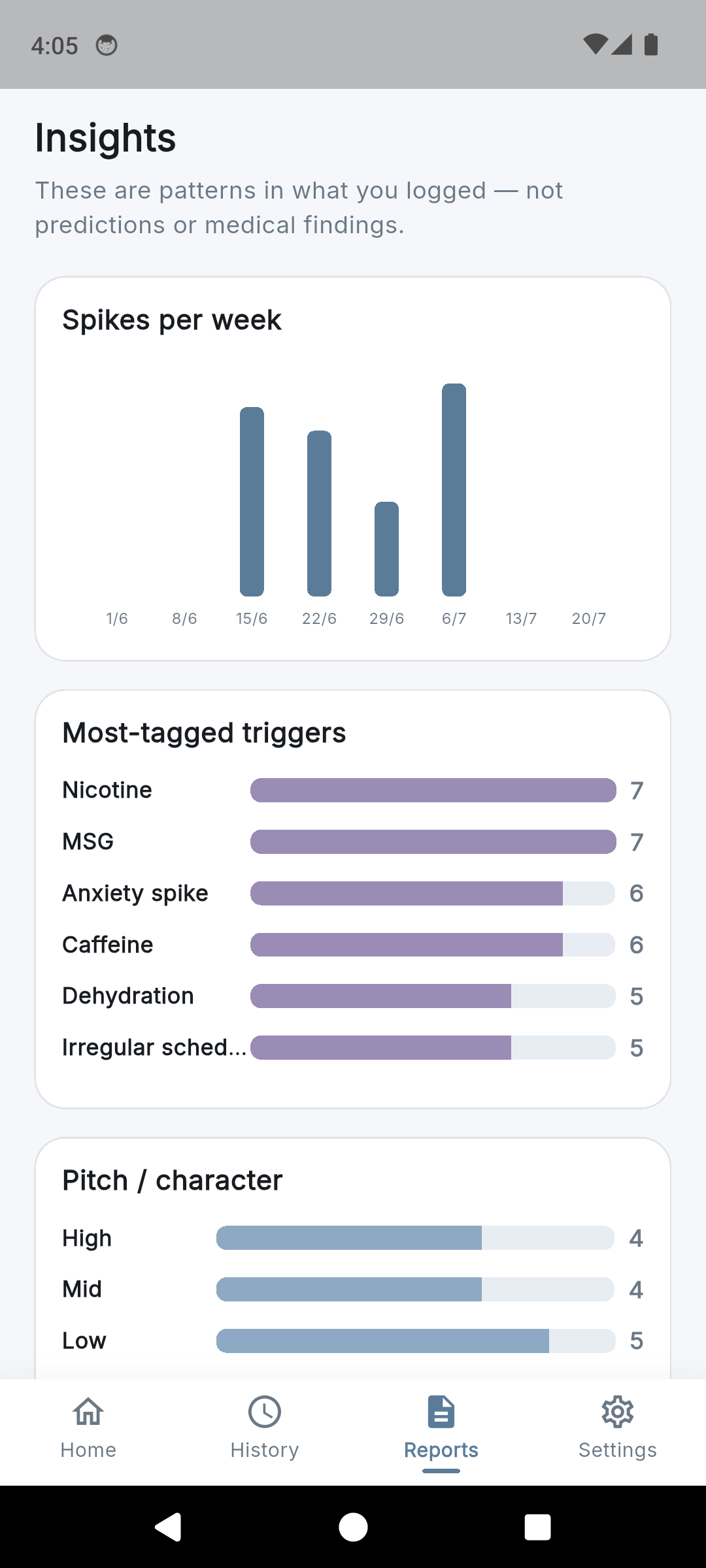
The Pro Insights tab, once you have three spikes, does a simpler version of this. It compares the average loudness of spikes logged in weeks when your check-in said under six hours of sleep with weeks of seven hours or more, and loud or very loud weeks with the rest. It only reports a difference when each side has at least two spikes and the averages are more than half a point apart. The screen itself says these are patterns in what you logged, not predictions or medical findings.
After 21 days and eight spikes, the app suggests pausing daily logging, for the attention reason above.
What to take to the appointment
Take dates, not impressions. “Louder in the left ear for three days after a wedding, and since I started a new tablet on the 4th” gives a GP or audiologist far more than “it has been bad lately”. NICE suggests clinicians consider the Tinnitus Functional Index questionnaire, so expect questions about sleep, concentration and mood as well as the sound.
TinnitusLog Pro makes a PDF for any date range, with a summary, a table of every spike and its triggers, your weekly check-ins and your notes. This post is general information, not medical advice; speak to your GP, an audiologist or an ENT specialist about your own tinnitus, and go back to the urgent signs near the start of this page if anything changes suddenly. To start the record today, the tinnitus diary that builds that report is the next step.
Common questions
Does caffeine make tinnitus worse?
For most people the evidence says no. A blinded 30-day trial in 66 regular tea and coffee drinkers with tinnitus found no difference in tinnitus severity between caffeinated and decaffeinated days, and the people withdrawing from caffeine got headaches and nausea. Tinnitus UK suggests keeping your intake moderate and steady instead. Meniere's disease is the exception, where the NHS does advise avoiding caffeine.
Why is my tinnitus suddenly louder?
Common reasons include a recent noisy day, earwax, a cold or blocked ear, a new or higher-dose medicine, a run of short nights, or a stressful week. If the change comes with sudden hearing loss, vertigo, facial weakness or a head injury, the NHS says go to A&E or call 999. Tinnitus that beats in time with your pulse needs an urgent GP appointment.
Can painkillers make tinnitus worse?
Some medicines list tinnitus as a side effect, especially at high doses. In a study of 69,455 women followed from 1995 to 2017, frequent use of NSAIDs or paracetamol was linked with a higher risk of developing persistent tinnitus, while frequent low-dose aspirin was not. Never stop a prescribed medicine on your own; ask your GP or pharmacist first.
How long should I keep a tinnitus diary?
Long enough to see a few bad days and a few good ones with notes against each, which for most people means a few weeks. Elimination tests for a single food usually run for two to six weeks. Logging every day for months can keep your attention on the sound, and the NHS warns that focusing on tinnitus can make it worse, so stop once you have what you need.
Photos: RDNE Stock project / Pexels , Pixabay / Pexels