














































































































































































How Many Service Attempts Before Substituted Service?
California sets three attempts on three days at three times from January 2027. What NY, Florida and federal rules ask, and what each attempt must prove.

In California, from January 1, 2027, the answer is written into the statute for the first time: three good-faith attempts at personal delivery, on three different days, at three different times. Only after that can you leave the papers with someone else at the home or business and mail a copy. Until the end of 2026, California’s law says “reasonable diligence” and gives no number at all. Elsewhere the bar is often lower: New York’s suitable-age service, Florida’s abode service and the federal rule ask for no earlier attempts, and only New York’s nail and mail asks for due diligence, again with no number.
So the answer depends on where the case is filed and, in California, on the date of the attempt. This page sets out each rule as its statute words it, then what your paperwork has to show, because an attempt nobody can prove counts for very little at a hearing on a default.
What California says until December 31, 2026
The current Code of Civil Procedure section 415.20(b) applies when the summons and complaint “cannot with reasonable diligence be personally delivered.” You may then leave them at the home, usual place of business or usual mailing address with a competent household member, or a person apparently in charge, who is at least 18 and “shall be informed of the contents thereof,” and mail a copy to the same place. Service is “deemed complete on the 10th day after the mailing.”
That is all it says about diligence. How many tries were enough was left to argument, carried by the declaration of diligence that the Judicial Council’s proof of service form, POS-010, has the server attach at item 5b, “stating actions taken first to attempt personal service.” Subdivision (d) gives this version its end date: it “shall remain in effect only until January 1, 2027.” Both versions sit on one page in the California Code of Civil Procedure article on substituted service, the old one first.
The 2027 rule: three days, three times, in good faith
The replacement came in with Assembly Bill 747, the Service of Process Accountability, Reform and Equity Act, which the Governor signed on October 10, 2025. The 2027 text of section 415.20(b)(2) is one sentence:
“a party shows reasonable diligence by attempting personal delivery of the summons and complaint, in good faith, on at least three occasions on three different days at three different times.”
At least three attempts. No two on the same day, and no two at the same time of day. “In good faith” means real tries at the person, somewhere you had reason to think they would be.
Debt collection gets one more condition. In an action to collect “consumer debt,” at least one attempt has to be at the person’s dwelling or usual place of abode if it “is known or could be determined with reasonable effort.” Three visits to an old workplace will not do.
The mailing widens too, to “first-class mail, Priority Mail with tracking, or Certified Mail with return receipt requested.” Completion stays at the tenth day after mailing.
What “three different times” leaves open
The statute does not define a “time.” It names no morning, evening or weekend, and sets no gap in hours. My advice is to build a log where nobody could argue two attempts were at the same time of day, because once a judge has to decide that question you have already lost ground.
An illustrative schedule, not one from any court: Tuesday at 7:10 a.m., Thursday at 6:45 p.m., Saturday at 11:30 a.m. If a neighbour says on the first visit that the person works nights, move the next attempt to the afternoon, and write down what the neighbour said.
Three is the minimum for serving an individual under 415.20(b). It does not apply to a company or other entity served at its office under 415.20(a), and where the only known address is a private mailbox at a commercial mail receiving agency, 415.20(c) allows leaving the papers there on the first delivery attempt. Nothing stops a fourth attempt at a person, and the draft court form below has an attachment for it.
From 2027, each attempt needs a stamped photo
From January 1, 2027, the proof of service requirements in section 417.10 say a proof of personal service, substituted service or posting “shall include one or more photographs of the site of each effected or attempted service.” The Judicial Council’s advisory committee reads the “attempted” part as applying when you are showing that a method failed, which is what a substituted service has to show. Each of the personal attempts before it gets a photo.
The photo has its own rules:
- It carries “a readable stamp that establishes and automatically records the date, time, and global positioning system (GPS) or equivalent coordinates.”
- At a home or business, at least one photo shows the door, or the entrance if the door is not reasonably accessible, with the reason.
- It is taken “as closely as practicable” to the attempt.
- With no GPS or phone signal, a detailed statement explains why the stamp is missing.
- If a photo would compromise your safety, you skip it and give a detailed statement of why.
Read item 1 slowly. The stamp is inside the photograph, recorded automatically, and coordinates written beside an unstamped picture are not what the statute describes. Check that your camera burns the stamp into the image before your first job in January.
The declaration of diligence and the draft form POS-012
In spring 2026 the Judicial Council published an invitation to comment on rules and forms to implement AB 747. It proposes an optional form, POS-012, Declaration of Diligence (Service of Summons), with a proposed effective date of January 1, 2027. The document says the proposal “has not been approved by the Judicial Council,” and comments closed on May 18, 2026, so check the council’s forms page for the version actually adopted.
Draft or not, it shows what the committee thinks a diligence record should hold. Item 3 has three rows, each asking for the date, time and address of an attempt, with an attachment for more. Item 4 asks, for each attempt, whether a stamped photo is attached and whether it shows the front door. And if more than one server tried, “each server should complete a separate” declaration. For an agency running a rota, three attempts by three people means three declarations.
Why the burden moves to the party who wants the default
Under Evidence Code section 647, the return of a registered process server “establishes a presumption, affecting the burden of producing evidence, of the facts stated in the return.” Registration is required under Business and Professions Code section 22350 for anyone making more than 10 paid services of process in a calendar year, with exemptions that include licensed private investigators.
AB 747 limits how far that presumption carries. Section 473.2, added by the act and operative from January 1, 2027, lets a defendant who says they were never served move to set aside a default, and offering evidence of that “rebuts a presumption of the facts stated in the process server’s return.” The party who sought the default then has “the burden of proving by a preponderance of the evidence” that service was lawful, and the court cannot refuse a reasonable request for a hearing with oral testimony.
The Legislature’s findings quote the state Supreme Court’s 2024 decision in Cal. Capital Insurance Co. v. Hoehn on “sewer service,” where a server “throws the documents ‘down the sewer’ and then falsifies its affidavit of service.” One small mercy: a return filed before January 1, 2027 is not unlawful merely because it has no photo.
New York: due diligence, with no number
Under New York’s CPLR 308 on personal service upon a natural person, leaving the summons with “a person of suitable age and discretion” at the person’s business, dwelling or usual abode under 308(2) needs no earlier attempts at all. Delivery and mailing happen “within twenty days of each other,” proof is filed within twenty days, and “service shall be complete ten days after such filing.”
Diligence enters only at 308(4), affix and mail, which most servers call nail and mail. It is available “where service under paragraphs one and two cannot be made with due diligence,” and the statute gives no number.
What a New York server has to write down
New York regulates the record itself. General Business Law section 89-cc requires “a legible record of all service,” kept “in chronological order in a bound, paginated volume” or sent to a third-party contractor “within three days of service or attempted service.”
For a nail and mail service the record holds “the dates, addresses and time of attempted service” and “a description of the color of the door to which the summons is affixed.” Door colour sounds like trivia until someone denies the door was theirs. Notaries keep a close cousin of this record; this rundown of what goes in a notary journal, state by state shows how differently states word theirs.
Florida: a 15-year-old can take the papers
Florida’s abode service, in section 48.031(1)(a), lets you leave the papers “with any person residing therein who is 15 years of age or older and informing the person of their contents.” That is three years below California’s floor.
Florida bites on the return. Florida Statutes section 48.21 has the server note “the date and time when it comes to hand, the date and time when it is served, the manner of service, the name of the person on whom it was served.” Then: “A failure to state the facts or to include the signature required by subsection (1) invalidates the service.” The return can be amended on application to the court, which is a hearing nobody wants over a missing time.
Federal cases borrow the state’s rule
Federal Rule of Civil Procedure 4(e) offers two routes. You can follow state law for serving a summons “in the state where the district court is located or where service is made,” or leave a copy “at the individual’s dwelling or usual place of abode with someone of suitable age and discretion who resides there,” which needs no earlier attempts. Follow California’s route from 2027 and its three-attempt rule comes with it.
Rule 4 as published by Cornell’s Legal Information Institute also sets the clock: if a defendant is not served “within 90 days after the complaint is filed,” the court must dismiss the action against them without prejudice or order service within a set time. Proof, except by a marshal, “must be by the server’s affidavit.”
The rules side by side
| Jurisdiction | Who can take the papers | Attempts first | Completion | Proof shows |
|---|---|---|---|---|
| California, to Dec 31, 2026 | Household member or person in charge, 18+ | Reasonable diligence, no number | 10th day after mailing | Time, place, manner, name |
| California, from Jan 1, 2027 | Same | 3, on 3 days at 3 times | 10th day after mailing | Same, plus stamped photo per attempt |
| New York, CPLR 308(2) | Person of suitable age and discretion | None | 10 days after filing proof | GBL 89-cc record |
| New York, CPLR 308(4) | Affixed to the door | Due diligence, no number | 10 days after filing proof | Attempt dates, times, door colour |
| Florida, 48.031 | Resident aged 15+ | None in the subsection | Not set there | Times received and served, manner, name |
| Federal, Rule 4(e)(2)(B) | Resident of suitable age and discretion | None; serve within 90 days (Rule 4(m)) | Not set in Rule 4 | Server’s affidavit |
Building the diligence trail as you go
All of this comes down to one habit: write each attempt up as its own record while the porch is fresh in your mind, not from memory on filing day.
ServeLog, the app we make for process servers, is built around that habit. Each attempt is saved separately with the date and time you set, one of six outcomes (served, not home, refused, evading, bad address, other), the address as attempted, notes, photos from the camera or gallery, a description of the person, and an optional GPS fix with its accuracy in metres. The GPS fix is kept beside the photo on the record; ServeLog does not print a stamp onto the image, so the 2027 door photo needs a camera that stamps it. When the papers are served, a process server log that builds the return of service pre-fills a draft from the case and your profile, includes every attempt by default, and exports a PDF with a table of each attempt’s date and time, outcome, coordinates and detail above your declaration and signature.
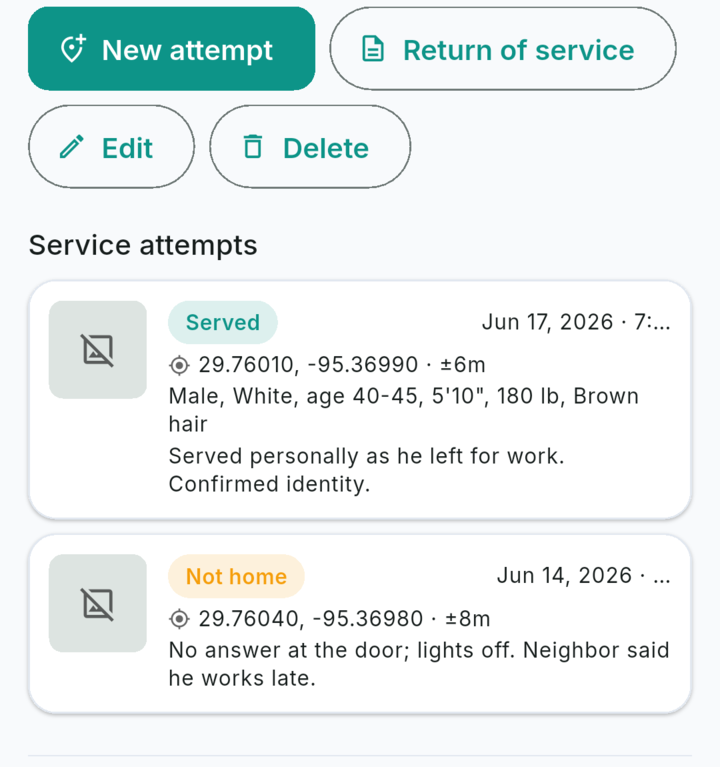
The return offers four scaffolds: generic, California, Texas and Arizona. They are field labels and a note pointing at the rule, not court forms, and you edit every line into your court’s wording. The draft POS-012 asks for the attempt rows the log already holds, so each try’s date, time and address come off your attempt records, not out of your head.
When three attempts are not enough
When none of the statutory methods works, California’s Senate Bill 85, in effect since January 1, 2026, lets a court authorise service “in any manner that is reasonably calculated to give actual notice,” naming email and “other electronic technology.” The court asks for a full account in return: the plaintiff must “set forth facts detailing all attempts to serve the defendant by each of the methods prescribed by statute,” including why each failed “at every address or location where the defendant is likely to be found.”
That is your log again, read by a judge. A gate guard who turns you away belongs in it. Under section 415.21, a staffed gated community or covered apartment building must let a registered process server in for a reasonable time on showing identification and proof of registration, so log a refusal with the time it happened.
Check the rule where you serve
This page is general information about published statutes and a draft court form, not legal advice. Local courts add their own requirements, and the final POS-012 may differ from the draft quoted here. Read your state’s current statute and your court’s rules, or ask the attorney who sent the job.
If you serve in California, run your next few jobs as if the 2027 rules already applied: three attempts on three days at three times, a stamped photo at the door each time, and every attempt written up that evening. Keeping a process server log of each attempt in ServeLog is one way to have those rows ready when the declaration asks for them.
Common questions
How many attempts does a process server have to make before substituted service in California?
From January 1, 2027, Code of Civil Procedure section 415.20(b) says reasonable diligence means good-faith attempts at personal delivery on at least three occasions, on three different days, at three different times. Before that date the statute says only 'reasonable diligence' and sets no number. In a consumer debt case, at least one of the three has to be at the person's home if it is known or could be found with reasonable effort.
Does every failed attempt need a photo in California?
Yes, for proofs of service under the 2027 version of section 417.10. Each effected or attempted personal, substituted or posting service needs a photo of the site with a readable stamp that automatically records the date, time and GPS coordinates. At a home or business the photo shows the door, or the entrance if the door cannot be reached. With no signal you explain the missing stamp, and a safety risk lets you skip the photo; both need a detailed written statement.
Does New York require a set number of attempts before nail and mail?
No. CPLR 308(4) allows affixing and mailing only where personal and suitable-age service 'cannot be made with due diligence', and it gives no number. Leaving the summons with a person of suitable age and discretion under 308(2) needs no earlier attempts at all. Your server's record under General Business Law 89-cc must list the dates, addresses and times of each attempt before a nail and mail service.
Who can accept substituted service for someone else?
It depends on the jurisdiction. California requires a competent household member or person apparently in charge who is at least 18. Florida allows anyone residing at the home who is 15 or older, and both states require that person to be told what the papers are. New York and the federal rule both say a person of suitable age and discretion.
What happens if a Florida return of service leaves out a required detail?
Florida Statutes section 48.21 says a failure to state the required facts or include the signature invalidates the service. The same subsection says the return can be amended to add them at any time on application to the court that issued the process. The facts it lists include when the papers came to hand and when they were served.
Is three attempts enough everywhere if I vary the times?
No. Outside California no statute covered here sets a number, and courts judge what you actually did, where and when. Three varied attempts is a sensible floor for a log, but the controlling rule is your state's statute and court rules. Check them before you serve.
Photos: Lisa Fotios / Pexels , Phil Evenden / Pexels , Jan van der Wolf / Pexels