















































































































































































What a Sewer Scope Report Should Include, Line by Line
A sewer scope report checklist from city CCTV rules: access point, camera direction, pipe material, distances to the foot, clock positions, what the water hid.
25 feet. Root intrusion. 6 o’clock. That is one row from the side sewer video inspection standards the City of Mercer Island, Washington, gives contractors, copied from its worked example, and it already holds most of what a sewer scope report owes its reader: how far along the pipe, what was there, and where on the pipe wall. A complete report wraps a frame around rows like that one. The address, date and reason for the visit. The access point and the direction the camera travelled. Pipe material and diameter. How far the camera got and what stopped it. Stills that match the rows, a note on what the water hid, and your own findings.
No federal rule in the US sets what a home buyer’s sewer scope report must contain. There is a stack of city and utility CCTV specifications written for contractors, and they agree on more than you might expect. This checklist is built from them.
Who reads the report after you leave
The buyer reads it first, with a closing date bearing down. If anything is wrong, a plumber reads it next to price the repair, and needs to know where to dig.
Some places make the inspection part of the sale. The East Bay Municipal Utility District in California lists buying or selling property as a trigger for its compliance certificate, “required to close escrow”, alongside remodels over $100,000 and water meter size changes, and EBMUD’s private sewer lateral program issues the certificate only when the lateral is shown to be leak-free. A seller short of time can buy an extension allowing 180 days for the work. The EPA’s guide for evaluating sewer maintenance (CMOM) programs suggests the same idea: one way to control existing connections “is to require an inspection of the lateral prior to sale of a property”, since service laterals can be a serious source of infiltration and inflow.
So write for the plumber with a shovel, and the buyer will be fine too.
1. The property, the date and why you were called
Mercer Island’s standard, written for side sewers inspected when construction or a large addition needs a permit, requires three things on the video itself: the property address, the date and time, and an ongoing footage counter. If the camera cannot overlay the first two, a whiteboard shown on screen before the camera enters the pipe is accepted. Put the same address and date at the top of the written report so the two never drift apart.
Then add the reason for the visit, because a pre-purchase scope and an insurance claim get read in different ways. Note the conditions too. Mercer’s form has a box for the weather, and a night of heavy rain explains a lot of water in a line.
2. Where the camera went in, and where zero is
Name the access point in words a stranger could find: front cleanout beside the porch steps, rodding eye at the boundary, the stack in the basement. Then say where your distances are measured from.
Mercer Island measures observations from the connection at the public main back toward the house, so in its worked example the 0 ft row is the main and the start of the video sits at 41 ft. Most home scopes run the other way, from a cleanout out toward the street. Either convention works. A report that does not say which one it used is a report where every distance can be read backwards.
The Jurupa Community Services District in California defines its lateral camera job as cleanout at the property line to mainline connection. A lateral has two ends; name both, even if the camera reached only one.
3. Which way the camera was travelling
Upstream or downstream. Mercer’s form gives it a tick box, and South West Water in England wants the direction of survey shown on screen at the start of every length and throughout it.
A plumber working from the other end needs it to flip your distances, and side-wall clock positions depend on it (item 8).
4. What the pipe is made of, and where that changes
Mercer’s form offers asbestos cement, concrete, cast or ductile iron, PVC or ABS, and other. Record every material you see and the distance where it changes, since roots tend to find their way in at joints.
One material earns its own line on any report for an older house. Bituminized fiber pipe, sold under the Orangeburg name, was accepted by the State of Michigan Plumbing Board on November 1, 1949, and the City of Ann Arbor approved it until around 1970. The City of Ann Arbor’s page on Orangeburg sewer piping describes how it fails: as the material deteriorates it “flattens due to the earth pressure around it and loses its circular cross section”, and tree roots invade, usually at the joints. Ann Arbor points to a video scan as one way to identify it from the damage pattern inside. If you think you are looking at fiber pipe, say so and say why.
If you cannot tell what a pipe is made of, write unknown. A guess written down as a fact will be quoted back to you by someone’s lawyer.
5. Diameter, in the units printed on the pipe
US residential laterals are quoted by nominal inch size, and Mercer’s form offers 3, 4, 6 and 8 inch. In the UK the same field gets slippery. Drains are described by nominal bore (100, 150, 225 mm), while plastic pipe is sold by outside diameter, so a 100 mm drain shows up as 110 on a merchant’s shelf. Write the size as it is marked or as the trade in your area names it rather than converting one system into the other.
6. How far the camera got, and why it stopped
Mercer requires the whole side sewer, from the building to the public main, “in one continuous recording”, and it rejects spliced or multi-part video. A buyer’s scope will not always manage that, which is acceptable as long as the report says where the camera stopped and what stopped it: a belly full of water, a collapse, a root mass the head would not pass, a trap.
San Diego’s television inspection specification has a rule to borrow here: if the camera cannot pass an obstruction while flow still gets through, approach it from the other end and film both sides. When that is not possible, make the run length on the report clearly the length you reached. Writing the distance you reached as the length of a pipe that carries on to the street turns a limit of your inspection into a false measurement of the pipe.
7. Every observation at its distance
Mercer wants defects and connections noted “to the nearest foot based on the on-going footage counter”, and San Diego describes the written log as “indexed to the footage counter”. A timestamp in a video file is no help to someone standing in a garden with a spade.
How accurate is the counter? South West Water’s CCTV survey specification asks for the camera position in metres and tenths, accurate to plus or minus 1 percent or 0.3 m, whichever is greater. Jurupa allows plus or minus 2 feet per 1,000 feet and wants the cable retracted to remove slack before a reading. On a push rod, take the reading once the cable is taut.
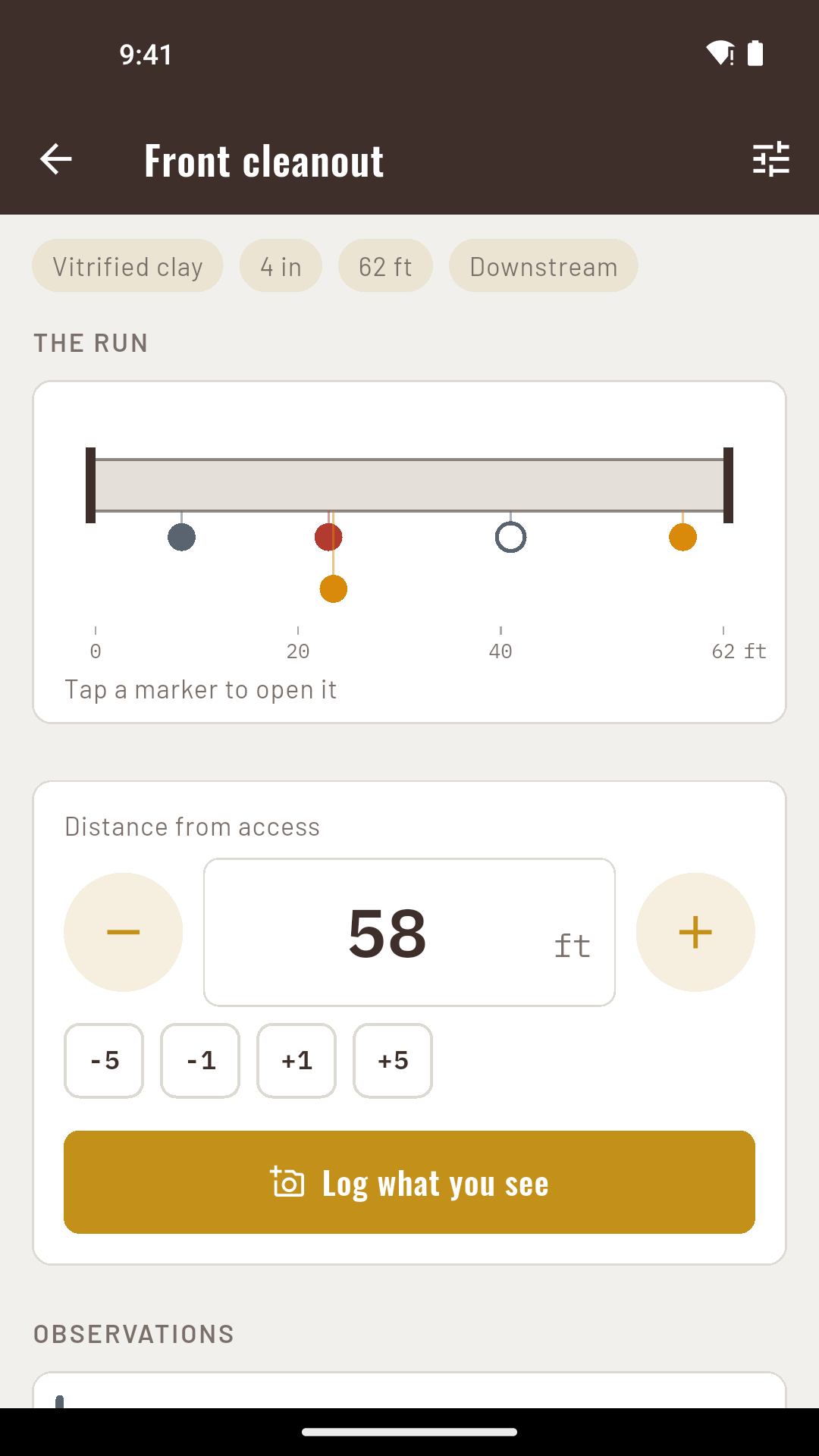
Keeping that log on a clipboard while you feed a camera is awkward. A sewer scope report app that stamps each observation with its distance is one way round it. In DrainPro you set the distance on a dial that steps in halves of a foot or a metre, pick the defect from a list and one of three severity levels, tap the clock position and attach a photo from the camera or the gallery. The run is drawn as a strip with every observation at its distance, and the same strip prints in the report.
8. A clock position, and the direction that makes it readable
Mercer’s example puts the roots at 6 o’clock, the bottom of the pipe. The convention is short: 12 is the crown, 6 is the invert, and gravity fixes both whichever way the camera points.
The trap is 3 and 9. Looking downstream, 3 o’clock is on the right-hand wall. Turn the camera round to look upstream and that same wall now sits at 9. A report that says “crack at 3 o’clock” without the direction leaves the reader guessing which side of the trench to open, and on a lateral that runs beside a driveway the wrong guess costs a section of concrete.
For a defect that spans part of the circumference, give the arc: a crack across the crown might read 11 to 1, an illustrative example rather than a reading from a real job.
9. Defect names, and whether you applied a coding standard
Municipal surveys code their defects. In North America the reference is NASSCO, whose PACP, LACP and MACP programs set condition coding for pipelines, laterals and manholes, with certification valid for 3 years. Toronto’s CCTV specification requires its coding to be done by PACP certified operators. In Britain and Europe the coding system sits in BS EN 13508-2, the BSI standard for visual inspection coding of drains and sewers, and South West Water wants its survey reports laid out in the format of the WRc Manual of Sewer Condition Classification.
Mercer Island’s form for private side sewers does not ask for PACP at all. It uses its own key of eight codes, from H for hole to S for sag. Plain names work: crack, fracture, deformation, root intrusion, displaced joint, standing water. What does not work is a report that looks coded when it is not. If you use names, say so in one sentence. If the client needs a coded survey, tell them early that it is a job for a certified operator, which saves an awkward call after the invoice.
10. Stills that match the rows
Mercer requires the camera to stop for at least 5 seconds at every defect and 30 seconds at pipe connections, pulling back and filming again if needed. South West Water asks for a photograph at the start of a continuous defect and every 5 m after it. Toronto names photo files by the position along the pipe and the defect code, so a still stays tied to its row even when someone saves it on its own.
In a PDF, a caption on each photo with the distance and the defect name does the same job. Our guide to jobsite photo documentation covers the wider habit of capturing evidence that still makes sense months later.
11. What the water hid
Mercer wants video shot “in low flow conditions that do not inhibit the view of the inside periphery” and treats heavy flow that hides the pipe as grounds for rejecting the video, “unless it is clearly due to a sag in the pipe”. That exception is the part to remember.
Water pooled over a stretch of pipe is itself a finding, and the likely cause is a belly where waste settles. Give the distance where it started and where it cleared, and say that the pipe wall under it was not seen. Debris, grease and a fogged lens get the same treatment.
12. Findings, a recommendation, and whose pipe it is
Finish with a short summary in your own words and a recommendation: monitor, clean and scope again, repair at a stated distance, or have a contractor price replacement. Keep it to what you saw. Local rules can decide it for you. Mercer Island requires side sewers with sags, root intrusion, low spots, misaligned joints, cracks or breaks, or signs of infiltration to be replaced when its permit inspection applies.
Then say whose pipe each section is, where you know. The EPA notes that customers typically own their building laterals but that municipalities “can have differing regulations pertaining to lateral ownership”. In England, shared private sewers and lateral drains outside a property’s boundary transferred to the water and sewerage companies on 1 October 2011, according to Defra’s announcement of the transfer, while a drain serving one property inside its own curtilage stays with the owner. A defect near the street end may not be the buyer’s problem at all.
This is general information, not legal or engineering advice. Time-of-sale rules and lateral ownership vary by city, county and utility, so check the current requirements with the local sewer agency before you rely on any of them.
Before your next job, put items 2, 3 and 6 on whatever you carry to the van, because a video on its own rarely makes those three clear afterwards. If you would rather the report took shape as the camera goes in, DrainPro builds the sewer scope report on the phone: it prints the direction the camera faced for every run, a cover note saying no coding standard was applied, and, when you leave the run length blank, a line saying the far end is as far as the camera reached.
Common questions
Does a sewer scope for a home sale have to be coded to PACP?
In most cases, no. Coded surveys are what cities and utilities specify for their own work, and Toronto, for one, requires its CCTV coding to be done by NASSCO PACP certified operators. A buyer's scope is normally a written record with plain defect names. If a local program, an insurer or a lender asks for a coded report, that is a separate job for a certified operator.
How accurate does the footage counter need to be?
Utility specifications give a benchmark. South West Water asks for the camera position to be accurate to plus or minus 1 percent or 0.3 m, whichever is greater, and the Jurupa Community Services District in California allows plus or minus 2 feet per 1,000 feet. On a push camera the usual error is slack in the cable, so pull it taut before you read the distance.
Which way should the camera face for clock positions?
Either way, as long as the report says which. 12 o'clock is the crown and 6 is the invert whichever direction the camera points, because gravity fixes them. The 3 and 9 positions land on opposite walls depending on whether the camera looked upstream or downstream, so state the direction for every run.
Should the video go to the client with the report?
Yes where you can, and some cities want the recording itself. Mercer Island, Washington, wants the written report submitted to the city with the recording, in one continuous video with the address, date and a running footage counter on screen. The written report then works as the index to the video, which is only possible if every row carries a distance.
Photos: Thirdman / Pexels , Sergei Starostin / Pexels