














































































































































































How to Build a Reading Habit: The 10 Mistakes That Sink It
A reading habit takes about two months to settle, not three weeks. Ten mistakes that stop it, from oversized targets to missed nights and bedtime screens.

Pick a slot you already pass through every day, read for about fifteen minutes in it, write down that you did, and expect it to take about two months before it runs without effort. That last part is where most attempts fall over. In a UCL study of how habits form, the median time to reach 95% automaticity was 66 days, and individuals ranged from 18 to 254 days. Three weeks was never a deadline anyone should hold you to.
Most people who want to read more already know how to read. What stops them is a handful of predictable mistakes. Here are ten, each with what the evidence suggests doing instead.
Expecting it to stick in three weeks
The 66 days comes from Phillippa Lally and colleagues at UCL, who asked volunteers to repeat one chosen behaviour daily in a fixed context and to rate, each day, how automatic it felt. A 2024 systematic review of health habit formation reports their result as a median of 66 days to reach 95% automaticity, with a range of 18 to 254 days. The same review describes a second study, on healthy eating, with a median of 59 days and a range of 4 to 335. In that one only 23% of participants reached the researchers’ threshold for a formed habit at all.
Look at what those people were doing. The studies in the review covered physical activity, drinking water, flossing, healthy eating and a few similar behaviours. Nobody was trying to get through a 400-page novel. Reading asks for more attention than a glass of water, so if anything you should expect the longer end.
So stop grading yourself at day 21. If reading still feels like a decision in week six, you are on schedule.
An hour a night from day one
Big targets feel motivating on the first evening and punishing on the fourth. The same UCL group, writing for doctors in the British Journal of General Practice on how habits form, noted that automaticity peaked more quickly for simple actions such as drinking water than for elaborate routines such as doing 50 sit-ups. An hour of reading after a full day of work is the sit-ups.
Fifteen minutes is not a token effort, either. A 2021 study comparing reading and listening speed cites a meta-analysis that puts average silent reading at 240 to 260 words a minute. A quarter of an hour at that pace covers 3,600 to 3,900 words. Call a page 300 words (an illustrative figure, since page sizes vary a lot between editions) and that is twelve or thirteen pages a day. On the same illustrative numbers, a 300-page novel takes a little over three weeks, and you would get through about fifteen of them in a year.
Set the floor so low that a rotten day still clears it. Reading past the floor is a bonus, never a higher bar you then fail to clear.
Reading whenever a spare minute turns up
Spare minutes never arrive at the same time twice, and habits are built on sameness. In two diary studies published in 2002, the psychologists Wood, Quinn and Kashy defined habitual behaviour as behaviour performed almost daily in stable contexts. They also found people reported less stress doing habitual things than non-habitual ones, which is the whole appeal: a settled habit stops costing willpower.
The BJGP paper turns this into a worksheet for patients. Its advice is to “choose a time and place that you encounter every day of the week,” and its worked example is “after I have lunch at home I will have a piece of fruit.” Swap the fruit for a book. Some illustrative versions:
- After I pour the first coffee, I read at the kitchen table until the cup is empty.
- When the train leaves my station, the book comes out and stays out until my stop.
- After I get into bed, I read before I touch my phone.

The anchor matters more than the hour. One more detail from the 2024 review: across the studies it covered, habits practised in the morning generally showed greater strength. Those were health behaviours, not reading, so treat it as a reason to try a morning slot first rather than as a rule.
Waiting to find the time
You will not find it. Nobody does, because the day is already full of something.
The US government’s American Time Use Survey for 2025 shows where the hours go. People aged 15 and over averaged 0.27 hours a day reading, about 16 minutes, and 2.61 hours watching TV, a little over two and a half hours. The split by age is sharper still: 25 to 34 year olds averaged 0.17 hours of reading, about ten minutes, while those aged 75 and over averaged 0.62 hours, around 37 minutes.
And fewer adults read books at all. The National Endowment for the Arts reported from its 2022 survey that 48.5% of US adults had read at least one book in the past year, down from 52.7% five years earlier and 54.6% ten years earlier.
The fix is to take the time from a named activity rather than hope it appears. Fifteen minutes out of the average day’s television is under a tenth of it. Decide which fifteen, and say it out loud if that helps.
Letting one missed night become two
The guilt after a missed day does more damage than the missed day. On that point the habit research is reassuring: the BJGP paper reports that missing the occasional opportunity “did not seriously impair the habit formation process,” and that gains soon resumed after one missed performance.
What does hurt is the second miss, because by then you are no longer reading less, you are not reading. My rule is blunt. If you read on Monday and miss Tuesday, Wednesday is the only night of the week that matters. Read two pages on Wednesday if that is all you have, and the run is intact.
Reading what you think you ought to
A habit built on a book you dread is a habit of avoiding that book. Enjoyment is what keeps the thing running.
The clearest numbers come from children, not adults, so read them with that in mind. The National Literacy Trust’s 2026 survey of more than 125,000 UK children and young people found that 49.8% of the children and young people who enjoyed reading read daily, against 4.5% of those who did not. The Trust’s 2025 survey found that 37.1% were motivated to read when the material matched their interests or hobbies, and 26.6% valued having the freedom to choose what they read.
The adult habit studies point the same way. The 2024 review found that self-selected habits generally showed greater strength, and in one physical activity study it covered, enjoyment of the behaviour was among the significant mediators of habit formation.
In practice that means three permissions. Abandon a book that is not working by page 50. Read the thriller, the romance, the cookbook or the comic, because all of them count. Reread an old favourite when you are stuck, since a book you know is the easiest one to open on a tired night.
Ending the day on a bright screen
Reading in bed is one of the easiest cues there is. Reading in bed on a backlit screen comes with a cost.
In a 2015 study in the Proceedings of the National Academy of Sciences, Chang and colleagues at Brigham and Women’s Hospital compared reading a book on a light-emitting device with reading a printed book in the hours before bedtime. On the device, participants took longer to fall asleep, had reduced melatonin secretion, showed later timing of their circadian clock and were less alert the next morning. The study tested a light-emitting reader against paper, so it does not tell you how a dimmed phone with a warm screen compares.
If bedtime is your slot, keep a printed book for it and do your phone or tablet reading earlier in the evening, on the commute or over lunch. If the only copy you own is on your phone, reading it is still better than scrolling something else on the same screen.
Deciding audiobooks do not count
Some readers treat listening as cheating. The research is less fussy. In the 2021 study on reading and listening speed, listening comprehension held up when speech was played at 270 words a minute and dropped steeply at 315, and the most efficient listening rate was on par with the participants’ own silent reading rate for the same texts, 269 words a minute on average. The authors concluded that “listening and reading follow the same time constraints.”
Audio also lets you attach a book to something you already do every day. Milkman, Minson and Volpp, at Wharton and Harvard, tested that idea in a 2014 study they called temptation bundling: participants could listen to page-turner audiobooks only while at the gym. At first, people with gym-only access went to the gym 51% more often than the control group, and those simply encouraged to save the audiobooks for the gym went 29% more often. The effect faded over time, especially after Thanksgiving, and 61% of participants later chose to pay for gym-only access to the audiobooks.
Two lessons sit in there. Pairing a story with a fixed chore made people turn up for the chore more often, and the same pairing hands the book a daily slot. And holidays break routines, so expect a wobble in late December and plan the restart.
Keeping the record in your head
Memory is generous. It will tell you that you read most evenings this month when the true answer is, say, nine.
A 2016 meta-analysis in Psychological Bulletin pulled together 138 studies with 19,951 participants, each of which randomly assigned people either to an intervention that prompted them to monitor progress towards a goal or to a control condition. Monitoring promoted goal attainment, and the effect was larger when the information was physically recorded and when it was reported or made public. A paper notebook with the date, the minutes and the page you reached does that job perfectly well.
If you read on an Android phone, Storyshelf is a reading tracker that logs your sessions and keeps the streak without a notebook. Its Log a session sheet takes the page you reached and the minutes, typed in or timed in the app, and books you read inside its own EPUB reader are logged without you starting anything: any stretch of three minutes or more is recorded, and leaving the app ends the session, so a phone left face-down on the sofa does not invent hours of reading. A day counts towards the streak when you logged a session or finished a book that day, and a reader session that runs past midnight is split so both days get the credit.
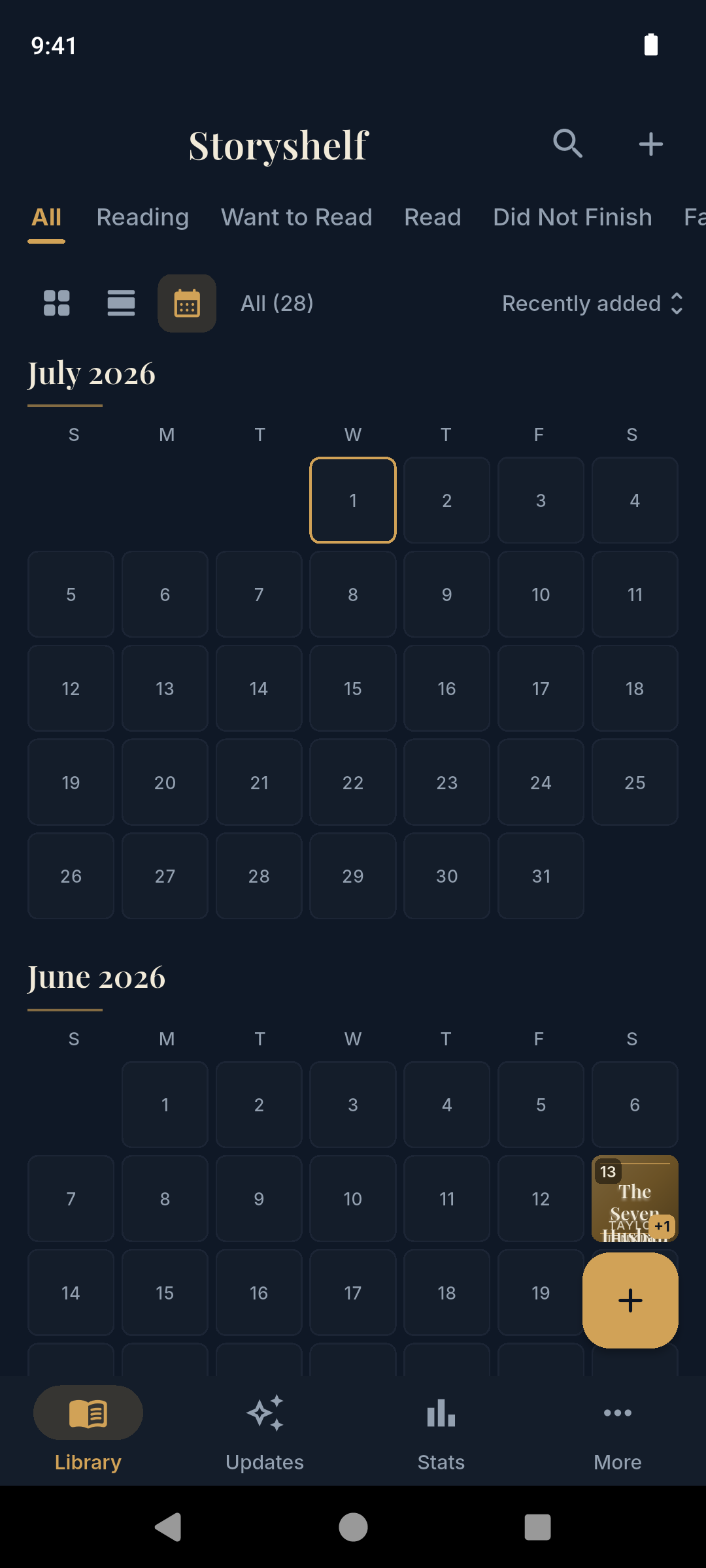
Two more details. The streak stays alive if you logged today or yesterday, so it does not drop to zero at breakfast just because you read at night. Books you give up on can be marked Did Not Finish, and while that view is empty it says “Did-Not-Finish is a perfectly good shelf. No guilt here.”
Counting books instead of hours
A yearly book count has a quiet side effect. It rewards short books and turns an 800-page novel into a debt.
Time is the better measure, and it is what one large study of reading and lifespan measured. Avni Bavishi, Martin Slade and Becca Levy at Yale followed 3,635 people from the US Health and Retirement Study for up to 12 years, grouping them by hours of book reading per week: none, up to 3.49, and 3.5 or more. In their paper on book reading and longevity, book readers had a 20% lower risk of dying over the follow-up than non-book readers after adjusting for age, education, health, wealth and other factors, and the authors summed it up as reading for an average of 30 minutes a day, a chapter a day. It is an observational study, so it shows an association rather than proof that reading caused the longer lives.
Thirty minutes a day is 3.5 hours a week. That makes a weekly minutes target, or a simple tally of reading days, a fairer score than titles finished. Keep a book count if you enjoy it, but set it after a few months of logging, from what you read, not from a round number that sounded good in January.
What to do tonight
Choose the anchor: the coffee, the train or the pillow. Choose the book, and make it one you want to open, not one you think you should. Put a pen and notebook beside it, or put Storyshelf on your phone, and log tonight’s fifteen minutes as session one. Then do the same tomorrow, and if tomorrow goes wrong, the night after.
Common questions
How long does it take to build a reading habit?
Plan on about two months. In a UCL study of how habits form, the median time to reach 95% automaticity was 66 days, with individuals ranging from 18 to 254 days. Those participants were forming health habits such as eating fruit or going for a walk, so treat the figure as a guide for reading rather than a promise.
How many minutes a day should I read to build the habit?
Pick a floor small enough that a bad day still clears it, such as fifteen minutes. At the average silent reading speed of 240 to 260 words a minute, that is 3,600 to 3,900 words, or about twelve pages if you assume an illustrative 300 words a page. Read longer when the book pulls you along, but keep the minimum easy.
Does missing a day ruin a reading habit?
No. In habit research, missing an occasional day did not seriously set people back, and progress picked up again after a single missed performance. The risk is letting one missed night turn into a second, so make the night after a miss the one you protect.
Do audiobooks count towards a reading habit?
For building the habit, yes. One study found the most efficient listening rate was on par with silent reading rate for the same texts, and its authors concluded that listening and reading follow the same time constraints. Audio also lets you attach a book to something you already do every day, such as a commute or a walk.
Photos: Rahul Shah / Pexels , freestocks.org / Pexels