













































































































































































Legionella ACoP L8: Mistakes the Responsible Person Makes
What ACoP L8 expects of the legionella responsible person, and the risk assessment, sentinel temperature and record keeping mistakes that leave a gap.
ACoP L8 asks whoever controls a building’s water for five things: an assessment of the legionella risk, a named responsible person, a written control scheme, regular checks that the controls work, and the results of those checks kept for at least five years. Where responsible people come unstuck is in the gaps between the items, and almost never through anything exotic. It is a tap nobody ran, a risk assessment nobody reopened, or a logbook that stops in March.
This is for the UK dutyholder or responsible person in a smaller setting: a landlord with a couple of shared houses, a care home manager, a plumber who looks after other people’s systems. These are the eleven mistakes that show the moment someone asks to see your paperwork.
Treating L8 as advice you can take or leave
L8 is an Approved Code of Practice, first published in 1991 and now in its fourth edition from 2013. People read “code of practice” as “suggestions”. The free copy of L8 on the HSE site puts it plainly: “the Code has a special legal status.” If you are prosecuted and you did not follow the relevant parts, you have to show you complied with the law some other way, or a court will find you at fault.
You can do things differently. You then have to prove your way worked.
The temperatures and frequencies sit in a separate HSE book, HSG274. The stakes are not abstract. The UKHSA report on legionellosis for 2024 counted 463 confirmed cases of Legionnaires’ disease in England and Wales that year and 13 deaths, with 63.9% of cases in people aged 60 and over. HSE warns that anyone running a care home is likely to have residents at higher risk.
Nobody’s name on the job, or only one name
The dutyholder, in L8’s words, “should specifically appoint a competent person or persons” to take day-to-day responsibility, the role it calls the responsible person. HSE adds that this can be you, one or more of your workers, or someone from outside the business. A self-employed dutyholder who is competent may appoint themselves.
The first mistake is assuming everyone knows it is you. HSE’s own audit questions include “Has a responsible person(s) been identified in writing?”, so the written scheme should name you.
Then there is cover. L8 expects arrangements so that “the responsible person, or an authorised deputy, can be contacted at all times”, and the records should name people’s deputies as well. A fortnight of annual leave is when a sentinel check goes missing. And when the named person leaves, L8 lists “changes to key personnel” as a reason to review the risk assessment.
A risk assessment filed and forgotten
Under regulation 6 of the COSHH Regulations 2002, a risk assessment “shall be reviewed regularly and forthwith” if there is reason to suspect it is no longer valid or the work it covers has changed significantly. L8 spells out the triggers: changes to the water system or its use, changes to the use of the building, new information about risks, checks showing the controls no longer work, changes of key staff, and a case of the disease linked to the system.
Notice what is missing from that list. A date.
HSE’s landlord guidance says “the law does not prescribe that the risk assessment be reviewed on an annual or biennial basis.” A two-year-old assessment of an unchanged building can be perfectly sound. A three-month-old one is already wrong if you have since added an en-suite, taken out a loft tank or turned a storeroom into a bedroom. Read it against the building you have today, not against the calendar.
While it is open: if you employ five or more people, COSHH requires you to record the significant findings; with fewer than five, HSE says you do not have to write anything down, though it is useful to. If someone else does the assessment, ask whether they work to BS 8580-1:2019, the British Standard code of practice for legionella risk assessments and their reviews.
Paying for a test certificate instead of reading a thermometer
Plenty of landlords have been sold a “legionella certificate”. HSE’s guidance on legionella and landlords’ responsibilities is blunt: “Health and safety law does not require landlords to obtain or produce a ‘legionella test certificate’.” The same page says testing for legionella “should not be confused with temperature monitoring, which is a reliable method for confirming the water system is under control.”
For enclosed hot and cold water systems, HSE says microbiological monitoring “is therefore not usually required.” Sampling has its place, for instance where the recommended temperatures are not being consistently achieved. It follows a problem the thermometer found first; it never replaces the thermometer. A similar myth hangs around electrical appliances, which our piece on whether landlords need PAT testing untangles.
Taking temperatures at whichever tap is handy
Monthly temperature checks are taken at sentinel outlets, and the word has a meaning. HSE’s guidance for care settings says to identify sentinel outlets as the “furthest and closest to each tank or cylinder”. HSG274 adds that the layout of the pipework decides it, not where the tap happens to be, and that more complex systems are likely to have several far sentinels, one at the end of each riser, for example.
The kitchen tap by the office door is rarely a far sentinel. It is the easiest one to reach.
HSE also expects representative outlets to be checked on a rotation, chosen so that “the entire system is covered over a period of time.” Say a three-storey shared house is fed from a loft tank. It might have the top-floor bathroom as its near sentinel, the ground-floor kitchen at the end of the longest run as its far sentinel, and the other basins and showers rotated through the year. The risk assessment sets the real list.
Stopping the clock too early, or too late
The figures from HSE’s page on hot and cold water systems, things to consider: hot water “should be at least 50°C within 1 minute of running the water”, and after running a cold sentinel for 2 minutes “the temperature should be below 20°C.” HSE’s page on reviewing what you do gives 55°C rather than 50°C for healthcare premises, so check which figure your own risk assessment uses.
The common error is writing down the final number and nothing else. An illustrative case: a hot tap that crawls to 51°C after three minutes looks fine in a column of temperatures, and it is not what the guidance describes. HSG274 makes the same point about cold water: observe the thermometer during flushing, because local heat gain “might not be apparent after one minute”. The time it took is part of the reading.
That is the job a water temperature monitoring log should be built around. In LegioCheck, a hot or cold sentinel reading stores the run time in seconds next to the temperature, with the reference line for that task on the form. The temperature is labelled “Within guidance” or “Outside guidance value” against that line, and the seconds stay on the record beside it, so a slow tap shows up in the log. The app never marks anything as a pass.
Forgetting the cylinder and the cold tank
Taps get the attention. The two things that set the temperature of everything downstream are the hot water cylinder, or calorifier, and the cold water storage tank.
HSE says hot water “should be stored at 60°C at least” and that legionella bacteria “do not survive above 60°C” and are “dormant below 20°C”. Between 20°C and 45°C they can grow. Its guidance for care settings says to check the cylinder temperatures every month and the cold tank temperatures at least every six months; HSG274 adds that the calorifier return should not fall below 50°C. For the tank, HSE suggests measuring at the ball valve outlet every six months and keeping a tight-fitting lid and an air vent on it.
Picture a loft tank that reaches 23°C every July. It is telling you something about insulation or about how much water it holds, and the six-monthly check is where you find out.
Leaving the spare-room shower alone for a month

Among the sources the NHS page on Legionnaires’ disease lists are “taps and showers that are not used often”. Drinking the water is not usually how people catch it, the same page says. Breathing in fine droplets is, and a shower makes them.
HSE’s answer is a weekly flushing programme for infrequently used outlets, purged to drain without spraying aerosols about, and showerheads dismantled, cleaned and descaled quarterly or as the risk assessment decides. HSE’s landlord guidance adds that outlets “should be used at least once a week”, and that a property standing empty for long needs a flushing regime or draining.
The ones that get missed are predictable: the guest room, the accessible toilet nobody uses, the flat between tenants. Put them on the list by name.
Logging a bad reading and moving on
A temperature outside guidance, written neatly in the log with nothing after it, is arguably worse than no reading at all. It shows you knew.
HSE’s guidance on the written control scheme expects you to keep records of “other actions taken, such as maintenance or repair work”. L8 names checks showing the controls are no longer effective as a reason to review the risk assessment, and HSE says testing for legionella may be needed where recommended temperatures are not being consistently achieved. Suppose a cold sentinel reads 22°C. That reading should lead somewhere: a cause, an action, a date it was put right, and a re-check.
LegioCheck builds that step into the monitoring round. Its end-of-round summary lists every reading outside guidance, each with a button that opens a defect with the cause filled in, such as the outlet’s name and “Cold sentinel temperature outside guidance value”. The defect then carries the action taken, the date raised and whether it has been resolved.
A logbook nobody could hand over
Under HSE’s page on monitoring and keeping records, records of monitoring inspections should be kept “for at least 5 years”, and other records for as long as they remain current and for at least two years after that. The records should cover who is responsible, the significant findings of the risk assessment, the written scheme and how it has been carried out, whether the system is in use, and “results of any monitoring inspection, test or check carried out, and the dates”. L8 adds that records should be signed, verified or authenticated by the people who did the work.
As an illustrative count, a building with only a near and a far sentinel, each read hot and cold every month, produces 240 readings in five years before the cylinder and tank are added. On paper, that is a box file; spread across spreadsheets, it is a lost weekend the day a CQC inspector or an insurer asks.
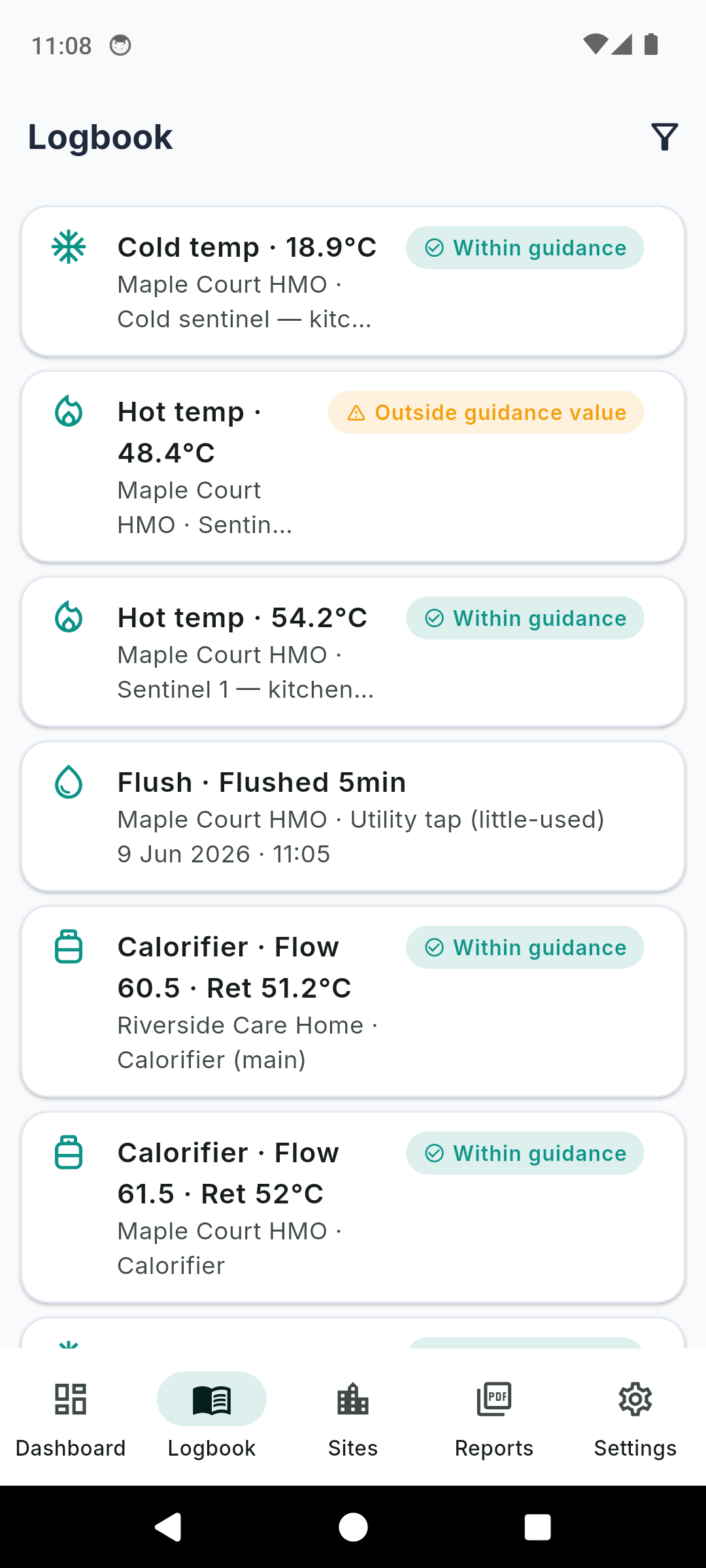
With the full version of LegioCheck, every site keeps its own outlet register, and the Reports screen exports a dated audit PDF for any of them whenever someone asks. The PDF opens with the property, address, responsible person and date range, then the asset register with each outlet’s type, location and frequency, the readings grouped by task with the reference target printed above each group, the defect register with causes, actions and dates, and the operator’s signature.
Assuming the contractor carries the duty
Hiring a water hygiene firm does not move the duty. HSE’s guidance on managing the risk is that if you use contractors for water treatment or other work, “it is still the responsibility of the competent person to ensure the treatment is carried out to the required standards.”
HSE’s audit questions ask whether you have checked the contractor’s competence, including membership of professional organisations or a recognised trade body. HSE’s own legionella pages point to the Legionella Control Association, founded in 1999, whose Code of Conduct now sets out nine Service Provider Requirements that members must have management processes for. Membership tells you a firm has signed up to a standard, not that their technician ran your far sentinel for the full two minutes last month. Ask for the readings and keep them with your own.
Before anyone asks to see it
If you do one thing this month, open the written scheme and check that the names in it are the right people today, deputy included. Then walk the building with the risk assessment in your hand and see whether it describes what is there now.
After that, the habits live in the monthly round: a timer in your pocket at the far sentinel, and a defect raised for anything outside guidance.
This post is general information, not professional or legal advice, and it is no substitute for a risk assessment by a competent person. Check the current wording of L8 and HSG274 on the HSE website, or ask a competent person, before you rely on any figure here.
If your monitoring lives on a clipboard, set up your sentinel outlets, cylinder and tank in LegioCheck, a legionella monitoring log with a dated audit PDF, and let the next round be the first one you would be happy to hand over.
Common questions
Who can be the responsible person for legionella?
Anyone the dutyholder appoints who has enough authority, competence and knowledge of the system to make sure the controls are carried out on time. HSE says it can be you, one or more of your workers, or someone from outside the business, and a competent self-employed dutyholder may appoint themselves. Name a deputy as well, because L8 expects the responsible person or an authorised deputy to be contactable at all times.
How long do legionella records have to be kept?
The results of monitoring, inspections, tests and checks, with their dates, should be kept for at least five years. Other records, such as the risk assessment and the written scheme, are kept for as long as they are current and for at least two years after that.
How often should a legionella risk assessment be reviewed?
Regularly, and straight away whenever there is reason to think it no longer fits, for example after changes to the water system, a change in how the building is used, a change of key staff, or checks showing the controls are not working. HSE says the law does not set a fixed annual or two-yearly review date.
Do landlords need a legionella test certificate?
No. HSE states that health and safety law does not require landlords to obtain or produce a legionella test certificate. What it expects is a proportionate risk assessment and simple controls, and it describes temperature monitoring as a reliable way of confirming the system is under control.
What temperature should a sentinel tap reach?
HSE's guidance is that hot water should reach at least 50°C within one minute of running, or 55°C in healthcare premises, and cold water should be below 20°C after the tap has run for two minutes. Sentinel outlets are normally checked monthly and are the taps nearest to and furthest from each tank or cylinder.
Photos: Karolina Grabowska / Pexels , Pixabay / Pexels