


















































































































































What Happens to Your Body When You Stop Drinking
What the NHS and the research say happens after your last drink: withdrawal in the first 72 hours, then sleep, liver, blood pressure and weight changes.

If you drink heavily every day, the first thing that happens when you stop may be withdrawal, and the NHS says it begins within 6 to 12 hours of your last drink and usually lasts 3 to 7 days. For someone who is dependent on alcohol, stopping suddenly can be dangerous. That is why it comes first here, and not in a footnote at the bottom.
If you drink less than that, withdrawal is unlikely to be your story, and the NHS says cutting down should leave you feeling more rested when you wake up. The changes a doctor can measure, such as blood pressure, liver enzymes, insulin resistance and weight, show up over about a month in the studies that have looked. Cancer risk moves slowest of all, over years.
Below is what the health agencies and the research report, stage by stage, with the size of each change and who was studied.
Should you stop all at once? Check this first
The US National Institute on Alcohol Abuse and Alcoholism (NIAAA) draws the heavy drinking line at five or more drinks on any day, or 15 or more a week, for men, and four or more on any day, or eight or more a week, for women. Those figures are in the NIAAA’s definitions of moderate, binge and heavy drinking. A US standard drink holds 14 grams of pure alcohol, about a 12 ounce beer at 5 percent. A UK unit is 8 grams.
Being over those lines does not automatically mean you are dependent. Withdrawal symptoms are the clearer sign. The NHS lists them as anxiety, difficulty sleeping, nausea and vomiting, a racing heartbeat, sweating and shaking, hallucinations, confusion and seizures, and says plainly that getting them when you stop or cut down “is a sign your body is dependent on alcohol.”
If that describes you, the advice on the NHS page on treating alcohol-use disorder is to get medical help before you try to stop. The NHS alcohol support page goes further: for someone physically dependent, stopping overnight could be harmful, and you should get advice about any medicine you may need to do it safely.
Most readers are not in that group. For the ones who are, a “just stop tomorrow” plan carries real risk.
The first three days
Withdrawal has a fairly predictable clock. The NHS puts the start at 6 to 12 hours after the last drink. MedlinePlus, the US National Library of Medicine’s entry on alcohol withdrawal, says symptoms tend to appear within 8 hours, though they can start days later, and tend to peak by 24 to 72 hours.
So the second or third day can be harder than the first. Feeling fine on the first morning is not proof that you were never at risk; on that timing, it is simply too early to tell.
MedlinePlus describes delirium tremens as a severe form of withdrawal and says withdrawal “may quickly become life-threatening.” People with moderate to severe symptoms may need hospital treatment. The NHS signs that mean calling 999 or going to A&E include shaking visibly, confusion such as not knowing what day it is, seeing or hearing things that are not there, and having a seizure. Its instruction is blunt: do not drive yourself to A&E; ask someone to drive you or call for an ambulance. Outside the UK, call your local emergency number.
The NHS ties these symptoms to dependence, so a lighter drinker may get none of them. What is left is the habit, the hour of the evening when a glass would normally be poured, and that is a planning problem rather than a medical one.
Why does sleep get worse before it gets better?
Difficulty sleeping is on the NHS list of withdrawal symptoms, and for people who were dependent it can outlast the rest of withdrawal by weeks. The fullest account of this is Kirk Brower’s 2001 review of alcohol and sleep in Alcohol Research and Health.
Brower describes REM rebound: during withdrawal, the share of sleep spent in REM rose and even exceeded the levels measured before. One study Brower cites found that insomnia was a common symptom that persisted for approximately five weeks. Some sleep abnormalities lasted one to three years after drinking stopped, and total sleep time took one to two years to return to normal.
Those figures come from people who had been dependent on alcohol, so a moderate drinker taking a month off should not expect the same.
The finding that matters most for anyone trying to stay stopped is a different one. Brower lists insomnia, especially difficulty falling asleep, among the sleep predictors of relapse. On that five-week timing, bad nights in week three would not be unusual. Raise them with a doctor rather than treating them with a nightcap.
What one month without alcohol did in a study
The most useful measurement of a month off that I have found is Mehta and colleagues’ 2018 paper in BMJ Open. It followed 94 people who chose to stop for a month and 47 who kept drinking.
The abstinence group were not light drinkers. Their average at the start was 258.2 grams of alcohol a week. By my arithmetic that is about 32 UK units, or about 18 US standard drinks, well past the NHS guideline of 14 units.
After a month, the median changes in that group were:
| Measure | Median change after one month |
|---|---|
| Insulin resistance (HOMA score) | down 25.9 percent |
| Systolic blood pressure | down 6.6 percent |
| Diastolic blood pressure | down 6.3 percent |
| Weight | down 1.5 percent |
| ALT, a liver enzyme | down 14.5 percent |
| Gamma GT, a liver enzyme | down 28.6 percent |
| VEGF, a cancer-related growth factor | down 41.8 percent |
| EGF, a cancer-related growth factor | down 73.9 percent |
The authors report that none of these changes were associated with changes in diet, exercise or smoking.
Two cautions. People picked their own group, and the authors list the lack of randomisation as a limitation. And a median hides spread: for insulin resistance, the middle half of the group ranged from a fall of 48.6 percent to a rise of 0.3 percent.
Your liver: what can recover and what cannot
The NHS describes alcohol-related liver disease in three stages, and the answer to “will it heal” is different at each one. At the fatty liver stage, the liver can usually recover if you stop drinking. With alcohol-related hepatitis, it may be able to recover from some of the damage. At cirrhosis, the liver is badly damaged and scarred, and that damage cannot usually be reversed.
The awkward part is that alcohol-related liver disease does not always cause symptoms in the early stages, according to the NHS. Feeling well tells you very little about which stage you are at.
The NHS page does not attach a number of weeks to recovery, and I would be wary of any chart that does. The nearest measured figure is the one above: in the BMJ Open group, ALT fell by 14.5 percent and gamma GT by 28.6 percent within a month.
Blood pressure: who sees the biggest drop?
Heavy drinkers, by a wide margin. Roerecke and colleagues’ 2017 meta-analysis in The Lancet Public Health pooled 36 trials with 2,865 participants, of whom 2,464 were men and 401 women.
For people drinking two or fewer drinks a day, cutting down was not associated with a significant reduction in blood pressure. The largest effect was in people drinking six or more drinks a day who cut by about half: systolic pressure fell by an average of 5.5 mm Hg and diastolic by 3.97 mm Hg. The authors describe a dose-dependent effect with an apparent threshold.
So if you had two glasses of wine at the weekend, do not expect the cuff at your next check-up to notice. If you were well past the heavy drinking line, it may be one of the clearest numbers you see move.
Weight, calories and that 1.5 percent
The NHS puts a pint of 5 percent beer at up to 222 kcal and a 175 ml glass of 12 percent wine at up to 158 kcal. Alcohol itself carries 7 calories per gram, almost as many as fat.
As an illustration, someone drinking four pints on each of three evenings a week takes in about 2,664 kcal a week from the beer alone, if each pint is at the NHS upper figure. That is a lot to remove from a week.
Yet the measured result is modest. In the BMJ Open study, median weight fell by 1.5 percent over the month, about 1.2 kg for an illustrative 80 kg person. What replaces the drinks decides much of the rest.
The brain in the first fortnight
In a 2013 study in Alcoholism: Clinical and Experimental Research, van Eijk and colleagues scanned 49 alcohol-dependent patients within 24 hours of detoxification and again after two weeks of supervised abstinence, and compared them with 55 healthy controls.
On day one, grey matter volume was smaller in the patients than in the controls. After two weeks, the authors found a significant but partial recovery of grey matter volume in several brain regions. They concluded that recovery starts within a few days of detoxification and that its speed differs from one region to another.
Partial is the word to keep, and the patients were dependent drinkers under supervision.
Mood and energy over the first weeks
Anxiety is on the NHS list of withdrawal symptoms, so the first days can feel worse, not better.
After that, the NHS advice on cutting down says it may put you in a better mood generally, and lists feeling more energetic among the effects people notice soon. Its page on the risks of drinking adds that regular drinking at high-risk levels can make your mental health worse.
If low mood or anxiety is getting heavier after the first couple of weeks rather than lighter, that is a reason to see a GP, not a stage to push through alone.
Why the neat day-by-day charts mislead
The popular “day 1, day 3, week 2, month 1” graphics tend to stack findings from different kinds of people into one line, as if they all applied to you. Laid out by who was studied, they look like this:
| Change | When it was seen | Who was studied | Source |
|---|---|---|---|
| Withdrawal begins, then peaks | 6 to 12 hours; peak by 24 to 72 hours | People dependent on alcohol | NHS, MedlinePlus |
| Grey matter partly recovers | 2 weeks | 49 dependent patients | van Eijk, 2013 |
| Insomnia | About 5 weeks; some changes 1 to 3 years | People recovering from dependence | Brower, 2001 |
| Insulin resistance, blood pressure, liver enzymes fall | 1 month | 94 moderate to heavy drinkers, not randomised | Mehta, 2018 |
| Blood pressure falls by about 5.5/4 mm Hg | Across 36 trials | People on six or more drinks a day who cut by about half | Roerecke, 2017 |
| Fatty liver can recover | No fixed time given | People at the fatty liver stage | NHS |
| Fewer mouth and oesophagus cancers | No timeline given | Evidence reviewed by IARC | IARC, 2024 |
A moderate drinker reading the dependent-patient rows will expect too much drama in week one. A heavy drinker reading only the month-off row may expect too little risk.
Cancer risk is the slow one
The World Health Organization’s European office stated in January 2023 that no level of alcohol consumption is safe for health, that alcohol causes at least seven types of cancer, and that the risk starts from the first drop.
The reverse direction was reviewed a year later. In January 2024 the International Agency for Research on Cancer’s summary of Handbook Volume 20A reported sufficient evidence that reducing or stopping alcohol reduces the incidence of cancers of the oral cavity and the oesophagus, with limited evidence for the larynx, colorectum and breast. The page does not give a timeline, and nobody should promise you one.
In the US, the CDC estimates that about 178,000 people die from excessive alcohol use each year. Its summary line is simple: drinking less is better for your health than drinking more.
If you drink again
It is common enough that the research treats it as part of the condition. The National Institute on Drug Abuse’s guide to treatment and recovery puts relapse rates for substance use disorders at 40 to 60 percent, similar to the 50 to 70 percent it gives for hypertension and asthma, and says relapse does not mean treatment has failed.
What helps afterwards is a record. Brower’s link between insomnia and relapse is the kind of pattern you only see if you wrote down how you had slept and what had happened that day.
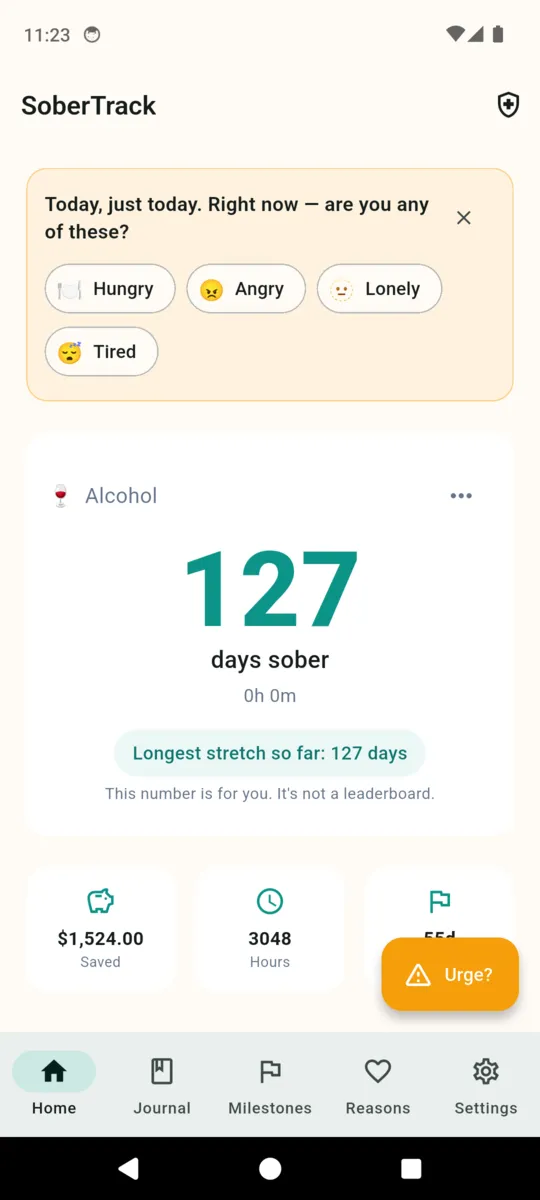
That is the reasoning behind how SoberTrack handles a reset. It is a sober day counter that keeps your earlier streaks when you press Restart counter: the length of the run you had is stored, and the home screen goes on showing your longest stretch so far. The reset screen asks, if you want to answer, whether you were hungry, angry, lonely or tired, and has room for another trigger and a short note to read next time.
Where to get help
In the UK, the NHS says a good place to start is with a GP, and asks you to be accurate and honest about how much you drink. Drinkline, the national alcohol helpline, is on 0300 123 1110, weekdays 9am to 8pm and weekends 11am to 4pm.
In the US, start with your own doctor. You would not be unusual in needing help: the NIAAA reports that 27.9 million people aged 12 and older had alcohol use disorder in the past year in the 2024 National Survey on Drug Use and Health, and that only 2.1 million of them, about 7.5 percent, received treatment for it.
This article is general information, not medical advice. If you drink heavily or have had withdrawal symptoms before, speak to your GP or doctor before you stop, and call 999 in the UK or your local emergency number if you see any of the severe signs described above.
Once you have that conversation behind you, or you know you are nowhere near the heavy drinking line, pick a start date and note how you slept the night before. Then let SoberTrack count the days from there. At the one-month mark, ask your GP whether a blood pressure check or a liver blood test makes sense for you; a month is when the BMJ Open group’s numbers had moved.
Common questions
How long does alcohol withdrawal last?
The NHS says withdrawal symptoms begin within 6 to 12 hours of the last drink and usually last 3 to 7 days, though some can last a few months in people who drank heavily. MedlinePlus says symptoms tend to peak between 24 and 72 hours. If you are dependent on alcohol, get medical advice before you stop rather than waiting to see how it goes.
Is it dangerous to stop drinking suddenly?
It can be. The NHS says it can be very dangerous to stop drinking suddenly if you are dependent on alcohol, and that stopping overnight could be harmful for someone who is physically dependent. Shaking, sweating or a racing heart when you go without a drink are withdrawal symptoms, and the NHS treats them as a sign of dependence. Speak to a GP or doctor first; they can advise on medicine to make it safer.
How long does it take for the liver to recover after you stop drinking?
It depends on the stage of damage. The NHS says a fatty liver can usually recover if you stop drinking, some damage from alcohol-related hepatitis may recover, and cirrhosis cannot usually be reversed. In one study of moderate to heavy drinkers, two liver enzymes, ALT and gamma GT, fell by 14.5 and 28.6 percent after a month without alcohol.
Why is it hard to sleep after you stop drinking?
Difficulty sleeping is one of the NHS's listed withdrawal symptoms, and it can last. A review in Alcohol Research and Health cites a study in which insomnia persisted for about five weeks in people recovering from alcohol dependence, and reports that some sleep changes lasted one to three years. Tell your doctor if it goes on, because the same review lists insomnia as a predictor of relapse.
Will I lose weight if I stop drinking?
Some people do, but not much in a month. In the BMJ Open study of 94 people who stopped for a month, the median weight change was a fall of 1.5 percent. The NHS puts a pint of 5 percent beer at up to 222 kcal, so the result depends on how much you drank and what replaces it.
Photos: David Kanigan / Pexels , Polina / Pexels , Mikhail Nilov / Pexels