





















































































































































































What to Record in a Headache Diary for Your Doctor
Eight things to record in a headache diary for a GP or neurologist, from headache days and painkiller days to your period, and why NICE asks for eight weeks.

When a headache diary is used to help with diagnosis, NICE asks for five things recorded for at least eight weeks: how often, how long and how bad each headache was; any other symptoms; every medicine taken for it, prescribed or bought over the counter; possible triggers; and how the headaches line up with periods. That list sits in NICE’s guideline on headaches in over 12s, recommendation 1.1.4.
Each item hides more detail than it first appears to. Below is the checklist, with the number a doctor will hold each line against.
Why eight weeks, and why memory will not do
In McKenzie and Cutrer’s 2009 study in Headache, from the Mayo Clinic, 209 people with migraine kept a daily diary for four weeks, then filled in a questionnaire about the same four weeks from memory. The counts came out close: a recalled headache frequency of 14.7 against 15.1 in the diaries. Severity did not. On a 0 to 3 scale, people remembered an average of 1.84; the diaries said 1.63. The authors concluded that for an individual patient the daily diary is preferable when there is one.
Memory gets the rough count and inflates the pain. Eight weeks of daily entries is the floor NICE sets.
1. Every day you had a headache, mild ones included
Count days, not attacks. NICE defines chronic migraine as headache on 15 or more days a month, with at least 8 of those days having features of migraine, for more than three months. Below 15 days it is episodic.
The ICHD-3 entry for chronic migraine, the International Headache Society’s classification, counts tension-type-like days as well as migraine-like ones toward that 15. It also says frequently recurring headache generally needs a diary recording pain and associated symptoms day by day for at least one month.
So a dull ache you shrugged off on a Thursday counts as a headache day, and an illustrative month with eleven bad days and five mild ones is a 16-day month. Write a line on the clear days too. A blank page could mean a good day or a day you forgot.
2. When it started, and when it ended
Start time is easy. The end is where diaries go vague.
Duration is one of the main ways the common types are told apart. In NICE’s diagnostic table, tension-type headache lasts from 30 minutes to continuous, migraine 4 to 72 hours in adults, and cluster headache 15 to 180 minutes. A diary that says “afternoon” for every attack cannot separate a 40-minute headache from a four-hour one.
One rule surprises people. If you fall asleep during a migraine and wake up without it, the classification counts the attack as lasting until you woke. Write down that time, not the time you went to bed hoping.
The NHS notes that early migraine symptoms, such as feeling very tired, can start hours or up to two days before the head pain. If the warning signs came on Sunday and the pain on Monday, put both in.
3. How bad it was, on one scale you keep using
The Migraine Trust’s diary guidance offers mild, moderate or severe, or a 1 to 10 scale where 10 is the worst pain you can imagine. Either works. Switching halfway does not, because nobody can compare a “7” from week two with a “moderate” from week six.
Add what the headache stopped you doing. The ICHD-3 migraine criteria include pain made worse by routine activity, or that makes you avoid it, such as walking or climbing stairs. “Could not do the school run” tells a doctor more than a number.
4. What came with the pain
The ICHD-3 criteria for migraine without aura ask whether the headache was on one side, whether it throbbed, and whether it came with nausea or vomiting, or with sensitivity to both light and sound. Those few yes-or-no answers do much of the sorting between migraine and tension-type headache.
Aura gets its own line. NICE describes aura as fully reversible, developing over at least 5 minutes and lasting 5 to 60 minutes, with flickering lights, spots or lines, numbness or pins and needles as typical examples. Note when it started and how long it lasted. The NHS advises an urgent GP appointment or NHS 111 if aura lasts longer than an hour at a time.
5. Every painkiller, with the day you took it
It is tempting to trim this item, and it is the one with the clearest numbers attached.
NICE tells doctors to be alert to medication overuse headache in people whose headaches started or got worse while they were taking triptans, opioids, ergots or combination painkillers on 10 or more days a month, or paracetamol, aspirin or an NSAID on 15 or more days a month, alone or in any combination, for three months or more. The WHO fact sheet on headache disorders calls medication overuse headache the most common secondary headache disorder and says it may affect up to 5% of some populations.

Those limits are counted in days, so the diary needs the date of every dose, supermarket tablets included. As an illustrative example, paracetamol on Monday, Wednesday and twice on Saturday is three painkiller days, not four doses. Write the name and dose from the packet, too. “Painkillers” is not enough, since paracetamol and a triptan sit under different limits.
6. Whether the medicine helped
A dose without a result is half an entry. The Migraine Trust’s list includes noting a second dose, and NICE suggests a diary partly to monitor how well treatments are working.
That record has a job later. NICE says preventive treatment should be reviewed 3 to 6 months after starting, and that CGRP inhibitors should be stopped after 12 weeks if migraine frequency has not fallen by at least 50% in episodic migraine, or 30% in chronic migraine. A reduction is measured against the count you kept before treatment began. If a preventive is likely, the weeks before the first dose are the ones a later count gets compared with.
7. Possible triggers, written as suspects
In Kelman’s 2007 study of 1,207 migraine patients, 75.9% reported triggers, led by stress (79.7%), hormones in women (65.1%), not eating (57.3%), weather (53.2%) and sleep disturbance (49.8%).
Some of those may be the attack starting rather than causing it. In a 2021 study of 53 people with migraine, Karsan and colleagues at King’s College London found that light and sound named as triggers lined up with light and sound sensitivity in the early, premonitory phase, and skipped meals and food triggers lined up with premonitory food cravings. NINDS says that phase can begin hours to days before an episode.
So the chocolate from the afternoon before may have been the craving, not the cause. Record the day rather than the moment: NINDS suggests the previous night’s sleep, food and drink from the previous 24 hours, stress, the weather and changes in routine. Tick suspects and let the weeks decide which keep turning up, the same approach as our checklist on what makes tinnitus worse.
8. Your period, counted from day one
NICE says to suspect menstrual-related migraine when attacks happen mainly between two days before and three days after the start of a period, in at least two out of three consecutive cycles, and to confirm it with a diary covering at least two cycles.
The ICHD-3 appendix numbers the first day of bleeding as day 1 and the day before as day minus one; there is no day zero. Bleeding on the combined pill or cyclical HRT counts for this purpose. Record the date bleeding started each cycle, and the attacks can be checked against it.
Fill it in on the day, not on Sunday night
A diary written up at the end of the week is mostly memory again. The study below comes from chronic pain rather than headache, so take it as a warning about diaries in general. In Stone and colleagues’ 2002 BMJ study, 40 people kept paper diaries in binders that secretly logged each opening. They reported 90% of entries on time; the binders showed 11%. On 32% of days the binder was never opened, yet those days had entries. An electronic group reached 94%.
If you fill in a day late, mark it as late, so your doctor knows which entries came from memory.
What should not wait for eight weeks
A diary is for headaches that keep coming back. Some need help the same day.
The NHS headaches page says to call 999 or go to A&E for a headache that started suddenly and is extremely painful, or one that comes with warning signs it lists, among them a seizure, numbness or weakness in the body or face, confusion, loss of vision, or a head injury in the last three months. For migraine, the NHS suggests seeing a GP if attacks are getting worse or happen more than once a week, and NHS 111 or an urgent appointment if an attack has lasted longer than 72 hours.
One page to hand over
Eight weeks of entries is a lot to read in a short appointment. Put a one-page summary at the front.
| What to count | How to write it | Checked against |
|---|---|---|
| Headache days | Days per month, mild ones included | 15 or more for chronic migraine (NICE, ICHD-3) |
| Duration | Start, and end or time you woke without it | 30 min to continuous, 4 to 72 h, 15 to 180 min (NICE) |
| Severity | One scale, kept throughout | Your own earlier weeks |
| Other symptoms | Nausea, light, sound, aura length | ICHD-3 criteria; aura over 1 hour (NHS) |
| Painkiller days | Days per month, by medicine | 10 for triptans and combinations, 15 for simple painkillers (NICE) |
| Response | Helped or not | 50% or 30% fewer migraines at 12 weeks on a CGRP inhibitor (NICE) |
| Triggers | Suspects, plus the day before | Your own repeats |
| Periods | Start date of each bleed | 2 days before to 3 days after, 2 of 3 cycles (NICE) |
Bring the daily entries as well, in case the doctor wants to check a week.
Keeping it on your phone
Paper works, and the Migraine Trust publishes a monthly template. A phone has one advantage: it tends to be in your hand when the headache starts.
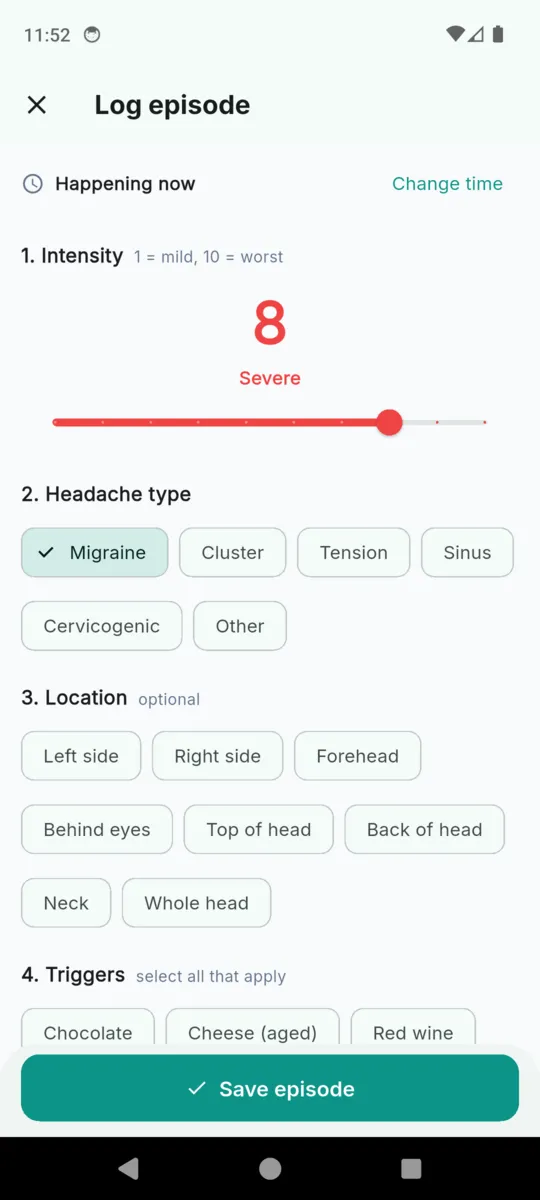
On Android, a migraine and headache journal that turns your log into a PDF for the appointment covers a good part of this list. The log form starts at the current time, with a button to change the date for an attack you log later. It takes intensity on a 1 to 10 slider, the headache type, the location, triggers from 32 seeded ones (skipped meal, bright light, barometric drop and irregular sleep among them), toggles for aura and for nausea or vomiting, each medicine and dose with a “Did it help?” answer, and typed notes.
A daily entry records hours slept, sleep quality, stress, hydration in cups and screen hours, plus cycle phase if you turn cycle tracking on. The PDF covers the date range you choose: a summary with the number of episodes and average intensity, a table of date and time, type, intensity, triggers and medicines, then your notes.
Two things go in the notes: when the attack ended, and any light or sound sensitivity, since the form has no field for either. Insights counts episodes rather than painkiller days, but the PDF lists the medicines against each attack’s date, which gets you a long way towards the item five count.
This is general information, not medical advice. A GP or neurologist is the person to read your diary with you and decide what it means for treatment.
Pick a start date this week and keep the diary for eight weeks, clear days included. If your phone is what you will have with you when it starts, set up MigraineLog’s attack log and appointment PDF tonight and log the next headache as it begins.
Common questions
How long should I keep a headache diary before seeing a doctor?
NICE asks for at least eight weeks when a diary is used to help diagnose headaches. The International Headache Society's classification says frequent headache generally needs a day-by-day diary for at least one month. If your headaches seem tied to your period, NICE asks for a diary covering at least two menstrual cycles.
Should I count headache attacks or headache days?
Days. The thresholds doctors use are written in days per month: chronic migraine is headache on 15 or more days a month for more than three months, with at least 8 of those days migraine-like, and the medication overuse limits are counted in days too. If a headache runs past midnight, note it on both days and let your doctor decide how to count it.
How many days a month is too many for painkillers?
NICE tells doctors to consider medication overuse headache when headaches started or got worse while someone took triptans, opioids, ergots or combination painkillers on 10 or more days a month, or paracetamol, aspirin or an NSAID on 15 or more days a month, for three months or more. Those are the figures a doctor checks your diary against. Talk to your GP before changing how you take any medicine.
Do I need to write down mild headaches?
Yes. A mild day counts towards your headache days, and the chronic migraine definition counts tension-type-like headaches as well as migraine-like ones. Leaving the mild days out makes your month look better than it was.
Photos: Kindel Media / Pexels , Pixabay / Pexels